
What is the VinFast VF9 Charging Cost Calculator?
This tool estimates how much it costs to charge a VinFast VF9 electric SUV. The VF9 is offered with a large battery pack (roughly 92–123 kWh depending on trim and region), so charging from a low state of charge can use a meaningful amount of electricity. By entering your battery capacity, local electricity price, and the charge range you want, you get an instant cost estimate that also accounts for charging losses.
How to use it
Enter your VF9's usable battery capacity in kWh, your electricity tariff in dollars per kWh, your current battery percentage and your target percentage, and an estimated charging efficiency. Most home AC charging is around 85–92% efficient because some energy is lost as heat in the charger, cables, and battery. Click calculate to see the total cost plus the energy added to the battery and the energy actually pulled from the grid.
The formula explained
First we find the energy added to the battery: \(\text{Battery} \times \dfrac{\text{Target} - \text{Start}}{100}\). Because charging is not perfectly efficient, the energy drawn from the grid is higher: we divide by the efficiency fraction. Multiplying grid energy by your price per kWh gives the total cost.
$$\text{Cost} = \frac{\text{Battery (kWh)} \times \dfrac{\text{Target \%} - \text{Start \%}}{100}}{\dfrac{\text{Efficiency \%}}{100}} \times \text{Price (\$/kWh)}$$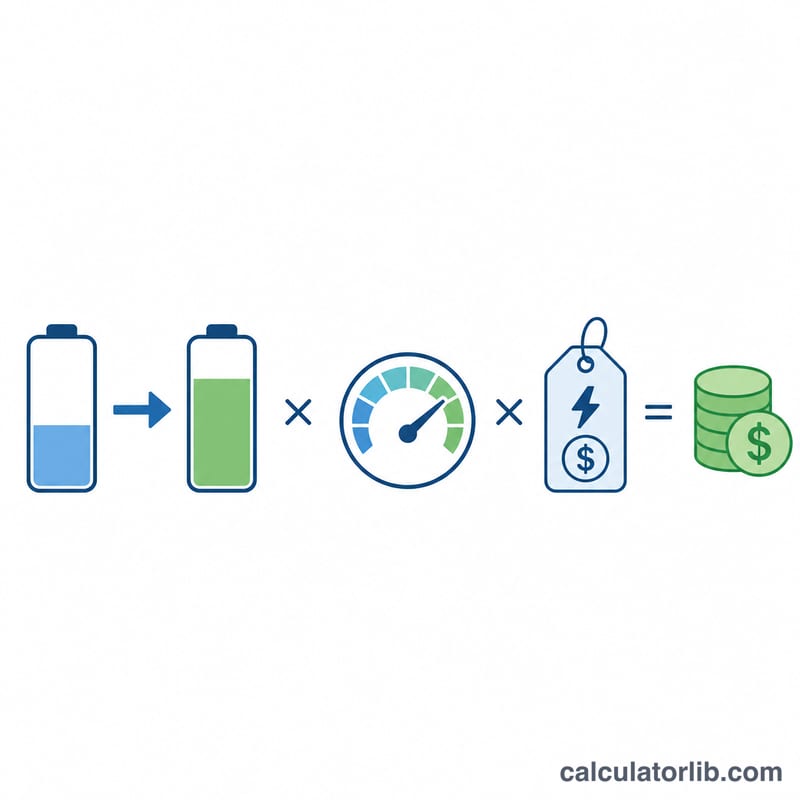
Worked example
Suppose your VF9 has a 123 kWh battery, electricity costs $0.17/kWh, and you charge from 20% to 80% at 90% efficiency. Energy to battery = \(123 \times 60 / 100 = 73.8\) kWh. Energy from grid = \(73.8 / 0.90 = 82\) kWh. Cost = \(82 \times 0.17 = \$13.94\).
FAQ
Why is grid energy higher than battery energy? Charging losses (heat in cables, the onboard charger, and the battery) mean you pay for more electricity than ends up stored.
What efficiency should I use? Home AC charging is typically 85–92%; DC fast charging is often a bit higher, around 90–95%.
Does this include public charger fees? No — public stations may charge per-session or per-minute fees. Use your effective $/kWh rate for the most accurate estimate.