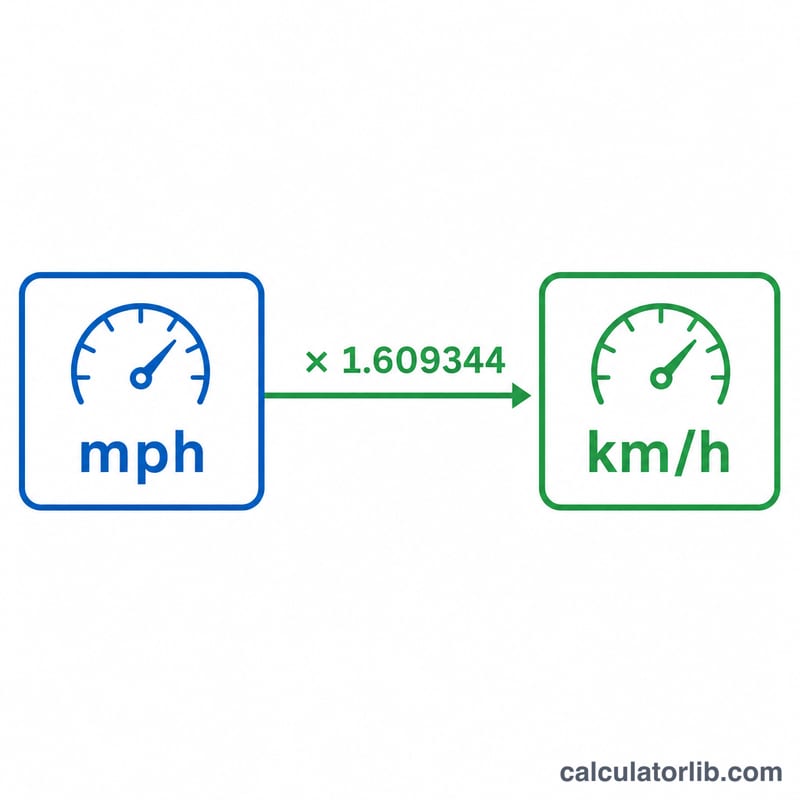
1 mile is exactly 1.609344 km, so km/h = mph × 1.609344: 60 mph = 96.56 km/h, 70 mph = 112.65 km/h and 120 mph = 193.12 km/h.
What is the MPH to KM/H Converter?
This tool converts a speed expressed in miles per hour (mph) into kilometers per hour (km/h). It is useful for travelers, drivers, runners, cyclists, and anyone comparing speed limits or vehicle speeds between countries that use imperial units (such as the United States and the United Kingdom) and those that use the metric system. The conversion is purely mathematical, so it applies universally.
How to use it
Enter the speed in miles per hour and the calculator instantly returns the equivalent in kilometers per hour. For example, type a highway speed limit in mph to see what it would read on a metric speedometer.
The formula explained
One mile equals exactly 1.609344 kilometers, so one mile per hour equals 1.609344 kilometers per hour. To convert, simply multiply:
$$\text{km/h} = \text{mph} \times 1.609344$$To go the other way, divide kilometers per hour by 1.609344 to get miles per hour.
Worked example
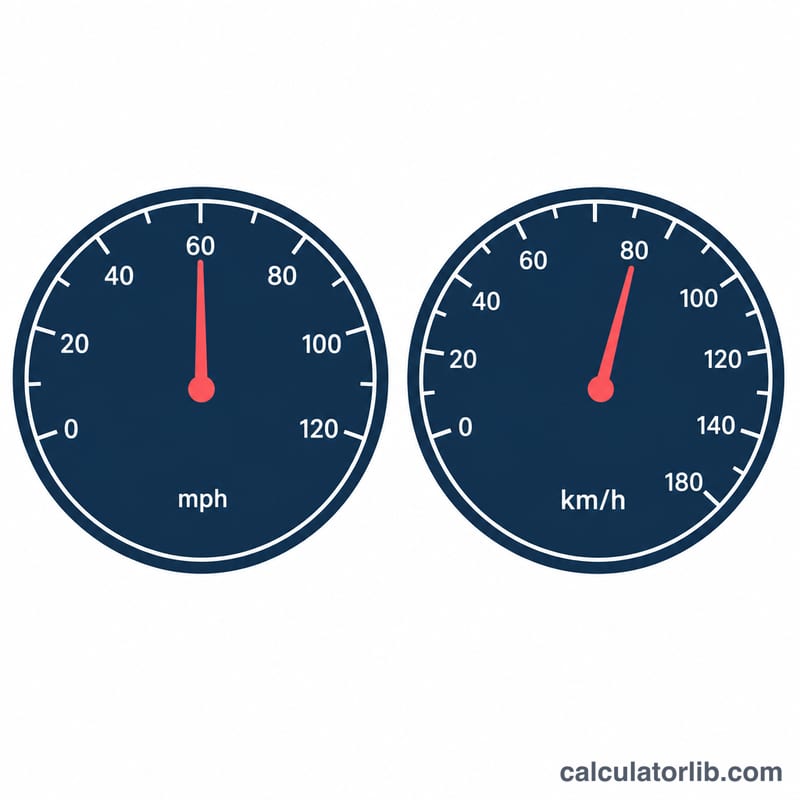
Suppose a car is traveling at 60 mph. Multiply: $$60 \times 1.609344 = 96.56064 \text{ km/h}$$ So 60 mph is about 96.56 km/h — just under 100 km/h, a common metric motorway limit.
Common MPH to KM/H Conversions
The conversion uses the exact international definition of the mile: 1 mph = 1.609344 km/h. Multiply the speed in mph by 1.609344 to get km/h. Values below are rounded to two decimals.
| Speed (mph) | Speed (km/h) |
|---|---|
| 5 | 8.05 |
| 10 | 16.09 |
| 15 | 24.14 |
| 20 | 32.19 |
| 25 | 40.23 |
| 30 | 48.28 |
| 35 | 56.33 |
| 40 | 64.37 |
| 45 | 72.42 |
| 50 | 80.47 |
| 55 | 88.51 |
| 60 | 96.56 |
| 65 | 104.61 |
| 70 | 112.65 |
| 75 | 120.70 |
| 80 | 128.75 |
| 90 | 144.84 |
| 100 | 160.93 |
Example of the formula: \(30 \times 1.609344 = 48.28032 \approx 48.28\) km/h. As a quick mental shortcut, multiply by 1.6 (for example, 60 mph ≈ 96 km/h).
Speed Limits Compared: US/UK vs Metric Countries
The United States and the United Kingdom post road speed limits in mph, while most other countries use km/h. Actual limits differ by state, country and road type, so the table shows typical mph figures and the closest commonly used metric limit for comparison only.
| Scenario | Speed (mph) | Exact km/h | Nearest common metric limit |
|---|---|---|---|
| School or residential zone (UK 20 mph) | 20 | 32.19 | 30 km/h |
| Residential street (typical US 25 mph) | 25 | 40.23 | 40 km/h |
| Urban road (30 mph) | 30 | 48.28 | 50 km/h |
| Rural road (55 mph) | 55 | 88.51 | 90 km/h |
| Rural road (60 mph) | 60 | 96.56 | 100 km/h |
| US highway (65 mph) | 65 | 104.61 | 100 or 110 km/h |
| UK motorway national limit (70 mph) | 70 | 112.65 | 110 km/h |
| US interstate (75 mph, some states) | 75 | 120.70 | 120 km/h |
| US interstate (80 mph, a few states) | 80 | 128.75 | 130 km/h |
Note that a metric limit is usually slightly different from the mph equivalent: for example, 70 mph is about 113 km/h, which is a little faster than a 110 km/h limit but slower than 120 km/h.
Running and cycling examples
- A 6 mph running pace is \(6 \times 1.609344 = 9.656\) km/h, which is about 6:13 per kilometer (10:00 per mile).
- A 15 mph cycling speed is \(15 \times 1.609344 = 24.14\) km/h.
FAQ
Is 1.609344 an exact value? Yes. Since 1959 the international mile is defined as exactly 1,609.344 meters, making the factor exact rather than rounded.
What is 70 mph in km/h? \(70 \times 1.609344 = 112.65408\) km/h, roughly 113 km/h.
How do I convert km/h back to mph? Divide by 1.609344. For instance, \(100 \div 1.609344 \approx 62.14\) mph.