
What Is a Knot?
A knot is a unit of speed equal to one nautical mile per hour. It is used worldwide in maritime and aviation contexts because nautical miles relate directly to lines of latitude on a globe. One knot equals exactly 1.852 kilometers per hour and approximately 1.15078 miles per hour. This converter turns any speed in knots into both miles per hour (mph) and kilometers per hour (km/h) at once.
How to Use This Converter
Enter the speed in knots into the input box and the calculator instantly returns the equivalent in mph and km/h. It works for any value — boat speeds, wind speeds, aircraft cruise speeds, or weather forecasts that report sustained winds in knots.
The Formula Explained
The two conversions are simple multiplications by fixed factors. To get miles per hour, multiply knots by 1.15078. To get kilometers per hour, multiply knots by 1.852. These factors come from the definition of the nautical mile (1,852 meters) compared with the statute mile (1,609.344 meters) and the kilometer (1,000 meters).
$$\text{MPH} = \text{Speed (knots)} \times 1.15078$$$$\text{KM/H} = \text{Speed (knots)} \times 1.852$$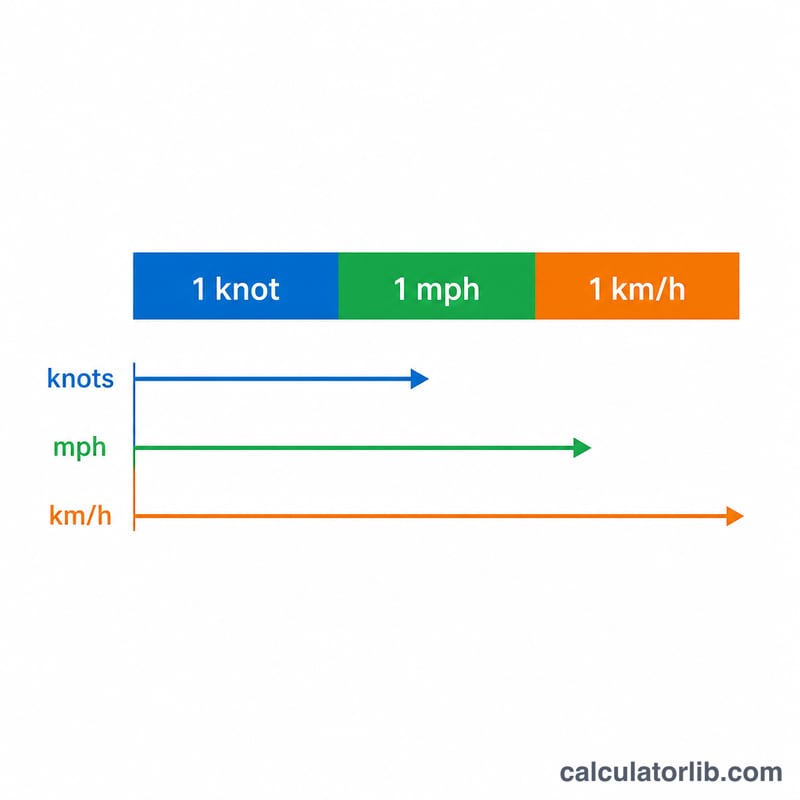
Worked Example
Suppose a yacht is traveling at 20 knots. Multiplying \(20 \times 1.15078\) gives 23.0156 mph. Multiplying \(20 \times 1.852\) gives 37.04 km/h. So 20 knots is about 23 mph or roughly 37 km/h.
$$20 \times 1.15078 = 23.0156 \text{ mph}$$$$20 \times 1.852 = 37.04 \text{ km/h}$$FAQ
Is a knot faster than mph? Yes — one knot is faster than one mph. A knot equals about 1.15 mph, so a speed in knots is always a larger number when expressed in knots than the same speed in mph.
Why do ships and planes use knots? Because one nautical mile equals one minute of latitude, making navigation calculations on charts straightforward.
How do I convert mph back to knots? Divide the mph value by 1.15078. For example, \(23 \div 1.15078 \approx 20\) knots.