
What is an Octal to Decimal Converter?
An octal to decimal converter changes a number written in base 8 (octal) into its equivalent in base 10 (decimal), the number system we use every day. Octal uses only the digits 0 through 7 and was historically popular in computing because three binary bits map neatly to one octal digit. This tool is universal — it works the same everywhere and requires no country-specific assumptions.
How to Use It
Type an octal number using only the digits 0–7 (for example 755) and the converter instantly shows the decimal value. If you accidentally include a digit of 8 or 9, the tool flags the entry as invalid because those digits do not exist in base 8.
The Formula Explained
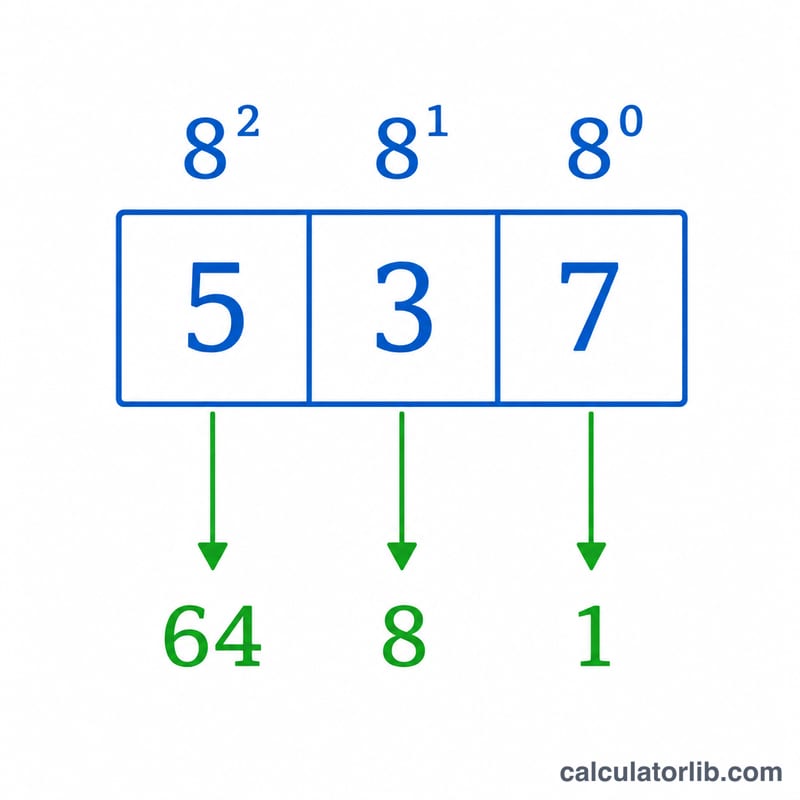
Every digit in a positional number system carries a weight based on the base. For octal the base is 8, so the rightmost digit has weight \(8^0 = 1\), the next has \(8^1 = 8\), then \(8^2 = 64\), and so on:
$$\text{Decimal} = \sum_{i=0}^{n-1} d_i \times 8^{\,i} \qquad \text{where } d_i \text{ are the digits of } \text{Octal Number}$$
where dᵢ is the digit at position i, counting from 0 at the right. Add up every digit times its place value and you get the decimal result.
Worked Example
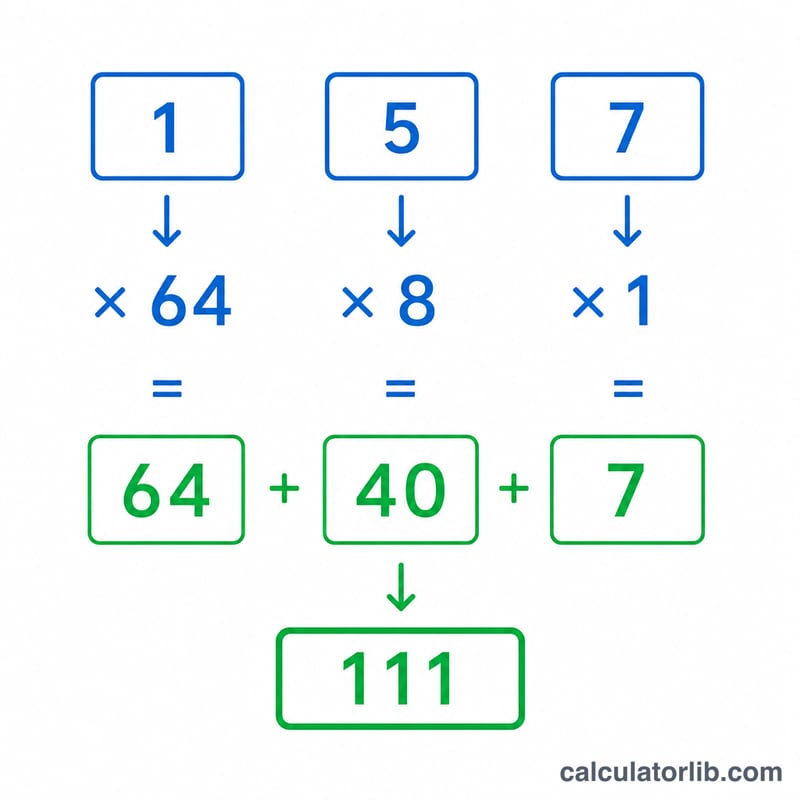
Convert octal 755:
$$7 \cdot 8^2 + 5 \cdot 8^1 + 5 \cdot 8^0 = 7 \cdot 64 + 5 \cdot 8 + 5 \cdot 1 = 448 + 40 + 5 = 493$$
So \(755_8 = 493_{10}\) — a value commonly seen as a Unix file permission (rwxr-xr-x).
FAQ
Which digits are valid in octal? Only 0, 1, 2, 3, 4, 5, 6 and 7. The digits 8 and 9 are not part of base 8.
Why is octal used in computing? Because each octal digit represents exactly three binary bits, making it a compact shorthand for binary, especially for file permissions and older systems.
What is the largest single octal digit? 7. After 7 the next octal number is 10 (which equals 8 in decimal).