

What Is a Blended Rate?
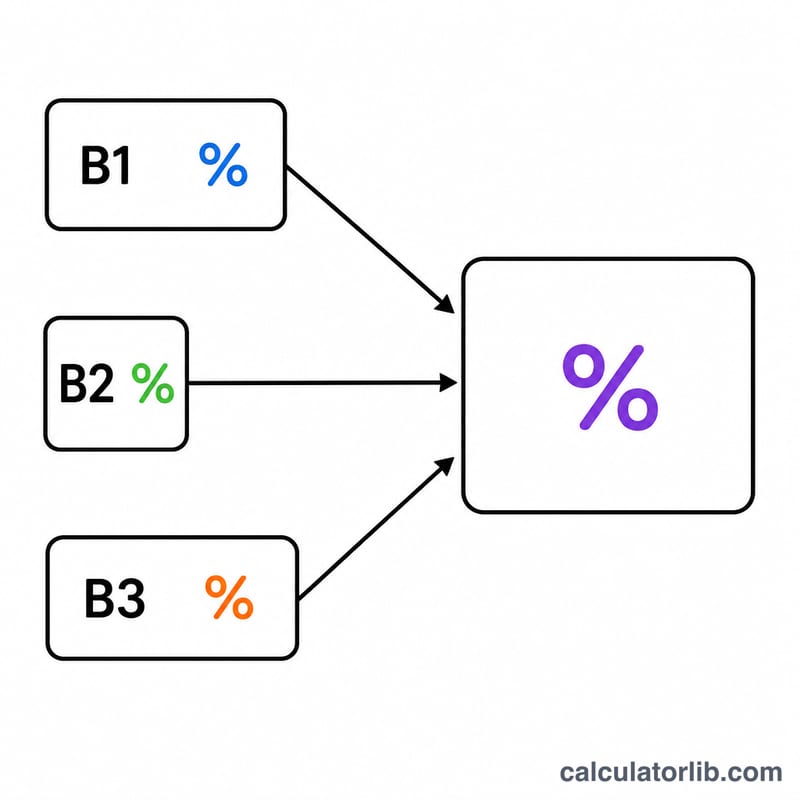
A blended rate is the single weighted-average interest rate that represents several different balances, each carrying its own rate. Lenders use it when consolidating loans, and borrowers use it to understand the true overall cost of debt spread across multiple accounts. Because larger balances influence the average more than smaller ones, a simple average of the rates would be misleading — the blended rate weights each rate by its dollar amount.
How to Use This Calculator
Enter the outstanding balance and annual interest rate for each loan or account. You can include up to three balances; leave the third row blank if you only have two. The calculator multiplies each balance by its rate, adds those products together, and divides by the total of all balances to produce the blended rate.
The Formula Explained
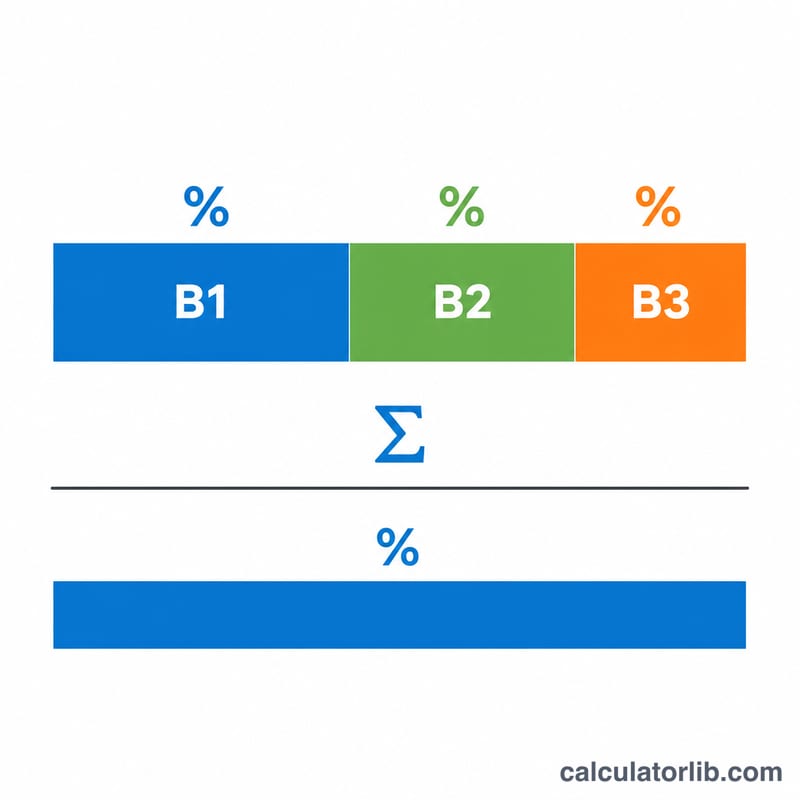
The blended rate equals the sum of each balance multiplied by its rate, divided by the sum of all balances:
$$\text{Blended Rate} = \frac{(\text{Bal}_1 \times \text{Rate}_1) + (\text{Bal}_2 \times \text{Rate}_2) + (\text{Bal}_3 \times \text{Rate}_3)}{\text{Bal}_1 + \text{Bal}_2 + \text{Bal}_3}$$Each balance acts as a weight, so an account with a high balance pulls the average toward its rate.
Worked Example
Suppose you have $10,000 at 5% and $20,000 at 8%. The weighted total is
$$(10{,}000 \times 5) + (20{,}000 \times 8) = 50{,}000 + 160{,}000 = 210{,}000$$The total balance is 30,000. Dividing gives
$$\frac{210{,}000}{30{,}000} = 7\%$$So your blended rate is 7%, closer to the 8% loan because it carries more of the balance.
Interpreting Your Blended Rate
The blended rate is the single effective interest rate that, when applied to your combined balances, produces the same total interest cost as the individual loans charged at their own separate rates. In other words, it is a weighted average that condenses several rates into one figure you can reason about as though you held a single loan.
A useful property of any weighted average is that it always falls between the lowest and highest input rates. If your loans carry rates of 4%, 6.5%, and 9%, the blended rate is guaranteed to land somewhere between 4% and 9% — it can never be lower than your cheapest rate or higher than your most expensive one. If your result lands outside that range, an input has been entered incorrectly.
The blended rate also leans toward the rate attached to the larger balance. Each rate is weighted by its share of the total balance, so a large balance at a low rate pulls the average down, while a small balance at a high rate has only a modest effect. For example, a $90{,}000 balance at 4% combined with a $10{,}000 balance at 9% blends to 4.5% — close to the 4% rate because that balance dominates the total.
Finally, this calculation reflects nominal interest rates only. It does not account for origination fees, points, or other charges captured by an APR, nor does it adjust for differences in compounding frequency (daily, monthly, or annual) among the loans. Treat the blended figure as a clean comparison of stated rates, not as a substitute for comparing full APRs or total cost of borrowing when those details differ between accounts.
FAQ
Is a blended rate the same as APR? No. APR includes fees; the blended rate here is purely a weighted average of the nominal rates you enter.
Can I use this for credit cards or savings accounts? Yes — it works for any set of balances with associated rates.
Why not just average the rates? A simple average ignores how much money sits at each rate, which can distort the result significantly when balances differ.