

What Is a Finance Charge?
A finance charge is the total cost of borrowing money, expressed as a dollar amount. It is the difference between everything you pay back over the life of a loan and the amount you originally borrowed. The finance charge bundles together interest and, in many lending disclosures, certain fees — giving you a single number that shows the true cost of credit.
How to Use This Calculator
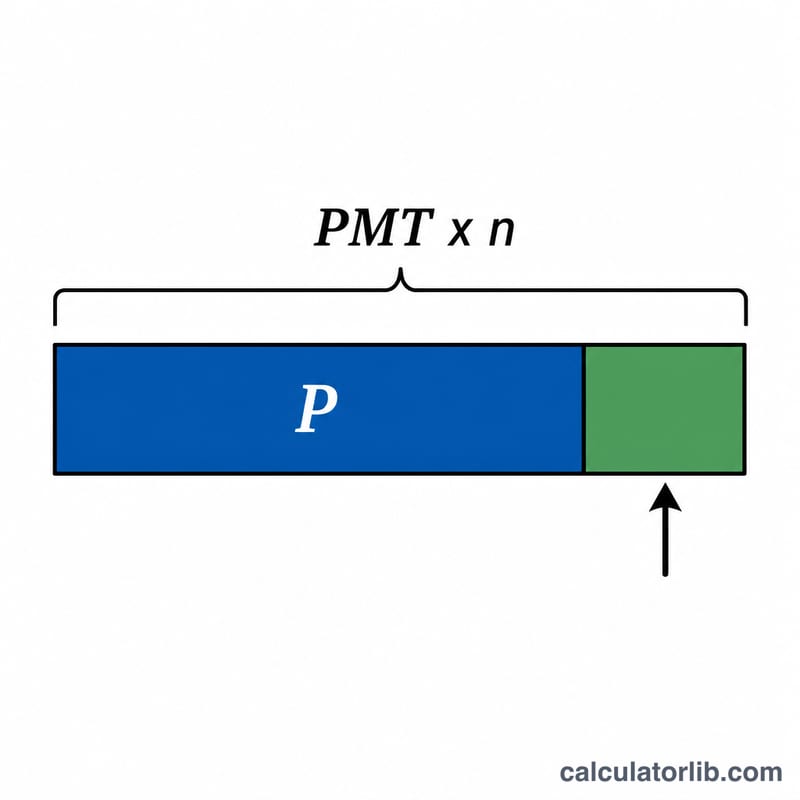
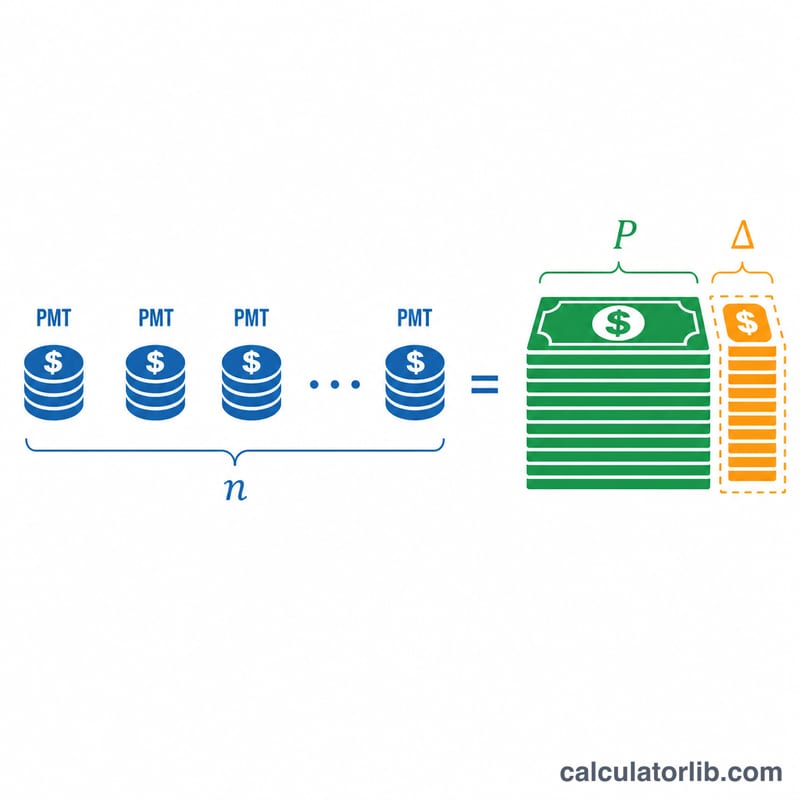
Enter three values: your monthly payment (PMT), the number of payments over the loan term (n), and the amount borrowed (the principal, P). The calculator multiplies the payment by the number of payments to get the total of payments, then subtracts the principal to reveal the finance charge.
The Formula Explained
The relationship is straightforward:
$$\text{Finance Charge} = \left( \text{PMT} \times n \right) - P$$
The term \(\text{PMT} \times n\) is the total of payments — the grand total of cash leaving your pocket. Subtracting the principal \(P\) isolates the extra amount you paid purely for the privilege of borrowing.
Worked Example
Suppose you take a $10,000 loan repaid with $300 monthly payments over 36 months. The total of payments is \(\$300 \times 36 = \$10{,}800\). Subtracting the $10,000 principal gives a finance charge of $800. That $800 is what the loan truly costs you beyond what you borrowed.
FAQ
Does the finance charge include fees? This calculator computes the charge purely from payments and principal. If your lender rolled origination or other fees into the financed amount, they are already captured because they raise the total of payments relative to the cash you received.
Is the finance charge the same as the interest rate? No. The finance charge is a dollar amount; the interest rate (APR) is a percentage. A long term at a low rate can still produce a large finance charge.
How can I lower my finance charge? Borrow less, choose a shorter term, secure a lower interest rate, or make extra principal payments to reduce the total paid over time.