

What Is the Future Cost Calculator?
The Future Cost Calculator shows how much something that costs a certain amount today will likely cost in the future, once inflation has eroded the purchasing power of money. It is useful for budgeting long-term purchases, planning a gift fund, estimating future tuition or healthcare costs, and understanding why prices steadily climb over time.
How to Use It
Enter three values: the current price of the item, the annual inflation rate you expect (a long-run average of about 2–3% is common), and the number of years into the future. The calculator compounds the inflation rate over each year and returns the projected future price, the total dollar increase, and the percentage increase.
The Formula Explained
The tool uses the compound growth equation:
$$\text{Future Price} = \text{Current Price} \times \left(1 + \frac{\text{Inflation Rate (\%)}}{100}\right)^{\text{Years}}$$
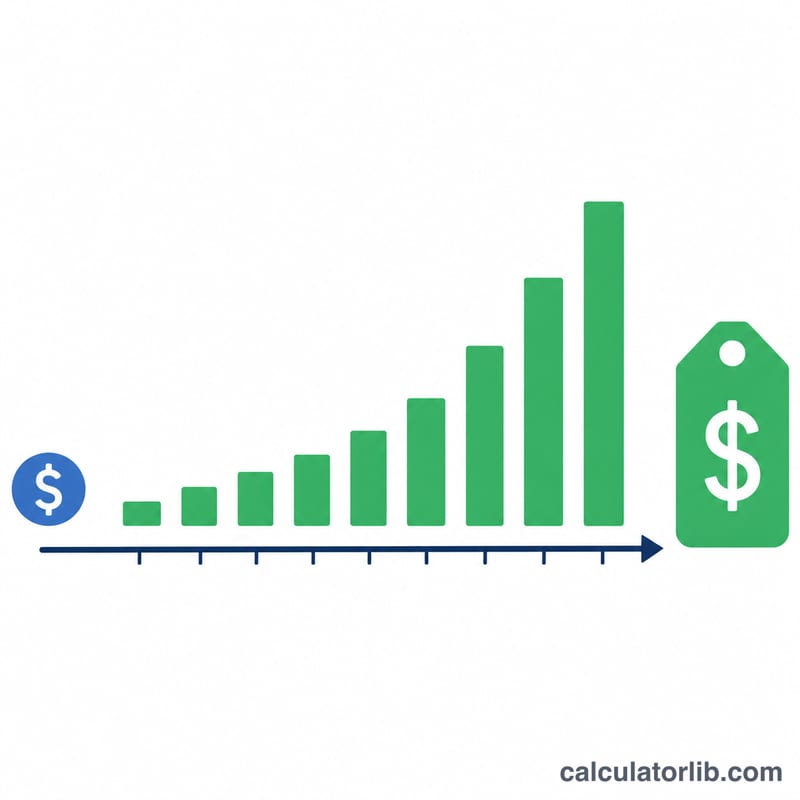
The inflation rate is divided by 100 to convert a percentage into a decimal. Raising (1 + rate) to the power of the number of years compounds the effect, meaning each year's increase builds on the previous year's already-higher price.
Worked Example
Suppose an item costs $100 today, inflation runs at 3% per year, and you look 10 years ahead. The factor is \((1 + 0.03)^{10} \approx 1.34392\). So the future price is $$\$100 \times 1.34392 \approx \$134.39,$$ a total increase of about $34.39, or roughly 34.4%.
FAQ
What inflation rate should I use? Many planners use a long-term average of 2–3%. Use a higher rate for categories like healthcare or education that historically inflate faster.
Does this account for changing inflation each year? No — it assumes a constant average annual rate. For a rough projection, an average rate works well.
Is this the same as a future value calculator? The math is identical to compound growth; here it is framed around rising prices rather than investment returns.