
What Is an Inflation-Adjusted Salary?
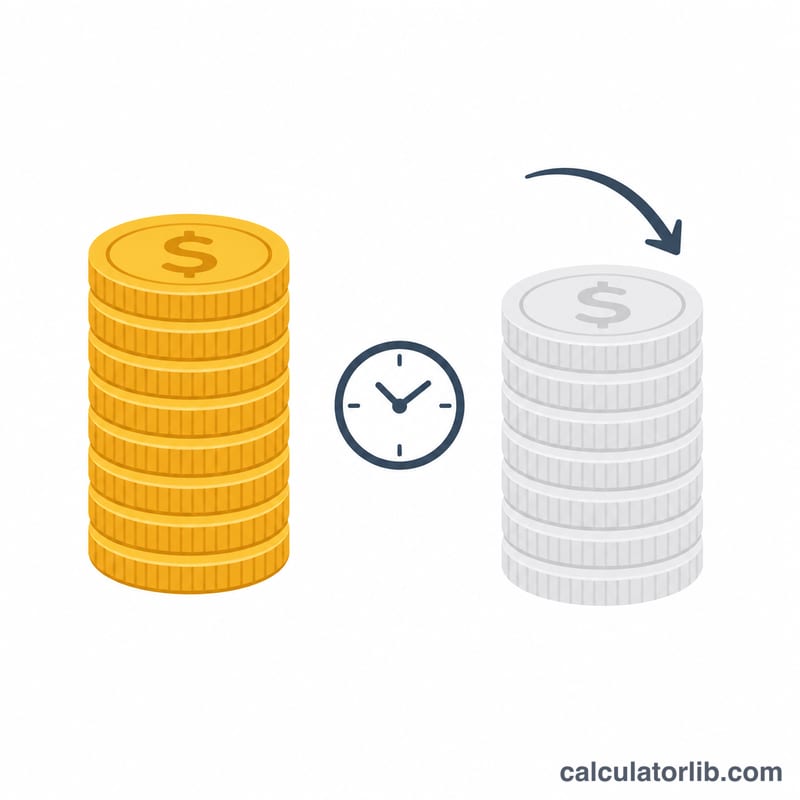
Inflation erodes the buying power of money over time. A salary that looks the same on paper buys less each year as prices rise. The inflation-adjusted (or "real") salary tells you what your nominal pay is actually worth in today's purchasing power after a number of years of inflation. This calculator is currency-agnostic and works for any country — just use your own local inflation rate.
How to Use the Calculator
Enter your current (nominal) salary, the expected average annual inflation rate as a percentage, and the number of years over which you want to measure the effect. The tool returns the real salary, the amount of purchasing power lost in currency terms, and that loss as a percentage of your original pay.
The Formula Explained
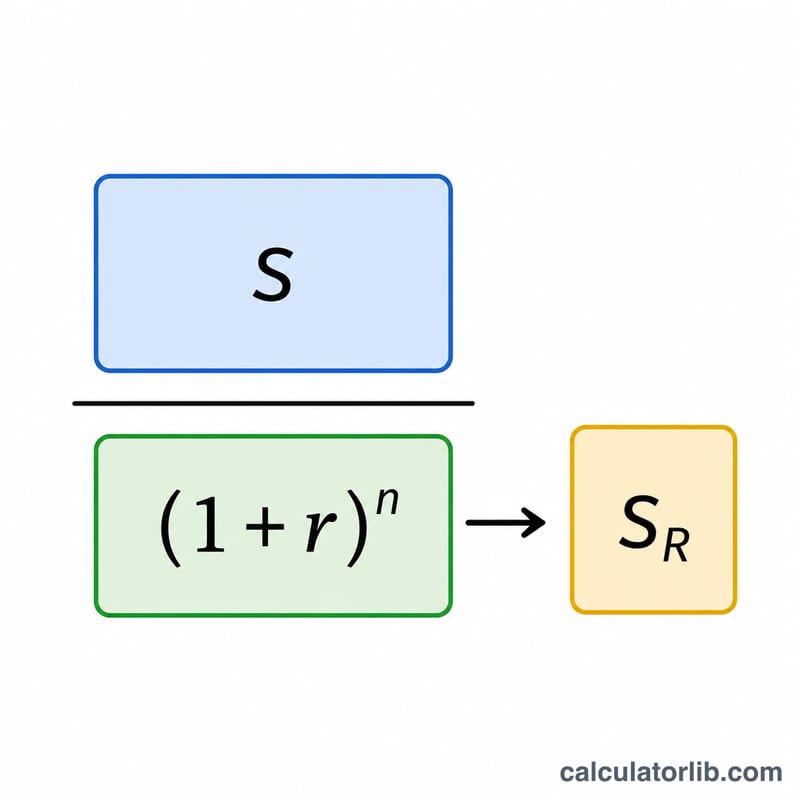
The core equation is $$\text{Real} = \dfrac{\text{Nominal}}{(1 + r)^{n}}$$ where \(r\) is the annual inflation rate written as a decimal (3% = 0.03) and \(n\) is the number of years. The denominator \((1 + r)^{n}\) is the compounding factor that captures how inflation builds on itself year after year.
Worked Example
Suppose you earn 60,000 today and inflation averages 3% per year for 5 years. The factor is \((1.03)^{5} \approx 1.159274\). Dividing 60,000 by 1.159274 gives a real salary of about 51,756:
$$\text{Real} = \dfrac{60{,}000}{(1.03)^{5}} = \dfrac{60{,}000}{1.159274} \approx 51{,}756$$That means roughly 8,244 of purchasing power — about 13.7% — has been eroded unless your pay keeps pace.
FAQ
Is this the same as a raise needed to beat inflation? Not exactly. This shows what your current salary is worth in the future. To keep pace, you would instead multiply your salary by \((1 + r)^{n}\).
What inflation rate should I use? Use your country's average CPI inflation, or a forecast. Many developed economies target around 2–3%.
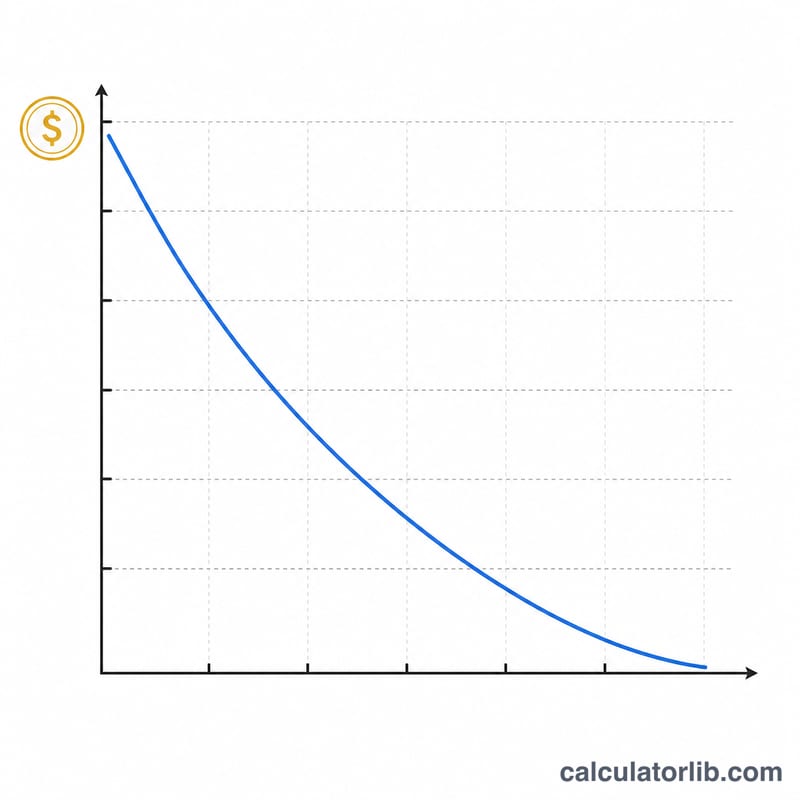
Why does the loss compound? Each year's inflation applies to an already-reduced base, so losses accelerate over longer periods.