
What Is Combined Household Income?
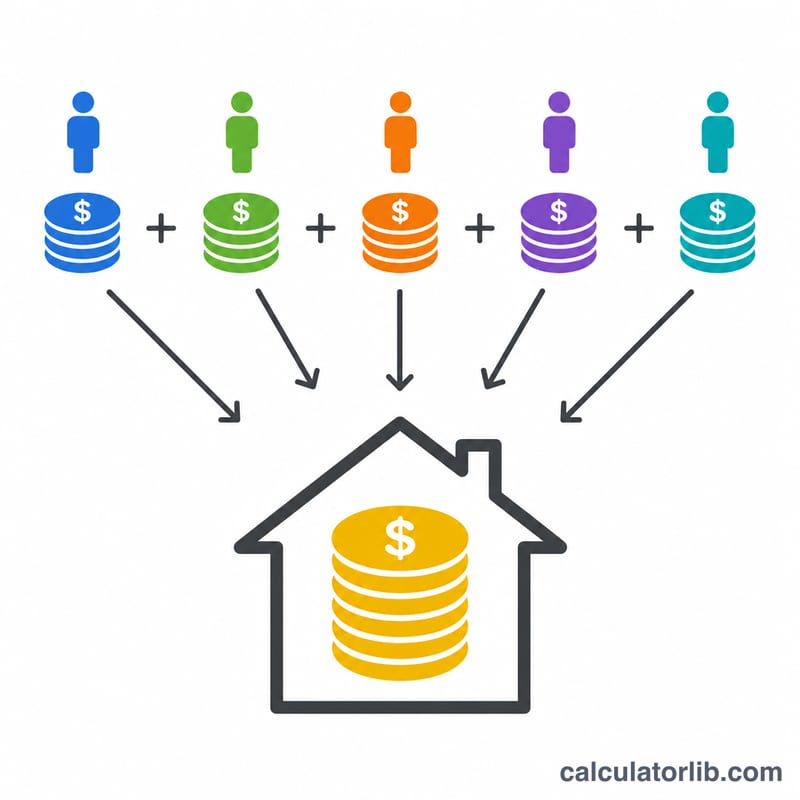
Combined household income is the total of all incomes earned by everyone living in your home who contributes to the budget. Lenders, landlords, and benefit programs often ask for this figure because it reflects the household's full earning power rather than a single person's pay. This calculator adds up to four earners and instantly shows the annual total plus an estimated monthly figure.
How to Use It
Enter each earner's income in the boxes provided. Use gross (before-tax) or net (take-home) figures consistently — just make sure every earner uses the same basis. Earners 3 and 4 are optional; leave them blank or at zero if they don't apply. The tool sums every box and divides by 12 to give your monthly household income.
The Formula Explained
The math is simple addition: $$\text{Household Income} = I_1 + I_2 + I_3 + I_4$$. To get the monthly equivalent, the annual total is divided by 12. For example, if Earner 1 makes $50,000 and Earner 2 makes $40,000, the combined household income is $90,000 per year, or $7,500 per month.

Interpreting Your Combined Household Income
Combined household income is the sum of the incomes of the earners you enter. This calculator adds up to four earners to give an annual total, then divides that total by 12 to give a monthly figure. The result is only as meaningful as the inputs: whether you enter gross or net amounts decides which uses it suits.
Where the figure is used
- Mortgage lenders: Lenders often add the qualifying incomes of co-borrowers and compare the total with monthly debt payments, commonly as a debt-to-income (DTI) ratio. Rules differ by country and lender, and most lenders work from gross (pre-tax) income and need documentation such as payslips or tax returns.
- Landlords: Many landlords and letting agents use a rent-to-income test. A common rule of thumb is that gross monthly household income should be about 3 times the monthly rent. For example, rent of $1,500 would call for roughly $4,500 per month. Thresholds vary by landlord, region, and market, and some count only listed tenants or guarantors.
- Benefit and eligibility programs: Programs such as subsidized housing, childcare support, school meal schemes, and health coverage subsidies often set limits based on household income and household size. Each program defines which income counts, which household members are included, and whether the test is gross or net, so check the official rules of the specific program and country.
Gross versus net totals
A gross total is income before taxes and deductions; a net total is take-home pay after them. Lenders, landlords, and many benefit programs usually ask for gross figures, although some programs use adjusted or net figures. For personal budgeting, a net total is generally more realistic because it reflects the money actually available to spend. Use the same basis for every earner so the sum is consistent.
Annual and monthly figures
The monthly figure is simply the annual total divided by 12:
$$\text{Monthly Income} = \frac{ \text{Household Income} }{12}$$
It is an average. Someone paid weekly receives 52 paychecks a year and someone paid biweekly receives 26, so in some months they receive extra paychecks, and the monthly average will not match any single month's deposits. Irregular income such as commission, bonuses, or self-employment can also vary a lot from month to month.
Whose income is typically counted
This depends on who is asking. Mortgage applications generally count the people applying on the loan. Landlords usually count adult tenants named on the lease. Benefit programs often count everyone in a defined household or tax unit, which may include a spouse or partner and sometimes other adults living together, while the income of dependent children may be treated differently. When in doubt, follow the definition given by the lender, landlord, or program.
This is general information, not financial or legal advice.
Key Terms: Gross, Net, and Household Income
- Gross income
- Total income earned before any taxes, social contributions, retirement contributions, or other deductions are taken out.
- Net (take-home) income
- The amount actually received after taxes and deductions such as social insurance, pension contributions, and health premiums.
- Household income
- The combined income of all people counted as living together in one residence, which may include relatives, partners, and unrelated housemates depending on the definition used.
- Family income
- The combined income of people in the household who are related by birth, marriage, or adoption. It can be lower than household income when unrelated people share a home.
- Earner
- A person who brings in income. Each earner's income is entered separately in this calculator, and an earner can have several income sources.
- Annualized income
- Income expressed as a yearly amount. Pay received weekly, biweekly, or monthly is converted to a yearly equivalent, for example monthly pay × 12.
- Monthly income
- The annual total divided by 12. It is an average and may differ from the actual amount received in any given month.
Common income sources
- Wages and salary: regular pay from an employer, sometimes including overtime, bonuses, and tips.
- Self-employment income: business or freelance earnings, usually counted after business expenses when used for taxes or lending.
- Benefits: pensions, unemployment or disability payments, child support, and other government or private payments. Whether they count depends on the program.
- Investment income: interest, dividends, and capital gains.
- Rental income: money received from renting out property, often counted net of certain costs.
Which sources are included varies by lender, landlord, and program, so confirm the definition before using your total in an application.
Combined Income Scenarios: Household Totals Compared
The table below shows how the calculator adds up different household setups. All figures are clearly illustrative round numbers chosen for demonstration. They are examples, not benchmarks or averages for any country. The calculation works in any currency, as long as every earner is entered in the same currency and for the same period (annual).
| Scenario | Earner 1 | Earner 2 | Earner 3 | Earner 4 | Combined annual total | Monthly total (annual ÷ 12) |
|---|---|---|---|---|---|---|
| A. Two earners | $50,000 | $40,000 | – | – | $90,000 | $7,500 |
| B. Three earners, one part-time | $60,000 | $45,000 | $15,000 (part-time) | – | $120,000 | $10,000 |
| C. Four sources, wages plus other income | $55,000 (wages) | $42,000 (wages) | $12,000 (pension or rental) | $6,000 (side income) | $115,000 | $9,583.33 |
| D1. Same household, entered gross | $70,000 | $50,000 | – | – | $120,000 | $10,000 |
| D2. Same household, assumed net (80% of gross) | $56,000 | $40,000 | – | – | $96,000 | $8,000 |
How the totals are built
Scenario A: \(50{,}000 + 40{,}000 = 90{,}000\) per year, and \(90{,}000 \div 12 = 7{,}500\) per month.
Scenario B: \(60{,}000 + 45{,}000 + 15{,}000 = 120{,}000\) per year, and \(120{,}000 \div 12 = 10{,}000\) per month.
Scenario C: \(55{,}000 + 42{,}000 + 12{,}000 + 6{,}000 = 115{,}000\) per year, and \(115{,}000 \div 12 \approx 9{,}583.33\) per month.
Scenario D: gross \(70{,}000 + 50{,}000 = 120{,}000\). With an assumed flat 80% kept after deductions, \(56{,}000 + 40{,}000 = 96{,}000\), or \(8{,}000\) per month. The 80% rate is a made-up illustration; actual take-home depends on your country's tax and deduction rules.
Takeaways
- Use the same basis for every earner. Mixing gross and net figures gives a misleading total.
- Gross and net totals can differ substantially, so check which one a lender, benefit program, or budget asks for.
- Irregular income, such as side work, is easiest to handle by entering its expected annual total.
FAQ
Should I use gross or net income? It depends on who's asking. Mortgage lenders usually want gross (pre-tax) income, while personal budgeting works better with net (take-home) pay. Pick one and apply it to every earner.
Can I include more than four earners? This version supports four. If you have more, simply add the extra incomes together first and enter the combined figure in one box.
Does it handle different currencies? The calculator is currency-agnostic — it just adds numbers. Make sure all incomes are entered in the same currency for an accurate total.