
What This Calculator Does
Applies to the United States. This tool estimates your annual and monthly net take-home pay after subtracting your traditional (pre-tax) 401(k) contribution, federal and state income tax, and FICA payroll taxes (Social Security + Medicare, normally 7.65%). It is a planning estimate and does not account for every deduction, credit, bracket detail, or the Social Security wage base cap — treat results as approximate.
How to Use It
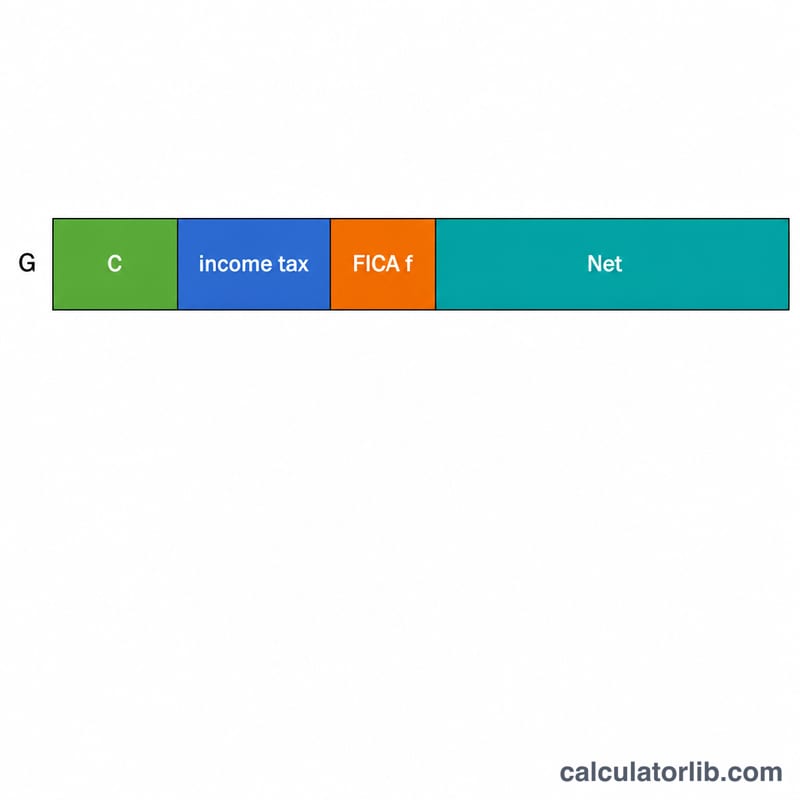
Enter your annual gross salary, the percentage of salary you contribute to a traditional 401(k), your combined effective income tax rate (federal + state), and your FICA rate. The default FICA rate of 7.65% covers 6.2% Social Security and 1.45% Medicare. Click calculate to see net pay broken down by each deduction.
The Formula Explained
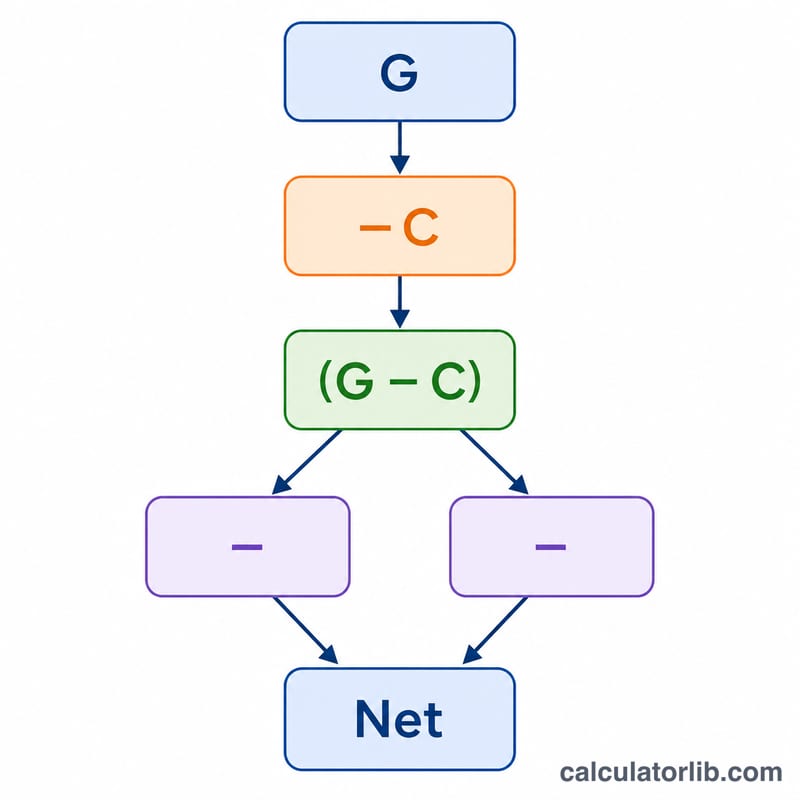
Because traditional 401(k) contributions are taken out before income tax, the taxable amount is your gross minus your contribution: Net = G − C − (G − C) × t − G × f.
$$\text{Net} = G - C - (G - C)\times t - G\times f$$FICA, however, is charged on your full gross salary, so it is not reduced by your 401(k) deferral.
Worked Example
Suppose you earn $60,000 and contribute 6% to a 401(k) with a 22% income tax rate and 7.65% FICA. Contribution = $3,600. Taxable = $56,400. Income tax = $12,408. FICA = $4,590.
$$\text{Net} = 60{,}000 - 3{,}600 - 12{,}408 - 4{,}590 = \$39{,}402$$Net = 60,000 − 3,600 − 12,408 − 4,590 = $39,402 per year, or about $3,283.50 per month.
FAQ
Does a 401(k) reduce my FICA taxes? No. Traditional 401(k) contributions lower income tax but Social Security and Medicare taxes are still calculated on your full gross wages.
What tax rate should I enter? Use your blended effective rate (total tax divided by income), not your top marginal bracket, for a more accurate take-home estimate.
Are Roth 401(k) contributions handled? No. Roth contributions are made after tax, so this pre-tax model does not apply to them.