
What this calculator does
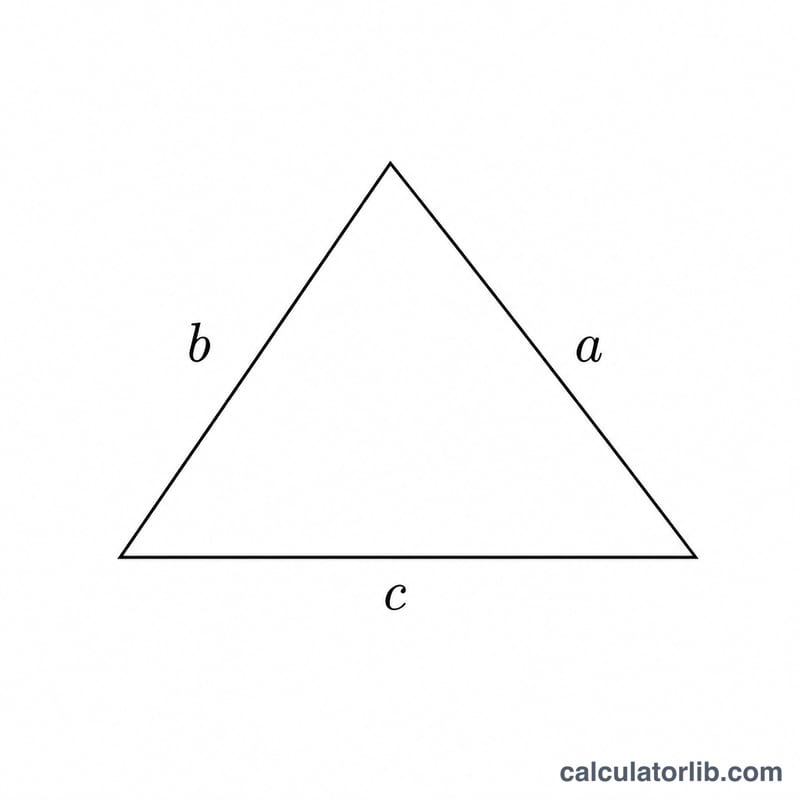
This tool computes the perimeter of a triangle when each side is given as a fraction. The perimeter of any triangle is simply the sum of its three side lengths, so this calculator adds three fractional values together and shows both the total and each decimal side length.
How to use it
Enter each side as a numerator and a denominator. For example, a side of \(\frac{1}{2}\) has numerator 1 and denominator 2. Fill in all three sides (A, B, C) and the calculator returns the perimeter as a decimal. Whole-number sides can be entered with a denominator of 1.
The formula explained
The core formula is $$P = a + b + c$$ where a, b and c are the side lengths. When sides are fractions, you add them by finding a common denominator. The calculator does this internally by converting each fraction to its decimal value and summing them, which gives the exact same result.
Worked example
Suppose a triangle has sides \(\frac{1}{2}\), \(\frac{3}{4}\) and \(\frac{5}{6}\). Convert each: \(\frac{1}{2} = 0.5\), \(\frac{3}{4} = 0.75\), \(\frac{5}{6} \approx 0.8333\). Adding gives $$0.5 + 0.75 + 0.8333 = 2.0833$$ As an exact fraction, the common denominator is 12: $$\frac{6}{12} + \frac{9}{12} + \frac{10}{12} = \frac{25}{12} \approx 2.083333$$
FAQ
Can I enter whole numbers? Yes — use a denominator of 1, e.g. \(3 = \frac{3}{1}\).
Do the sides need to form a valid triangle? The perimeter sum works for any three positive numbers, but a real triangle requires each side to be less than the sum of the other two (triangle inequality).
What units does it use? The result is unit-agnostic — the perimeter is in whatever unit your side lengths are measured in.