
What this calculator does
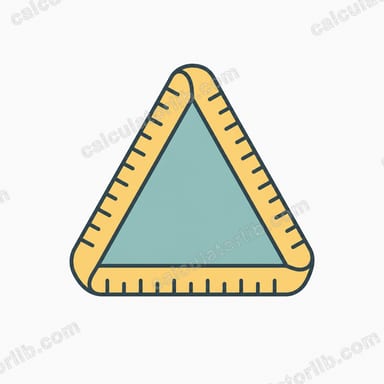
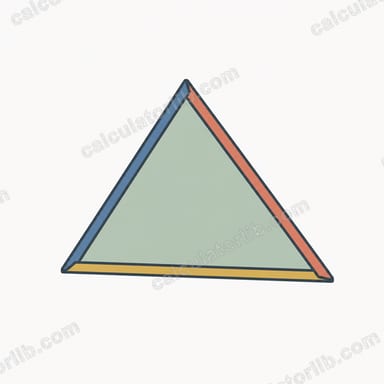
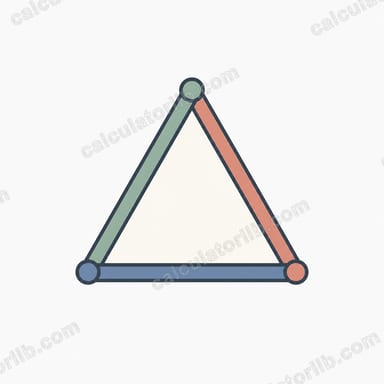
This tool computes the perimeter of a triangle from its three side lengths, then derives the semiperimeter (half the perimeter). As a bonus it checks whether the sides actually form a valid triangle and uses Heron's formula to report the area. It works with any consistent unit — centimeters, inches, meters — and the answer comes out in that same unit.
How to use it
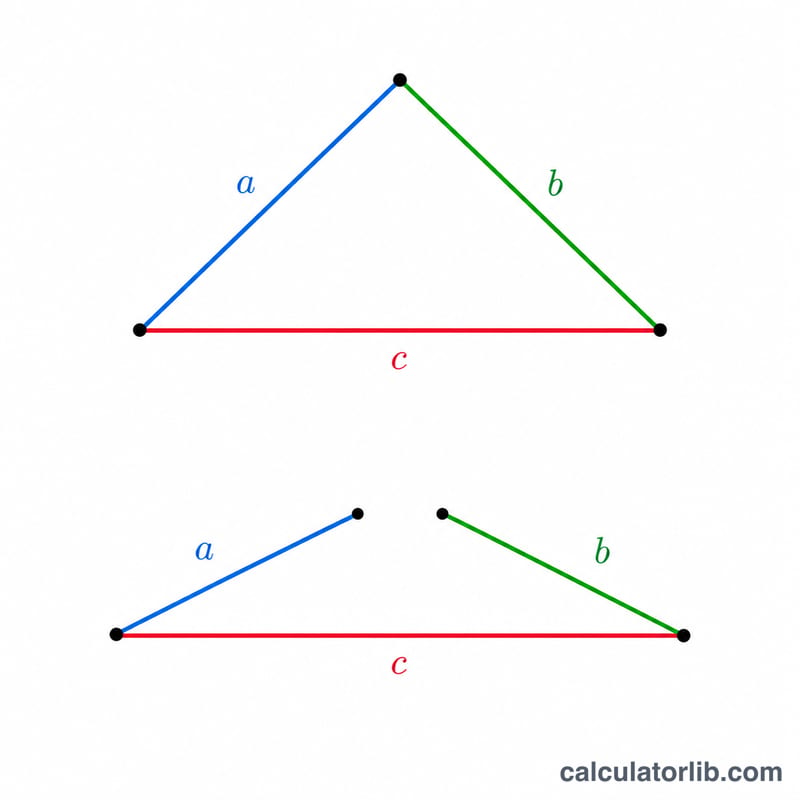
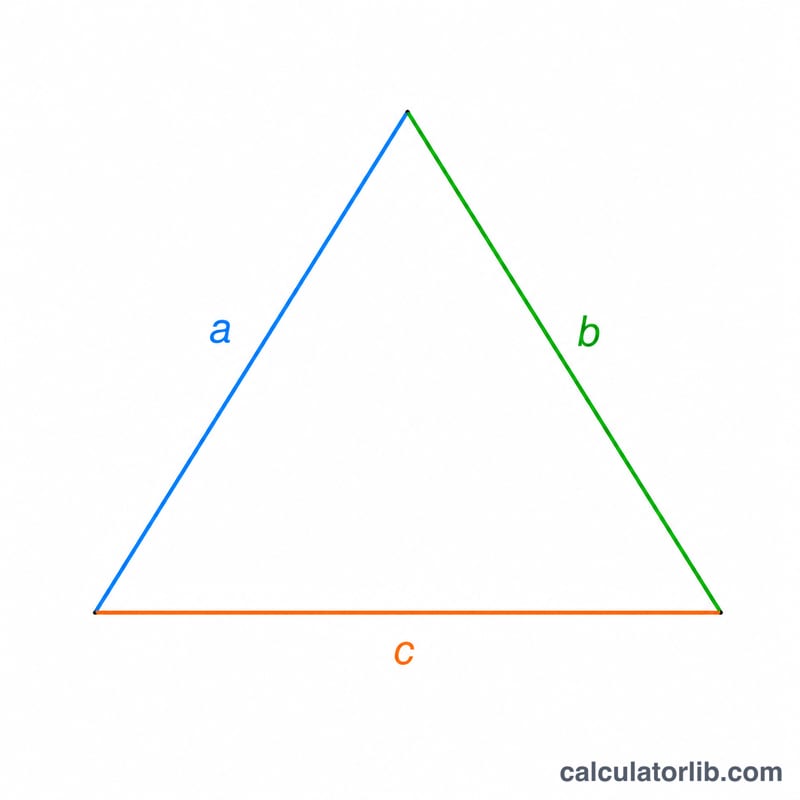
Enter the lengths of the three sides (a, b and c) and press calculate. The calculator adds them for the perimeter, halves the result for the semiperimeter, and verifies the triangle inequality: the sum of any two sides must be greater than the third. If that condition fails, no real triangle exists and the area is reported as zero.
The formula explained
The perimeter is simply \(P = a + b + c\). The semiperimeter $$s = \frac{P}{2}$$ is a key quantity in geometry because it lets you find the area without knowing any angle. Heron's formula states that the area equals $$A = \sqrt{s\left(s-a\right)\left(s-b\right)\left(s-c\right)}$$ The semiperimeter therefore links the perimeter directly to the area.
Worked example
For a 3-4-5 right triangle: $$P = 3 + 4 + 5 = 12$$ The semiperimeter is $$s = \frac{12}{2} = 6$$ Heron's area is $$\sqrt{6 \times (6-3) \times (6-4) \times (6-5)} = \sqrt{6 \times 3 \times 2 \times 1} = \sqrt{36} = 6$$ square units, which matches the familiar \(\frac{1}{2} \times \text{base} \times \text{height} = \frac{1}{2} \times 3 \times 4 = 6\).
FAQ
What units does it use? Any unit you like, as long as all three sides use the same one. The perimeter shares that unit; the area is in square units.
Why does it say my triangle is invalid? The triangle inequality requires each side to be shorter than the sum of the other two. If one side is too long, the three segments cannot close into a triangle.
Why is the semiperimeter useful? It is the value plugged into Heron's formula, and it also appears in the inradius (Area/s) and circumradius formulas.