
What Is the Polar to Rectangular Coordinates Calculator?
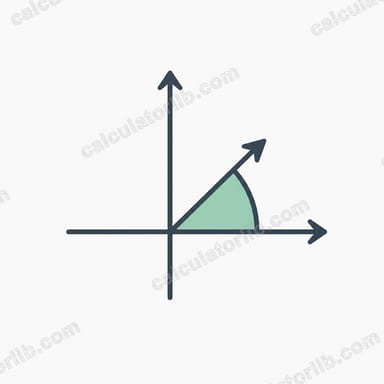
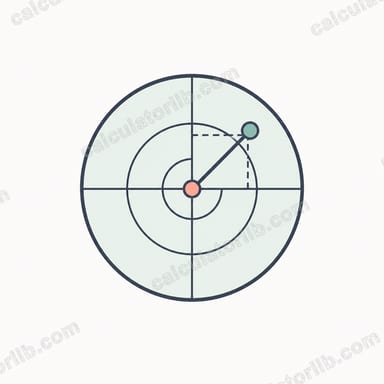
This tool converts a point given in polar form (r, θ) into Cartesian (rectangular) form (x, y). Polar coordinates describe a point by its distance r from the origin and the angle θ measured from the positive x-axis. Rectangular coordinates describe the same point by its horizontal (x) and vertical (y) distances. The conversion is universal mathematics — it works the same everywhere.
How to Use It
Enter the radius r and the angle θ, then choose whether your angle is in degrees or radians. The calculator returns the matching (x, y) pair. A negative radius simply reflects the point through the origin, and angles beyond 360° (or 2π) wrap around naturally.
The Formula Explained
Using right-triangle trigonometry on the radius drawn to the point:
\(x = r\cdot\cos\theta\) gives the horizontal projection, and \(y = r\cdot\sin\theta\) gives the vertical projection. When the angle is supplied in degrees it is first converted to radians with \(\theta_{\text{rad}} = \theta \times \pi / 180\), because the trig functions operate on radians.
$$x = r \cos\!\left(\theta\right), \quad y = r \sin\!\left(\theta\right)$$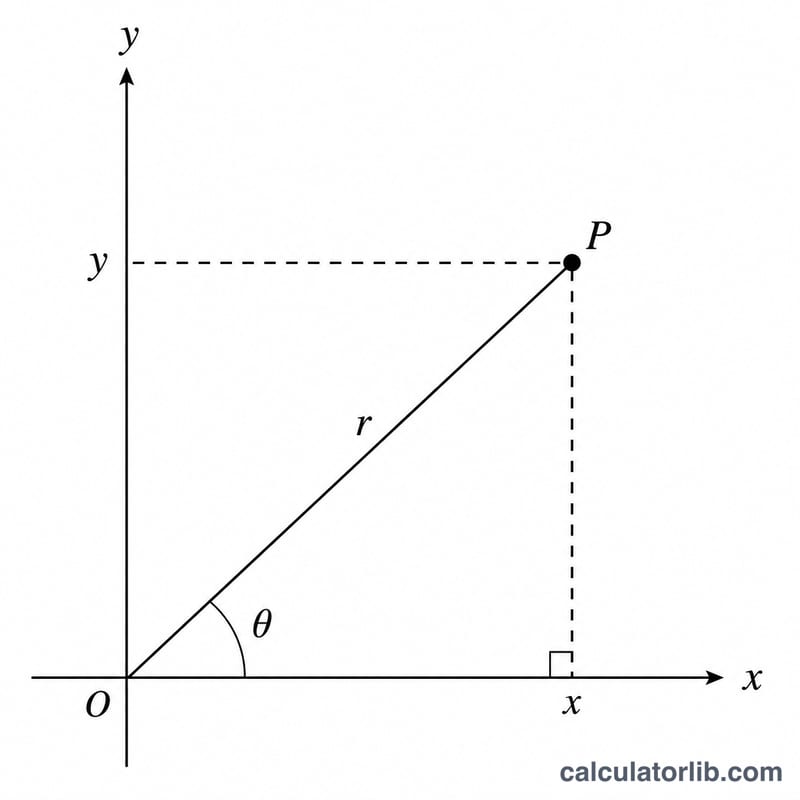
Worked Example
Convert (r = 5, θ = 30°). First θ in radians = \(30 \times \pi/180 \approx 0.5236\). Then $$x = 5 \times \cos(30°) = 5 \times 0.8660 = 4.3301,$$ and $$y = 5 \times \sin(30°) = 5 \times 0.5 = 2.5.$$ So the rectangular coordinates are approximately (4.3301, 2.5).
FAQ
Do I have to use degrees? No — toggle the unit selector to radians if your angle is already in radians (e.g. \(\pi/6\)).
What does a negative r mean? A negative radius points in the opposite direction, equivalent to adding 180° to the angle.
How do I go the other way? To convert back, use \(r = \sqrt{x^2 + y^2}\) and \(\theta = \operatorname{atan2}(y, x)\).