

What Is Trigonometric Form?
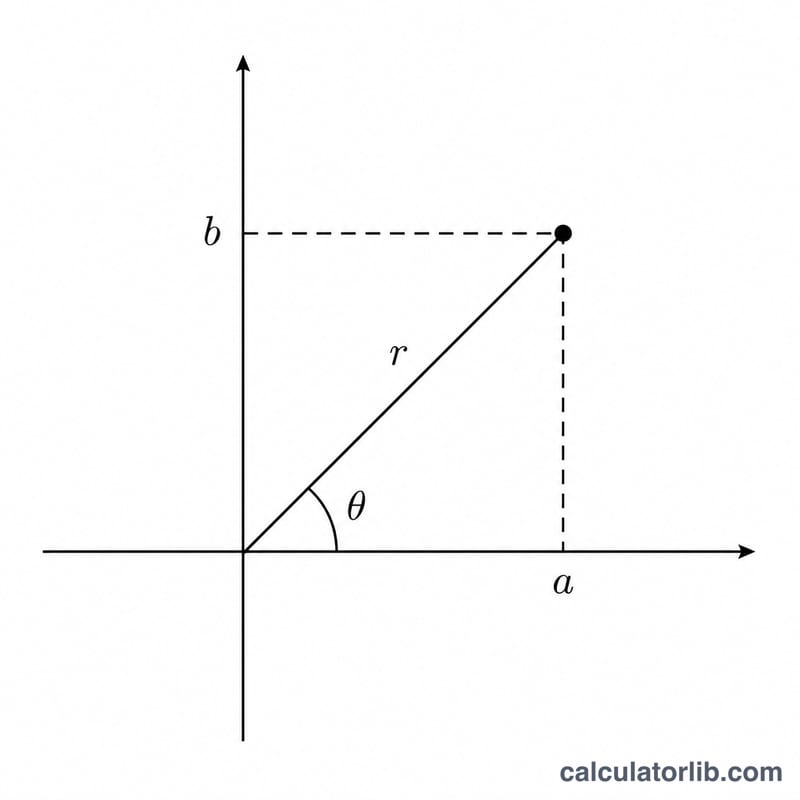
Every complex number \(z = a + bi\) can be written in trigonometric (polar) form \(z = r(\cos\theta + i\sin\theta)\). Here \(r\) is the modulus (its distance from the origin) and \(\theta\) is the argument (the angle measured from the positive real axis). This calculator converts any rectangular complex number \(a + bi\) into its trigonometric form and reports \(\theta\) in both degrees and radians.
How to Use It
Enter the real part \(a\) and the imaginary part \(b\) of your complex number, then read off the modulus \(r\) and the argument \(\theta\). The calculator uses the atan2 function so the angle is placed in the correct quadrant automatically — no manual sign adjustments needed.
The Formula Explained
The modulus comes from the Pythagorean theorem: \(r = \sqrt{a^2 + b^2}\). The argument is \(\theta = \operatorname{atan2}(b, a)\), which returns the angle of the vector \((a, b)\). Multiplying out \(r\cdot\cos\theta\) recovers \(a\) and \(r\cdot\sin\theta\) recovers \(b\), confirming the form is equivalent to the original number.
$$z = r\left(\cos\theta + i\sin\theta\right)$$$$\text{where}\quad \left\{ \begin{aligned} r &= \sqrt{\text{Real }(a)^{2} + \text{Imag }(b)^{2}} \\ \theta &= \operatorname{atan2}\!\left(\text{Imag }(b),\ \text{Real }(a)\right) \end{aligned} \right.$$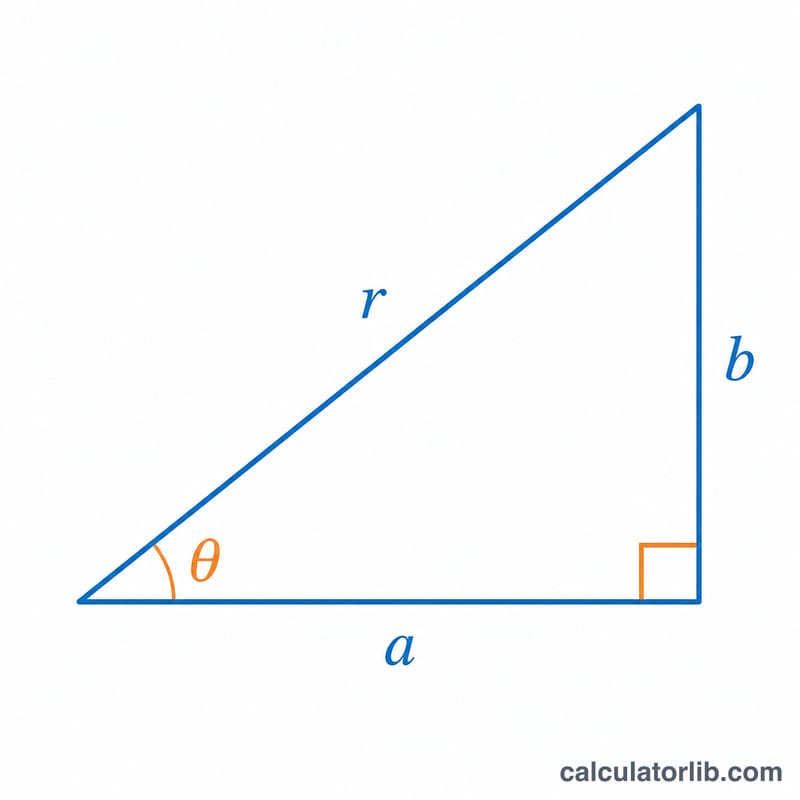
Worked Example
Take \(z = 3 + 4i\). The modulus is $$r = \sqrt{3^2 + 4^2} = \sqrt{25} = 5.$$ The argument is $$\theta = \operatorname{atan2}(4, 3) \approx 0.9273 \text{ radians} \approx 53.13°.$$ So \(z = 5(\cos 53.13° + i\sin 53.13°)\).
FAQ
Is degrees or radians correct? Both describe the same angle; use whichever your problem requires. Radians are standard in calculus and Euler's formula.
What if a and b are both zero? Then \(z = 0\), the modulus is \(0\), and the argument is undefined (conventionally taken as 0).
How does this relate to exponential form? By Euler's formula, \(r(\cos\theta + i\sin\theta) = r\cdot e^{i\theta}\), so the same \(r\) and \(\theta\) give the exponential form directly.