
What is the Cos 2 Theta Calculator?
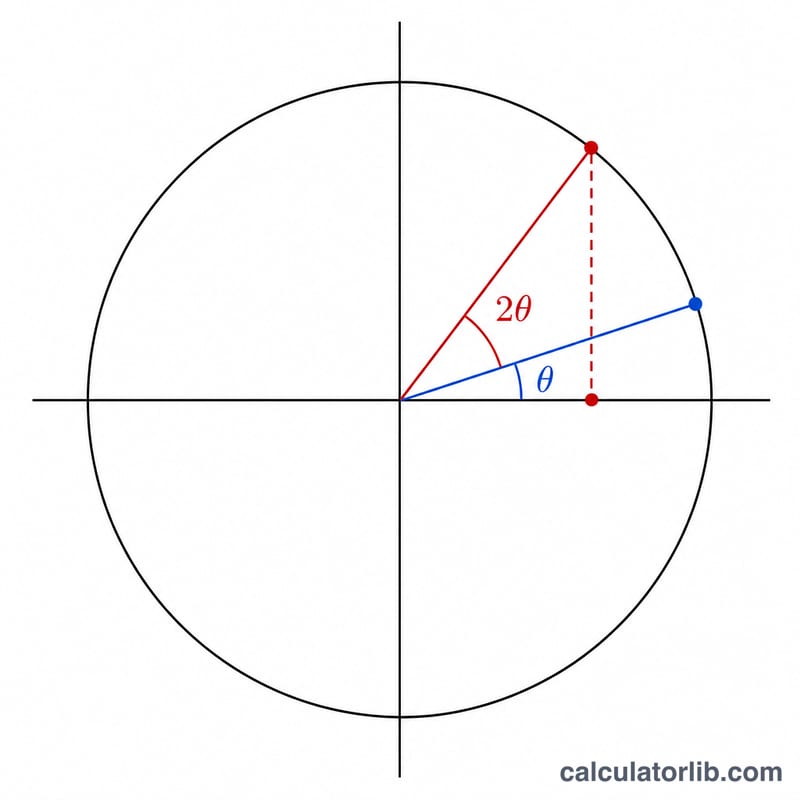
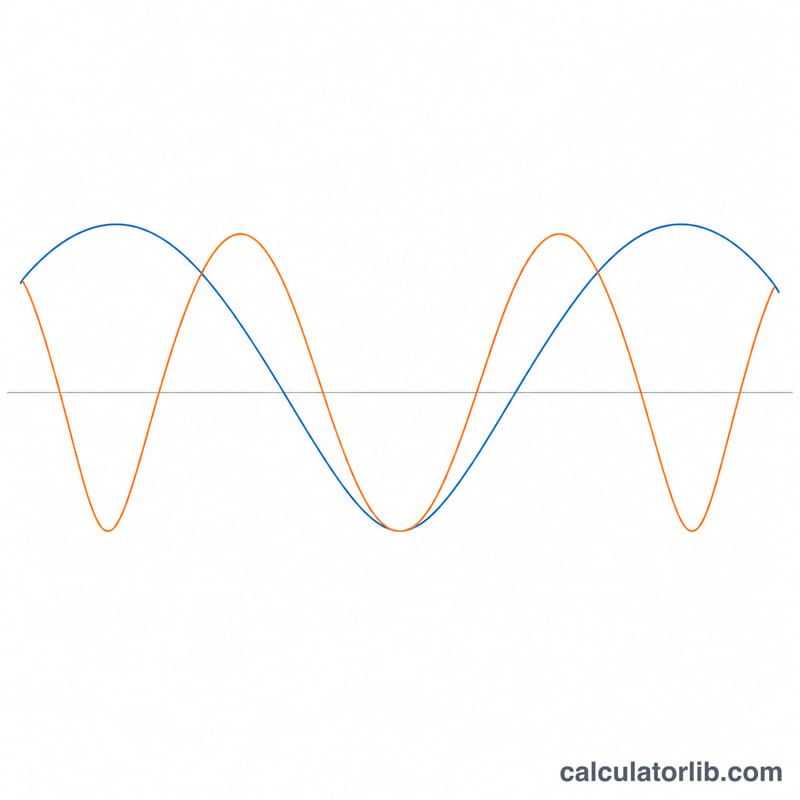
This tool computes cos(2θ) — the cosine of double an angle — for any value of θ entered in degrees or radians. It is built on the cosine double-angle identity, a cornerstone of trigonometry used in physics, engineering, signal processing and calculus simplifications.
How to use it
Enter your angle θ, choose whether it is in degrees or radians, and the calculator returns cos(2θ) along with cos θ and sin θ so you can verify the identity yourself. Negative angles and angles larger than 360° (or 2π) are fully supported.
The formula explained
The double-angle identity states:
$$\cos(2\theta) = \cos^2\theta - \sin^2\theta = 2\cos^2\theta - 1 = 1 - 2\sin^2\theta$$
All three forms are algebraically equivalent because of the Pythagorean identity \(\sin^2\theta + \cos^2\theta = 1\). The calculator evaluates cos(2θ) directly, then displays cos θ and sin θ so you can confirm that \(\cos^2\theta - \sin^2\theta\) matches.
Worked example
For θ = 30°: cos 30° = 0.866025, sin 30° = 0.5. Then $$\cos^2\theta - \sin^2\theta = 0.75 - 0.25 = 0.5$$ Indeed \(\cos(60°) = 0.5\), confirming the identity.
FAQ
Does it accept radians? Yes — select the Radians option and enter θ in radians (e.g. \(\pi/6 \approx 0.5236\)).
Why show cos θ and sin θ? They let you double-check the result via \(\cos^2\theta - \sin^2\theta\).
What is cos(2θ) at 45°? It equals \(\cos(90°) = 0\), since \(\cos^2 45° - \sin^2 45° = 0.5 - 0.5 = 0\).