
What is the Sin 2 Theta Calculator?
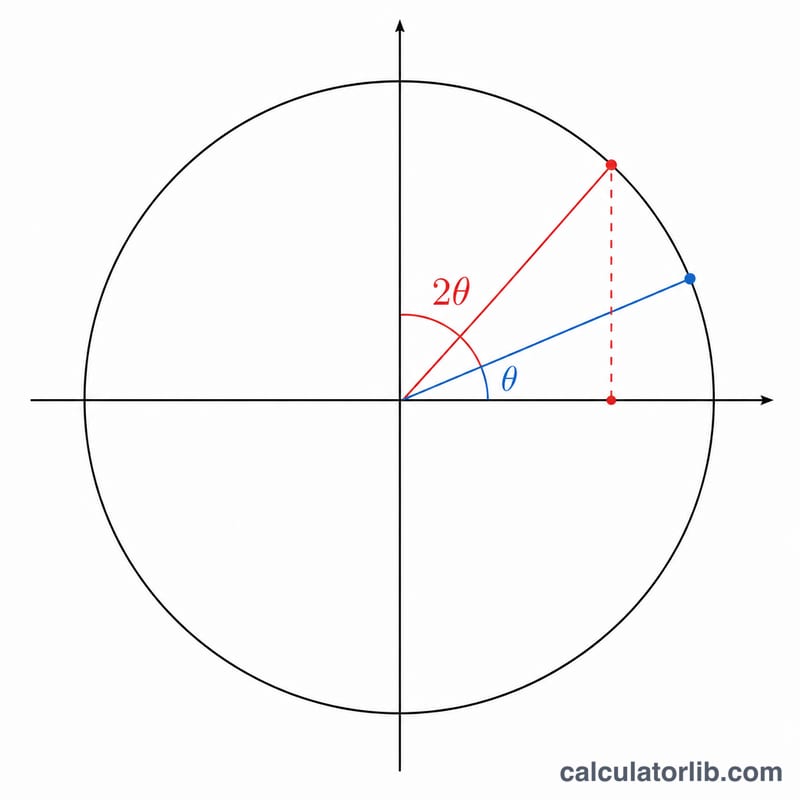
This calculator evaluates sin(2θ), the sine of a doubled angle, using the trigonometric double-angle identity. Enter any angle in degrees or radians and the tool returns sin(2θ) along with the intermediate values sinθ and cosθ so you can check the work step by step.
How to use it
Type your angle θ into the input box, choose whether it is measured in degrees or radians, and read off the result. Degrees are the default, which is convenient for geometry and most school problems; switch to radians for calculus and physics work.
The formula explained
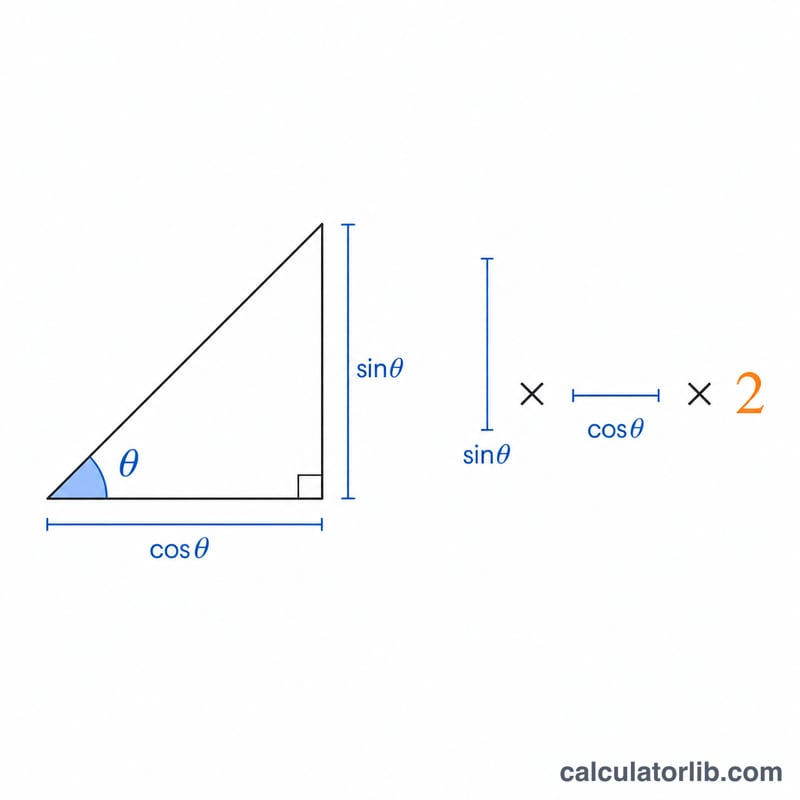
The double-angle identity for sine states:
$$\sin\!\left(2\,\theta\right) = 2\,\sin\!\left(\theta\right)\cos\!\left(\theta\right)$$
It is derived from the sine addition formula \(\sin(A + B) = \sin A\cos B + \cos A\sin B\) by setting \(A = B = \theta\). Because both terms become \(\sin\theta\cos\theta\), they combine into \(2\,\sin\theta\cos\theta\). This identity is exact for every real angle.
Worked example
Suppose \(\theta = 30^{\circ}\). Then \(\sin\theta = 0.5\) and \(\cos\theta = 0.8660254\). Multiplying:
$$2 \times 0.5 \times 0.8660254 = 0.8660254$$
You can verify this directly: \(\sin(2 \times 30^{\circ}) = \sin(60^{\circ}) = 0.8660254\). The two methods agree.
FAQ
Does sin(2θ) equal 2·sinθ? No. A common mistake is to "distribute" the 2 across the angle. The correct identity is \(2\,\sin\theta\cos\theta\), which is generally not the same as \(2\,\sin\theta\).
What range can the output take? Since sine of any real number lies between \(-1\) and \(1\), sin(2θ) always falls within \([-1, 1]\).
Can I enter negative or large angles? Yes. Sine is periodic and defined for all real angles, so negative values and angles beyond \(360^{\circ}\) (or \(2\pi\)) work fine.