
What is the Arcsine (Sin⁻¹) Calculator?
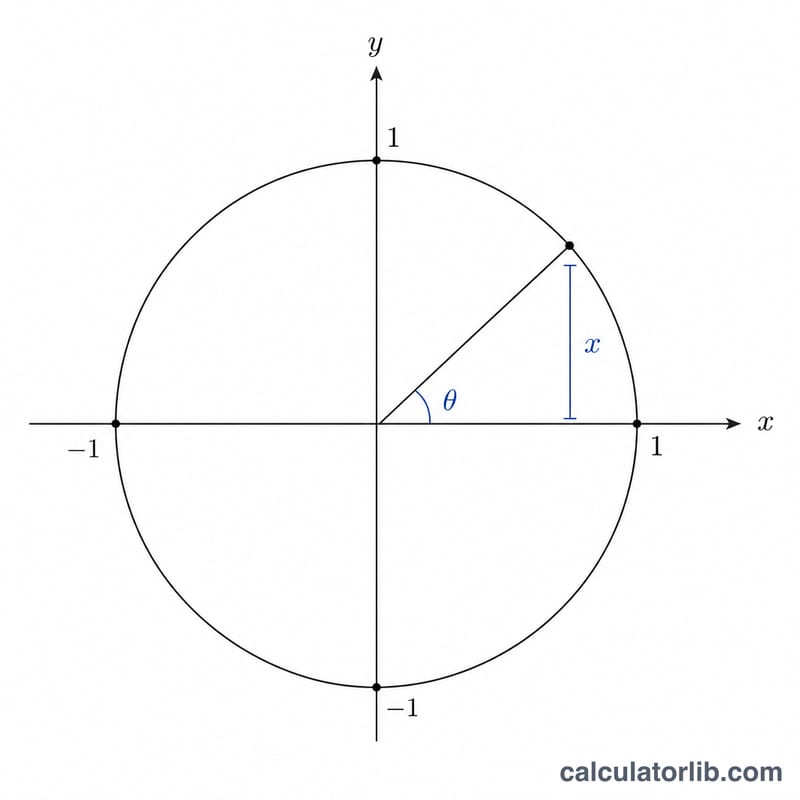
The arcsine, written as \(\sin^{-1}(x)\) or \(\arcsin(x)\), is the inverse of the sine function. Given a ratio x between -1 and 1, it returns the angle θ whose sine equals that value. This calculator instantly returns that angle in both degrees and radians.
How to use it
Enter any value x in the range \(-1 \le x \le 1\) and the calculator returns $$\theta = \arcsin(x)$$ Values outside this range have no real arcsine, so inputs are clamped to the valid interval. The result is shown both as degrees and radians for convenience.
The formula explained
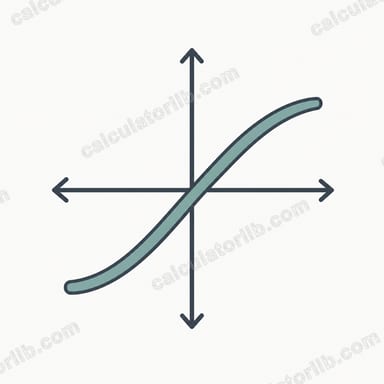
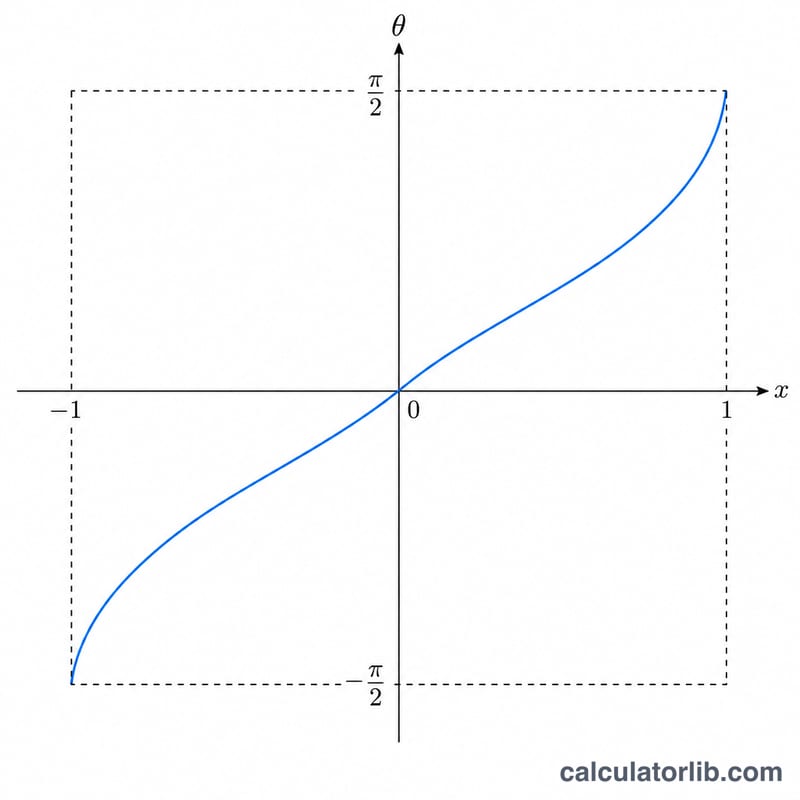
The principal value of arcsine is defined on the domain \([-1, 1]\) and produces an output (the principal angle) in the range \([-90°, 90°]\), or \([-\pi/2, \pi/2]\) radians. Internally the calculator computes the value in radians and converts to degrees using $$\theta_{deg} = \theta_{rad} \times \frac{180}{\pi}$$
Worked example
Suppose \(x = 0.5\). The angle whose sine is 0.5 is 30°. In radians, $$\arcsin(0.5) = \frac{\pi}{6} \approx 0.523599 \text{ rad}$$ Likewise, \(\arcsin(1) = 90° = \pi/2 \approx 1.570796\) rad, and \(\arcsin(0) = 0°\).
Key Terms & Definitions
- Arcsine / inverse sine
- The inverse of the sine function. Given a ratio \(x\), \(\arcsin(x)\) returns the angle \(\theta\) such that \(\sin(\theta) = x\). It "undoes" the sine operation.
- Principal value
- Because sine is periodic, infinitely many angles share the same sine. To make arcsine a well-defined function, it returns a single standard answer called the principal value, taken from the range \([-90^\circ, 90^\circ]\).
- Domain
- The set of valid inputs for arcsine: \(-1 \le x \le 1\). Values outside this interval have no real arcsine because sine never exceeds \(1\) or drops below \(-1\).
- Range
- The set of possible outputs: \([-\tfrac{\pi}{2}, \tfrac{\pi}{2}]\) radians, equivalently \([-90^\circ, 90^\circ]\). Every arcsine result falls within this band.
- Radian vs. degree
- Two units for measuring angles. A full circle is \(360^\circ\) or \(2\pi\) radians, so \(180^\circ = \pi\) radians. Convert with \(\text{radians} = \text{degrees}\times\tfrac{\pi}{180}\). Radians are the default in calculus and most programming languages.
- Notation: \(\sin^{-1}(x)\) vs. \((\sin x)^{-1}\)
- The superscript \(-1\) in \(\sin^{-1}(x)\) denotes the inverse function (arcsine), not a reciprocal. By contrast, \((\sin x)^{-1} = \tfrac{1}{\sin x} = \csc x\), the cosecant. These are different operations, so the parentheses matter.
FAQ
Why must x be between -1 and 1? Because the sine of any real angle always lies between -1 and 1, no real angle has a sine outside that range.
What range are the answers in? The principal arcsine returns angles from -90° to 90° (\(-\pi/2\) to \(\pi/2\) radians).
How do I convert the result to radians? The calculator already shows both; to convert manually, multiply degrees by \(\pi/180\).