
What is the Arcsine Calculator?
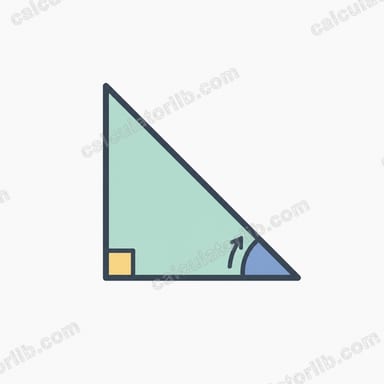
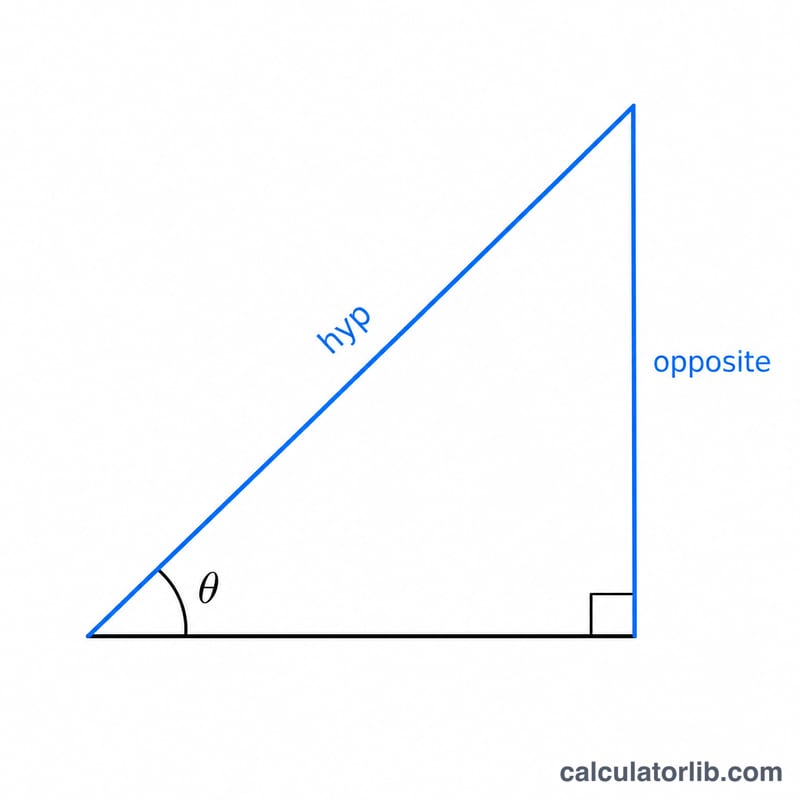
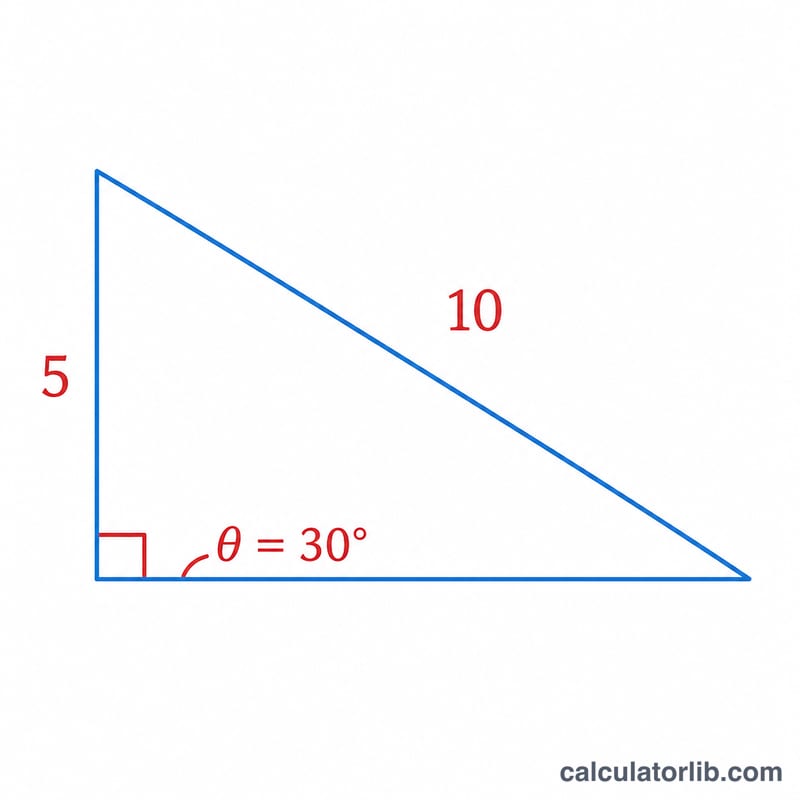
The arcsine (also written sin⁻¹ or asin) is the inverse of the sine function. In a right triangle, the sine of an angle equals the length of the opposite side divided by the hypotenuse. This calculator reverses that relationship: given the opposite side and the hypotenuse, it returns the angle \(\theta\) that produces that ratio. The result is shown in both degrees and radians.
How to use it
Enter the length of the side opposite the angle and the length of the hypotenuse (the longest side of a right triangle). Press calculate and read the angle. The hypotenuse should be at least as long as the opposite side, so the ratio stays between \(-1\) and \(1\) — the valid domain of arcsine. If you enter a larger opposite side, the ratio is clamped to \(\pm 1\) (giving 90° or −90°).
The formula explained
The core equation is $$\theta = \arcsin\left(\frac{\text{Opposite}}{\text{Hypotenuse}}\right) \times \frac{180}{\pi}$$ First the ratio is computed, then the inverse sine returns an angle in radians between \(-\pi/2\) and \(\pi/2\). We convert to degrees by multiplying by \(180/\pi\). Because arcsine is only defined for inputs in \([-1, 1]\), the tool guards against out-of-range ratios.
Worked example
Suppose the opposite side is 3 and the hypotenuse is 5. The ratio is \(3 \div 5 = 0.6\). Then $$\theta = \arcsin(0.6) \approx 0.6435 \text{ radians} \approx 36.87°$$ This is the classic 3-4-5 right triangle, where the angle facing the side of length 3 is about 36.87°.
Common Arcsine Values
The arcsine function takes a ratio between \(-1\) and \(1\) (the opposite side divided by the hypotenuse) and returns the angle whose sine equals that ratio. Because the hypotenuse is always the longest side of a right triangle, the ratio \(\frac{\text{opposite}}{\text{hypotenuse}}\) for a real angle never exceeds 1. The table below lists frequently encountered sine ratios alongside the corresponding angle in both degrees and radians.
| Sine ratio (opposite ÷ hypotenuse) | Angle (degrees) | Angle (radians) |
|---|---|---|
| 0 | 0° | 0 |
| 0.5 | 30° | \(\pi/6 \approx 0.5236\) |
| 0.6 | 36.87° | \(\approx 0.6435\) |
| 0.707 (≈ \(\tfrac{\sqrt{2}}{2}\)) | 45° | \(\pi/4 \approx 0.7854\) |
| 0.866 (≈ \(\tfrac{\sqrt{3}}{2}\)) | 60° | \(\pi/3 \approx 1.0472\) |
| 1 | 90° | \(\pi/2 \approx 1.5708\) |
To convert any of these angles between degrees and radians, multiply degrees by \(\pi/180\). For example, \(30° \times \pi/180 = \pi/6 \approx 0.5236\) radians.
Key Terms
- Arcsine (sin⁻¹, asin)
- The inverse of the sine function. Given a ratio \(x\), arcsine returns the angle \(\theta\) such that \(\sin\theta = x\). It is written \(\arcsin(x)\), \(\sin^{-1}(x)\), or \(\operatorname{asin}(x)\). Note that \(\sin^{-1}(x)\) means the inverse function, not \(1/\sin(x)\).
- Opposite side
- In a right triangle, the side directly across from the angle of interest. It is one of the two inputs to this calculator and forms the numerator of the sine ratio.
- Hypotenuse
- The longest side of a right triangle, located opposite the right angle. It serves as the denominator of the sine ratio and is always greater than or equal to the opposite side.
- Sine
- A trigonometric ratio defined as the length of the opposite side divided by the hypotenuse: \(\sin\theta = \frac{\text{opposite}}{\text{hypotenuse}}\). Arcsine reverses this relationship.
- Radian
- A unit of angular measure based on the radius of a circle. One full revolution equals \(2\pi\) radians (about 6.2832), and \(180° = \pi\) radians. Radians are the standard unit in calculus and most programming languages.
- Degree
- A unit of angular measure where one full revolution equals 360°. A right angle is 90°. Degrees are common in everyday geometry, navigation, and surveying.
- Domain and range of arcsine
- The domain (allowed inputs) of arcsine is \([-1, 1]\); ratios outside this range have no real-valued angle. The range (possible outputs) is \([-90°, 90°]\), or \([-\tfrac{\pi}{2}, \tfrac{\pi}{2}]\) radians, which is the principal value branch returned by calculators.
FAQ
Why must the ratio stay between \(-1\) and \(1\)? The sine of any angle never exceeds 1 or goes below \(-1\), so its inverse can only accept values in that range.
Can the hypotenuse be smaller than the opposite side? Not in a real right triangle — the hypotenuse is always the longest side. If you enter such values the ratio is clamped to \(\pm 1\).
How do I switch between degrees and radians? Both are shown automatically; degrees is the headline value and radians appears in the details table.