
What is a 45-45-90 triangle?
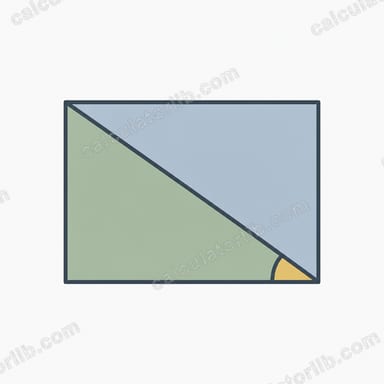
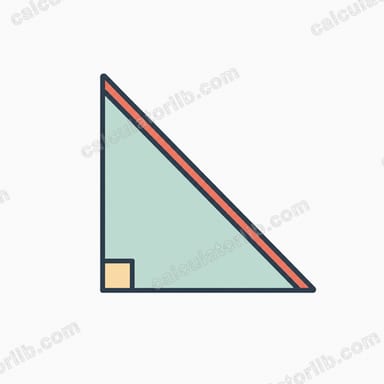
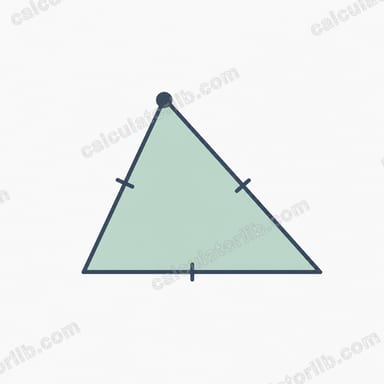
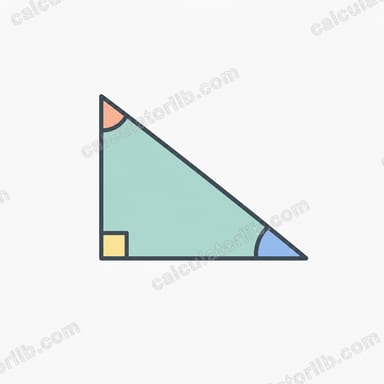
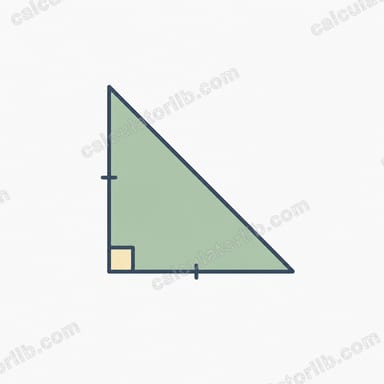
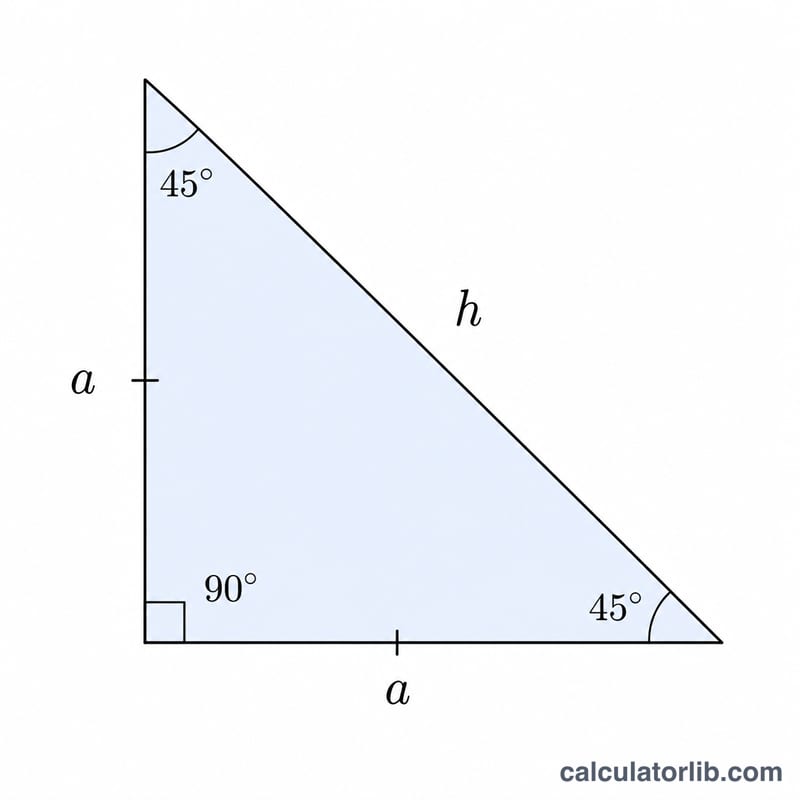
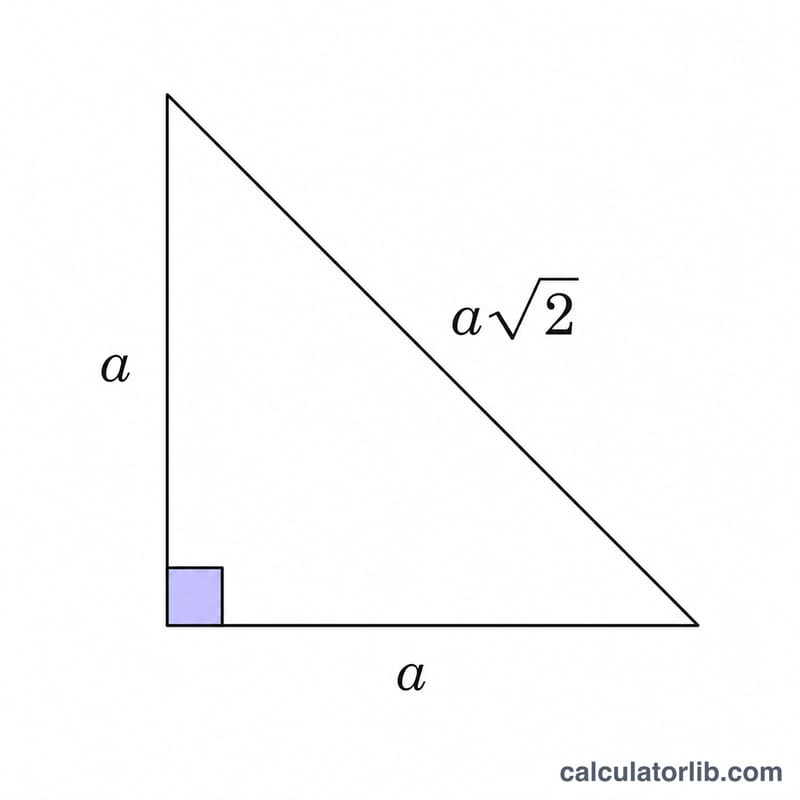
A 45-45-90 triangle is a right triangle whose two acute angles each measure 45°. Because the two non-right angles are equal, the triangle is isosceles: the two legs that meet at the right angle have the same length. This fixed shape gives it a constant side ratio of 1 : 1 : √2, meaning the hypotenuse is always √2 (about 1.41421) times the length of either leg.
How to use this calculator
Enter the length of one leg in any unit (cm, inches, meters — the result comes back in the same unit). The calculator instantly returns the hypotenuse, along with the perimeter and area of the triangle. Since both legs are equal, you only need to supply a single leg measurement.
The formula explained
By the Pythagorean theorem, \(c^2 = a^2 + b^2\). In a 45-45-90 triangle \(a = b\), so \(c^2 = 2a^2\), and taking the square root gives the standalone result
$$c = a\sqrt{2}$$The perimeter is \(2a + a\sqrt{2}\) and the area is
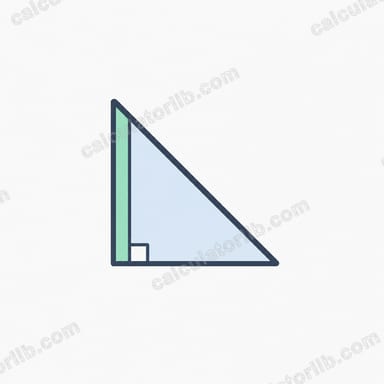
$$A = \tfrac{1}{2}\cdot a\cdot a = \tfrac{1}{2}a^2,$$because the two legs act as the base and height.
Worked example
Suppose a leg measures 10 units. The hypotenuse is
$$10 \times \sqrt{2} \approx 14.14 \text{ units.}$$The perimeter is \(2(10) + 14.14 = 34.14\) units, and the area is \(\tfrac{1}{2} \times 10^2 = 50\) square units.
FAQ
Can I find the leg from the hypotenuse? Yes — divide the hypotenuse by \(\sqrt{2}\) (equivalently multiply by \(\sqrt{2}/2 \approx 0.7071\)).
Are both legs really equal? Yes. Because both base angles are 45°, the triangle is isosceles, so the two legs are identical in length.
What units does it use? The calculator is unit-agnostic; the output uses whatever unit you entered for the leg.