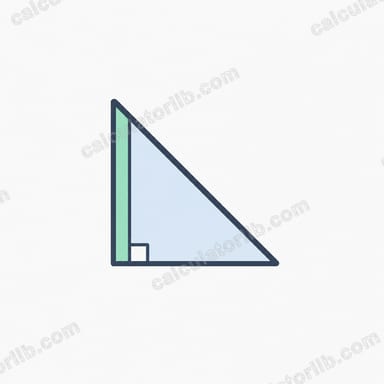

What Is a 30-60-90 Triangle?
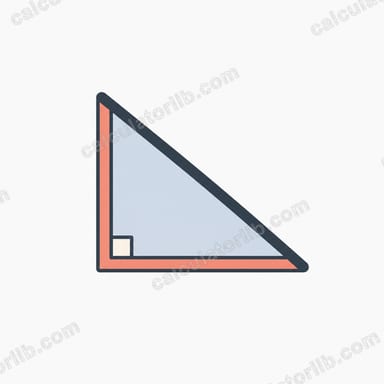
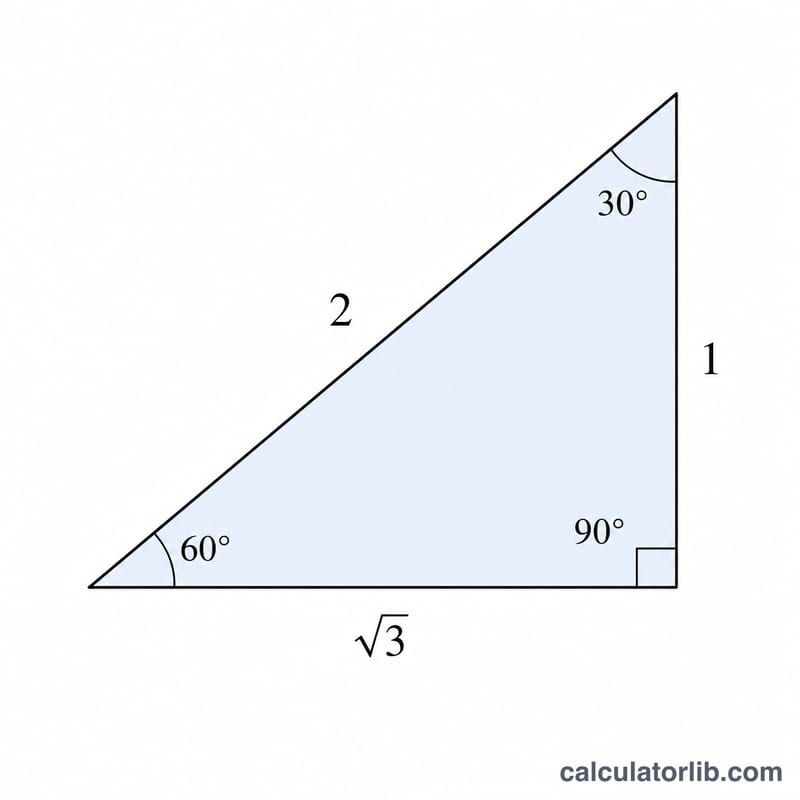
A 30-60-90 triangle is a special right triangle whose three interior angles measure 30°, 60°, and 90°. Because the angles are fixed, the three side lengths always follow a constant ratio of 1 : √3 : 2. This calculator takes the short leg (the side opposite the 30° angle) and instantly derives the long leg, the hypotenuse, the perimeter, and the area.
How to Use This Calculator
Enter the length of the short leg in any unit you like (cm, inches, meters — the result uses the same unit). Press calculate and you'll get every other measurement of the triangle. Since the ratios are universal, the tool works for any positive short-leg value.
The Formula Explained
If the short leg is \(a\), then the long leg is \(a\sqrt{3}\) and the hypotenuse is \(2a\). The perimeter is the sum of all three sides, \(a + a\sqrt{3} + 2a\), and the area of a right triangle is one half the product of its two legs:
$$\frac{1}{2}\cdot a\cdot\left(a\sqrt{3}\right)$$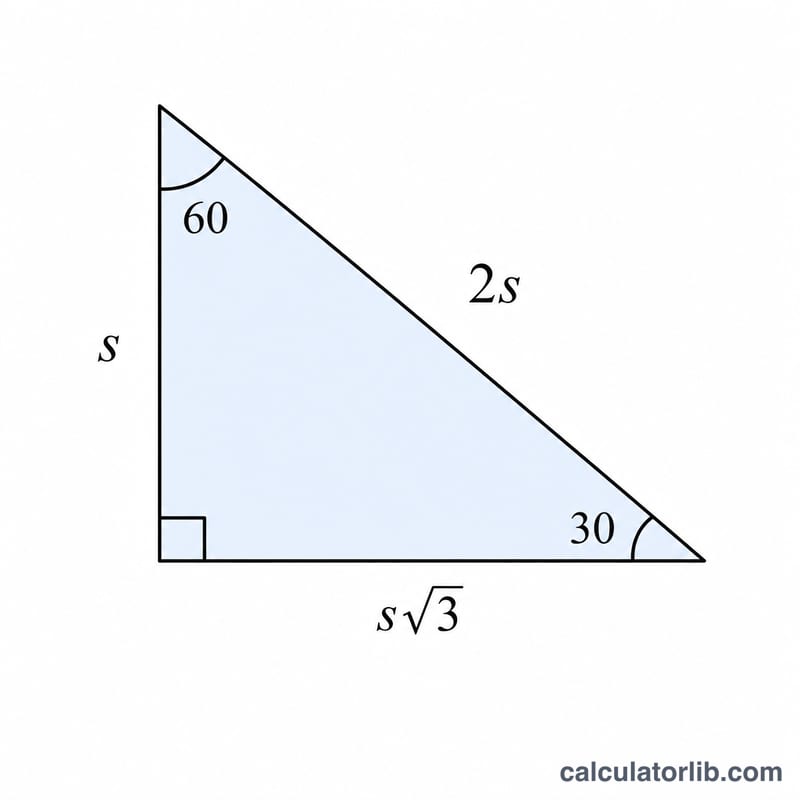
Worked Example
Suppose the short leg is 5. The long leg is \(5\cdot\sqrt{3} \approx 8.66\), and the hypotenuse is \(2\cdot 5 = 10\). The perimeter is \(5 + 8.66 + 10 \approx 23.66\), and the area is \(\frac{1}{2}\cdot 5\cdot 8.66 \approx 21.65\) square units.
FAQ
Which side is the short leg? The short leg is the side opposite the smallest angle (30°). It is always the shortest of the three sides.
Why is the long leg √3 times the short leg? The ratio comes from the trigonometry of the fixed angles: \(\tan(60°) = \sqrt{3}\), so the side opposite 60° is \(\sqrt{3}\) times the side opposite 30°.
Can I work backward from the hypotenuse? Yes — divide the hypotenuse by 2 to get the short leg, then this calculator gives the rest.