
What is the Daily Sugar Limit Calculator?
This tool estimates how many grams of free (added) sugar you should consume each day based on guidelines from the World Health Organization (WHO) and the American Heart Association (AHA). "Free sugar" includes sugars added by manufacturers, cooks, or consumers, plus sugars naturally present in honey, syrups, and fruit juices — it does not include sugar locked inside whole fruit and milk.
How to use it
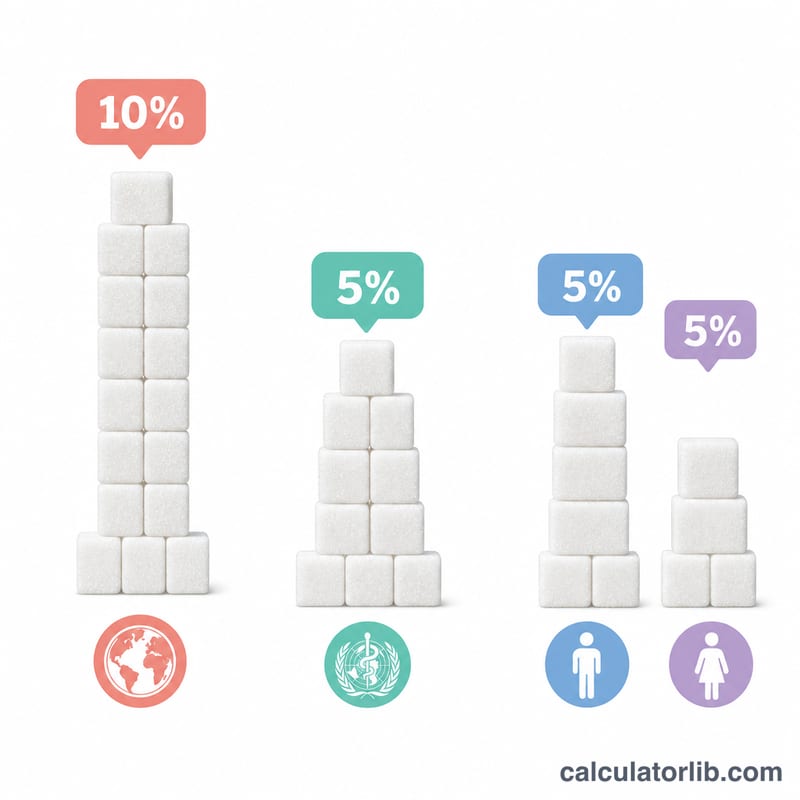
Enter your typical daily calorie intake and select your sex. The calculator returns three numbers: the WHO maximum (10% of energy), the WHO ideal target (5% of energy), and the AHA fixed limit (36 g for men, 25 g for women). Staying below these helps reduce the risk of weight gain and tooth decay.
The formula explained
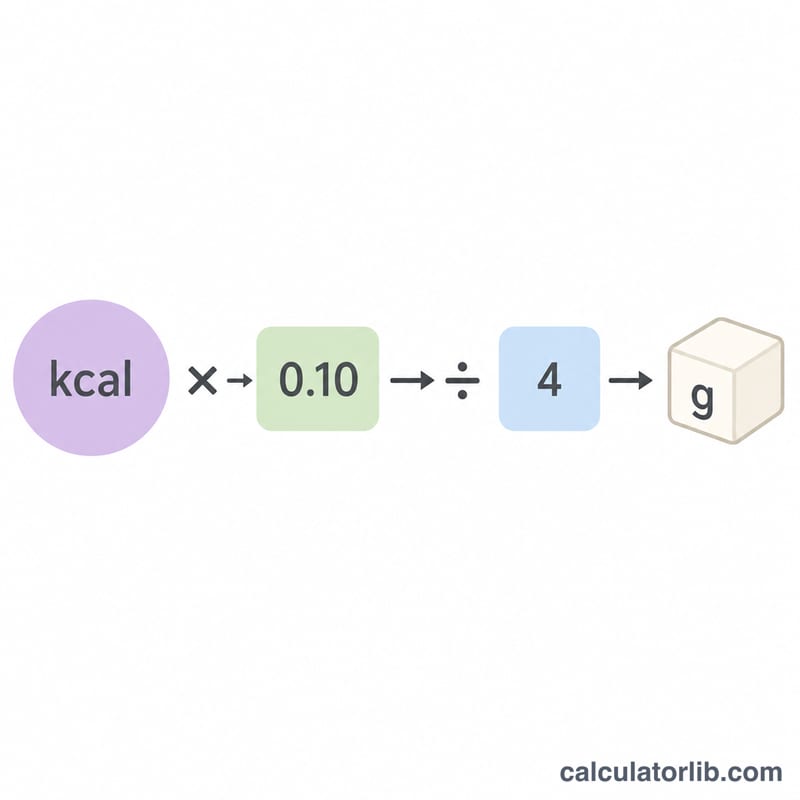
WHO frames its advice as a percentage of total energy. Since each gram of sugar provides about 4 kcal, the gram limit is calculated as (percentage × calories) ÷ 4. At 2,000 kcal, the 10% ceiling is
$$\text{WHO Limit} = \frac{0.10 \times 2000}{4} = 50\ \text{g}$$and the 5% ideal is 25 g. The AHA instead uses fixed teaspoon-based limits: about 9 teaspoons (36 g) for men and 6 teaspoons (25 g) for women.
Worked example
A woman eating 1,800 kcal per day: WHO maximum =
$$\text{WHO Limit} = \frac{0.10 \times 1800}{4} = 45\ \text{g}$$WHO ideal =
$$\text{WHO Ideal} = \frac{0.05 \times 1800}{4} = 22.5\ \text{g}$$and the AHA limit = 25 g. So she should aim to stay under roughly 22–25 g of added sugar daily.
FAQ
Does this include sugar in fruit? No — whole fruit and plain milk sugars are not counted as free sugar. The juice from fruit, however, is.
Which limit should I follow? The 5% WHO target is the healthiest goal; the 10% figure and the AHA limits are practical upper boundaries.
How many grams are in a teaspoon of sugar? About 4 grams, so 25 g ≈ 6 teaspoons and 36 g ≈ 9 teaspoons.