
What this calculator does
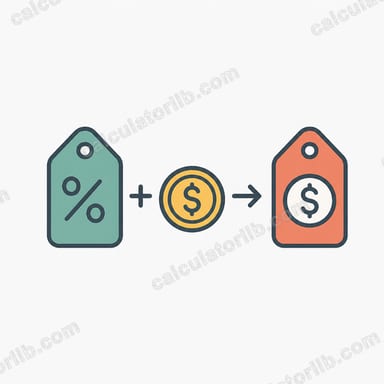
The Final Price Calculator tells you exactly how much you will pay when a store first takes a percentage off an item and then adds sales tax to the discounted amount. This is the most common order at checkout in many regions: discounts reduce the taxable subtotal, and tax is charged on what remains. The tool works with any currency — the dollar sign is just a label.
How to use it
Enter three numbers: the original price of the item, the discount percentage being offered, and the applicable sales tax percentage. The calculator instantly shows your final price plus a breakdown of the discount amount, the discounted subtotal, the tax added, and your total savings versus the original sticker price.
The formula explained
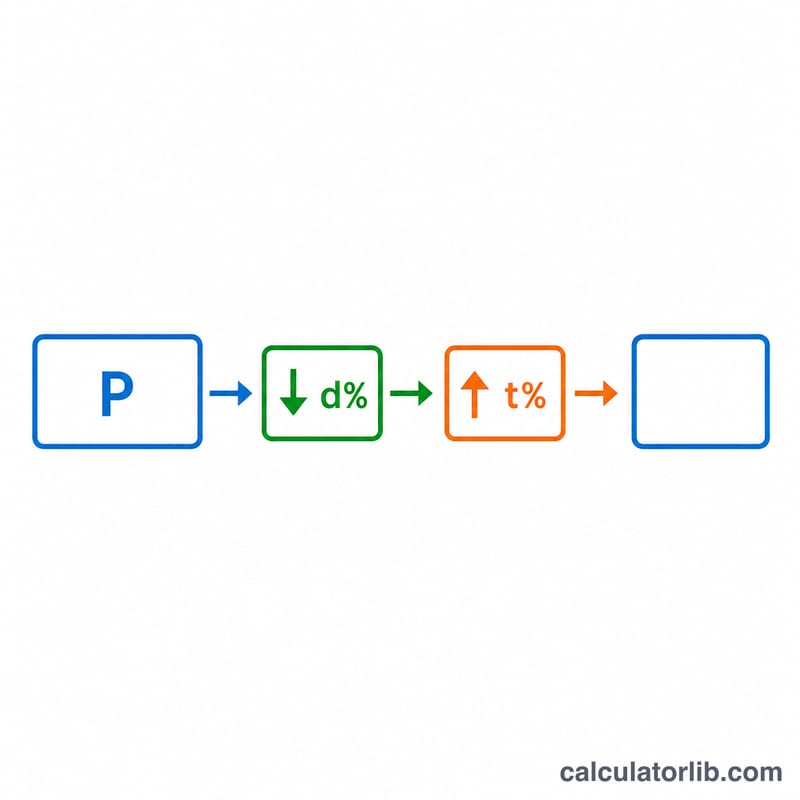
The math runs in two steps. First the discount is applied: \(\text{price} \times \left(1 - \frac{\text{discount}}{100}\right)\). Then tax is applied to that smaller number: \(\times \left(1 + \frac{\text{tax}}{100}\right)\). Combined, the final price is $$\text{price} \times \left(1 - \frac{\text{discount}}{100}\right) \times \left(1 + \frac{\text{tax}}{100}\right)$$ Because tax is charged after the markdown, you pay tax only on the reduced subtotal, not on the original price.
Worked example
Suppose an item costs $100 with a 20% discount and 8% sales tax. The discount is $20, leaving $80. Tax of 8% on $80 is $6.40. The final price is $$\$80 + \$6.40 = \$86.40$$ and you saved $20 off the original.
FAQ
Does the order matter? Mathematically, applying a percent discount then a percent tax gives the same result as tax-then-discount because multiplication is commutative. The dollar breakdown of "discount amount" and "tax added" will differ, but the final price is identical.
Is the discount taxed? No — in this model tax is computed on the post-discount subtotal, so you are not taxed on the amount you saved.
Can I use it for a coupon plus VAT? Yes. Put your coupon percentage in the discount field and your VAT rate in the tax field; the logic is the same.