
What is the Sin Degrees Calculator?
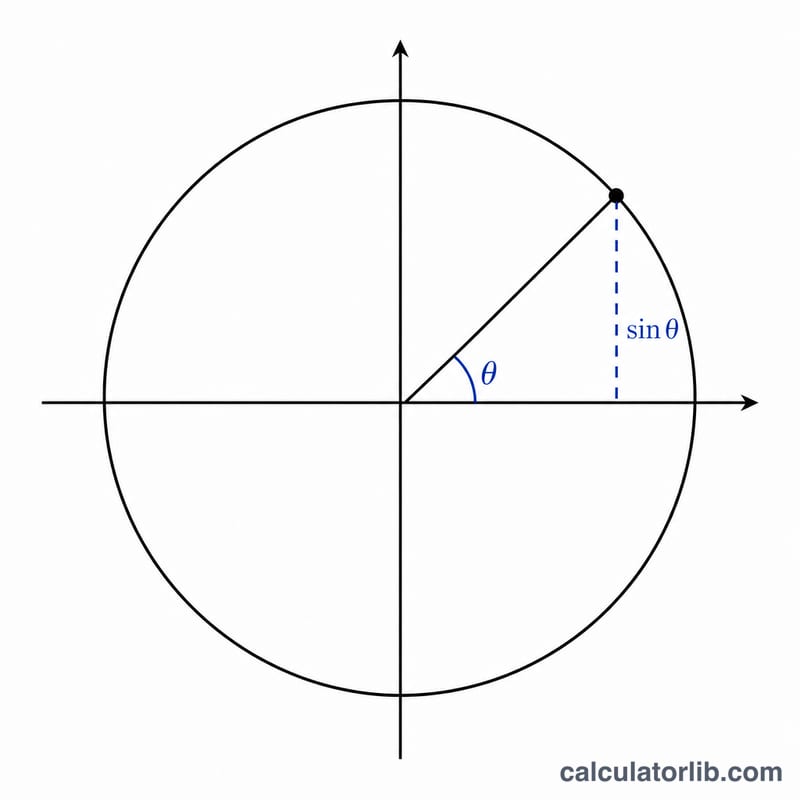
The Sin Degrees Calculator computes the sine of an angle when that angle is given in degrees. Most programming languages and scientific functions expect angles in radians, so this tool handles the conversion for you: it multiplies your degree value by π/180 and then evaluates the sine. The sine of an angle ranges from −1 to 1 and represents, on the unit circle, the vertical (y) coordinate of the point at that angle.
How to use it
Enter the angle θ in degrees. You can use whole numbers like 30, 45 or 90, decimals like 22.5, or values larger than 360 — the sine function is periodic with a period of 360°, so sin(370°) equals sin(10°). The calculator returns the sine value plus the equivalent angle in radians for reference.
The formula explained
The core relationship is $$\sin(\theta) = \sin\!\left(\text{Angle (deg)} \times \dfrac{\pi}{180}\right)$$ The factor \(\frac{\pi}{180}\) (≈ 0.0174533) converts degrees into radians, the unit the underlying trigonometric function uses. For example, 180° equals exactly \(\pi\) radians, and 90° equals \(\frac{\pi}{2}\) radians.
Worked example
Suppose θ = 30°. Convert to radians: $$30 \times \frac{\pi}{180} = 0.5236 \text{ rad}$$ Then \(\sin(0.5236) = 0.5\). So \(\sin(30°) = 0.5\) exactly. Similarly, \(\sin(90°) = 1\) and \(\sin(45°) \approx 0.7071\).
FAQ
Why does my angle get converted to radians? Standard math libraries define sine in terms of radians, so degrees must first be scaled by \(\frac{\pi}{180}\).
What is the range of the result? The sine of any real angle always lies between −1 and 1 inclusive.
Can I enter negative or very large angles? Yes. Negative angles reflect across the x-axis (\(\sin(-\theta) = -\sin(\theta)\)), and large angles wrap around every 360°.