
What is the Sine Cosine Tangent Calculator?
This calculator instantly returns the three primary trigonometric functions — sine (sin), cosine (cos) and tangent (tan) — for any angle you enter. You can work in either degrees or radians, making it useful for geometry homework, physics problems, engineering, surveying and computer graphics.
How to use it
Type the angle into the input box, choose whether the value is in degrees or radians, and read off the results. The sine appears in the highlighted box; cosine and tangent are listed in the table below. If the cosine of your angle is zero (for example 90° or 270°), the tangent is undefined and the calculator says so instead of showing a misleading huge number.
The formula explained
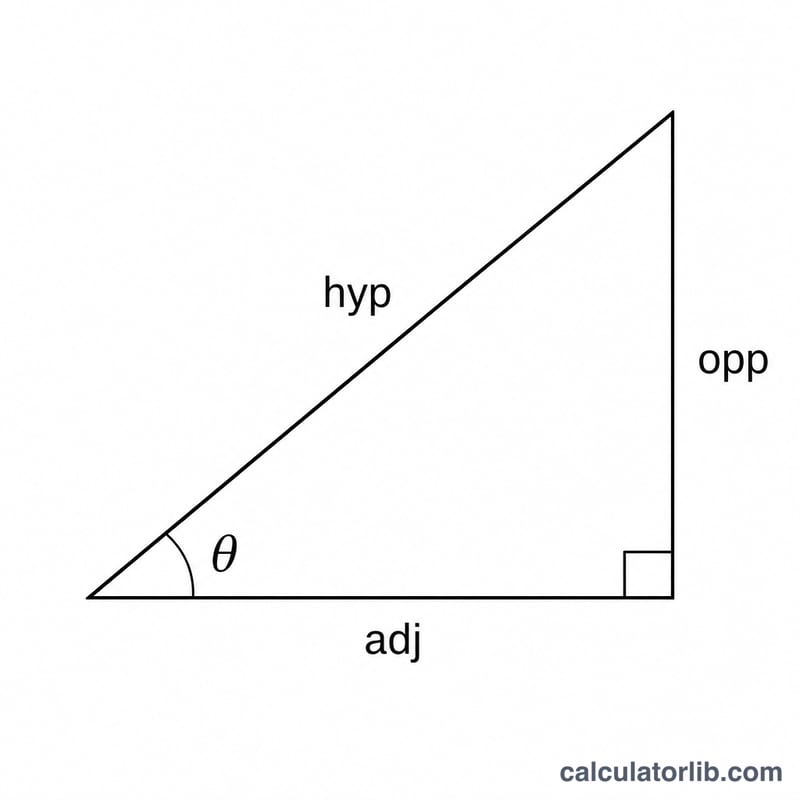
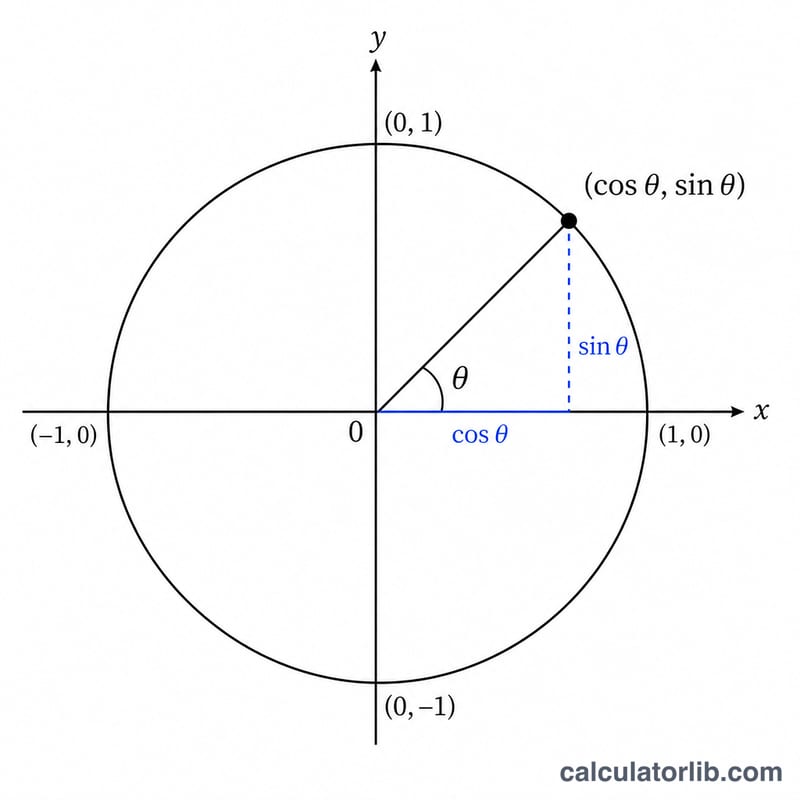
Sine and cosine are defined from the unit circle: for an angle θ, the point on the circle has coordinates \((\cos\theta, \sin\theta)\). Tangent is the ratio of the two: $$\tan\theta = \frac{\sin\theta}{\cos\theta}$$. Because most math libraries expect radians, an angle given in degrees is first converted with $$\theta_{\text{rad}} = \theta \times \frac{\pi}{180}$$
Worked example
Take \(\theta = 30°\). Convert: $$30 \times \frac{\pi}{180} \approx 0.5236\ \text{rad}$$ Then \(\sin 30° = 0.5\), \(\cos 30° \approx 0.8660254\), and $$\tan 30° = \frac{0.5}{0.8660254} \approx 0.5773503$$ These match the exact values \(\frac{1}{2}\), \(\frac{\sqrt{3}}{2}\) and \(\frac{1}{\sqrt{3}}\).
FAQ
Why is tan 90° undefined? Because \(\cos 90° = 0\), and dividing by zero has no value. The function shoots off to infinity near 90°.
Can I enter negative angles? Yes. Sine and tangent are odd functions, so \(\sin(-\theta) = -\sin\theta\), while cosine is even: \(\cos(-\theta) = \cos\theta\).
What is one radian in degrees? About 57.2958°, since \(\pi\) radians equal 180°.