
What is the Theta Calculator?
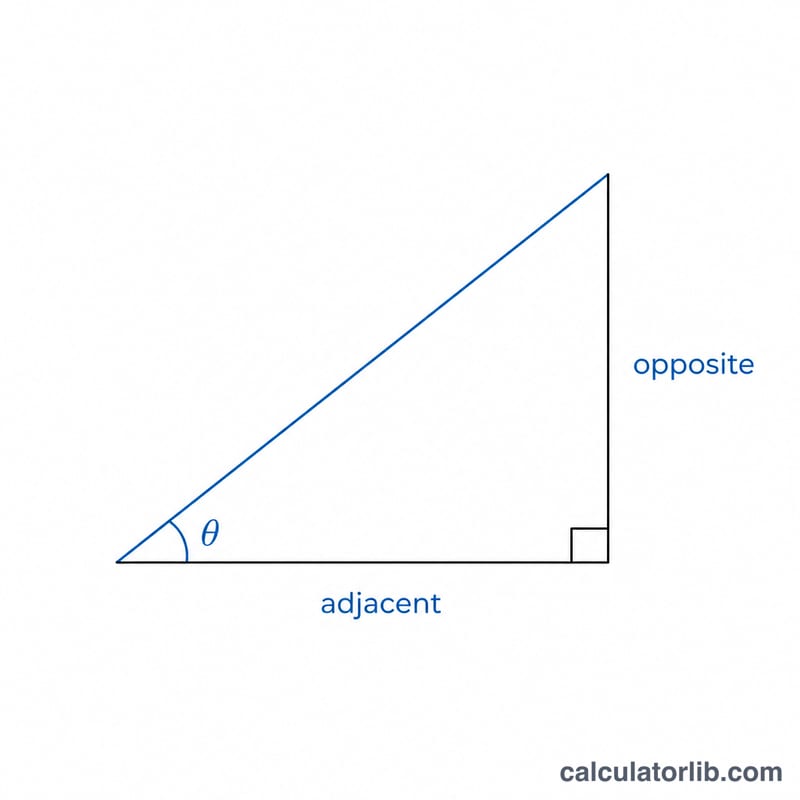
The Theta Calculator finds the angle θ of a right triangle when you know the lengths of its two legs: the opposite side (vertical) and the adjacent side (horizontal). It uses the two-argument arctangent function, atan2, which correctly handles every quadrant — including negative values and the case where the adjacent side is zero (a perfectly vertical line).
How to use it
Enter the length of the opposite side and the adjacent side relative to the angle you want to measure. The calculator returns θ in both degrees and radians, and also reports the hypotenuse so you can verify the triangle. Lengths can be any real numbers; signs let you place the vector in any direction.
The formula explained
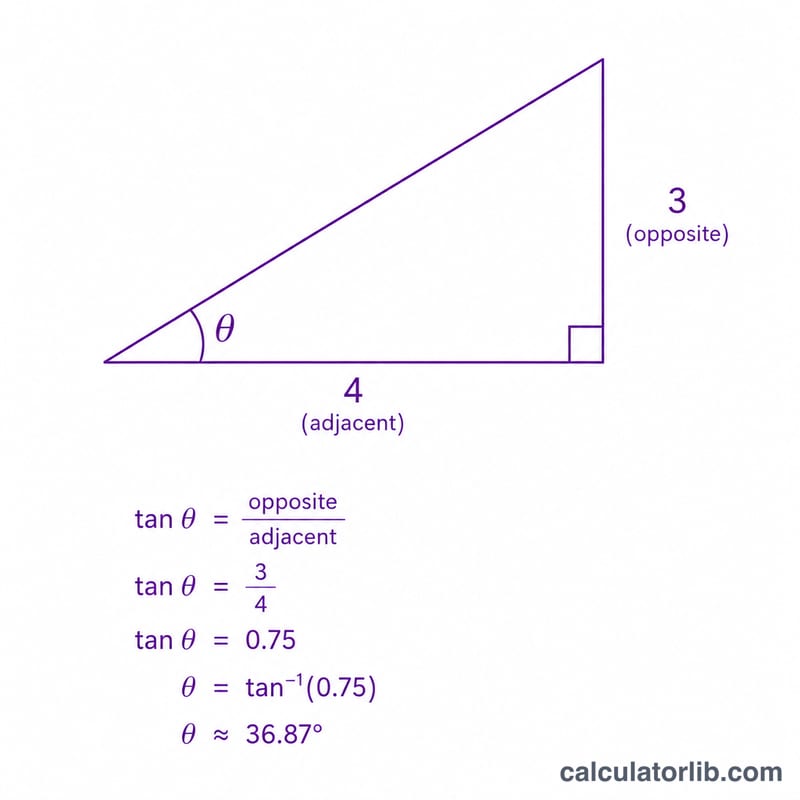
For a right triangle, the tangent of the angle equals the opposite side divided by the adjacent side: \(\tan(\theta) = \frac{\text{opp}}{\text{adj}}\). Taking the inverse gives
$$\theta = \arctan\!\left(\frac{\text{opp}}{\text{adj}}\right)$$We use atan2(opp, adj) instead of plain arctan because it preserves the sign of both inputs, returning angles across the full −180° to 180° range and avoiding division-by-zero when adj = 0. The hypotenuse follows from the Pythagorean theorem:
Worked example
Suppose the opposite side is 3 and the adjacent side is 4. Then
$$\theta = \operatorname{atan2}(3, 4) = 0.6435 \text{ radians} = 36.8699°$$The hypotenuse is
$$h = \sqrt{3^2 + 4^2} = \sqrt{25} = 5$$— the classic 3-4-5 triangle.
FAQ
What is the difference between atan and atan2? atan takes a single ratio and returns angles only between −90° and 90°. atan2 takes the two sides separately, so it knows the quadrant and covers the full circle.
Can the adjacent side be zero? Yes. With adj = 0 and opp > 0, θ = 90°; with opp < 0, θ = −90°. The calculator handles this without error.
How do I convert the result to radians? Multiply degrees by \(\frac{\pi}{180}\), or just read the radian value the calculator already provides.