
What this calculator does
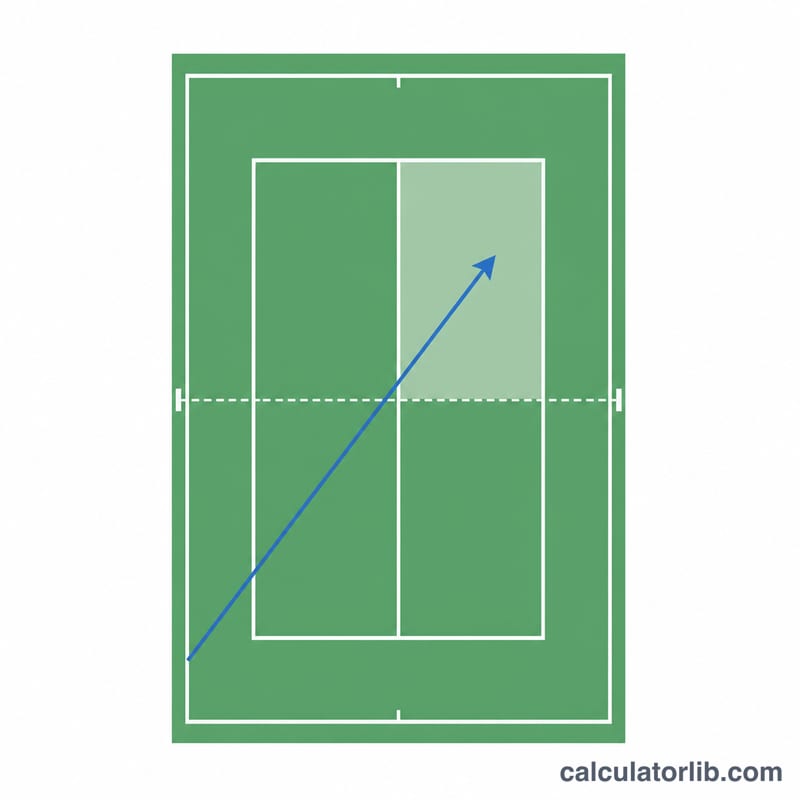
A flat tennis serve is hit with little spin, so over the short, fast serve path gravity drop is small and the ball travels in nearly a straight line from the contact point down into the service box. This calculator answers a precise question: how far above the center of the net can that straight line pass and still have the ball land inside the service box? The result is the allowable vertical aiming window. It uses universal ITF court dimensions and applies to any standard court worldwide.
How to use it
Enter your serve contact height (the height of the ball at racket impact, typically 2.5-3.1 m). Optionally add how far behind the baseline you stand. The net height (0.914 m), net-to-service-line distance (6.40 m) and baseline-to-net distance (11.885 m) are pre-filled with standard values; leave them unless you want to model a different court. The tool reports the window above the net top, in meters and centimeters.
The formula explained
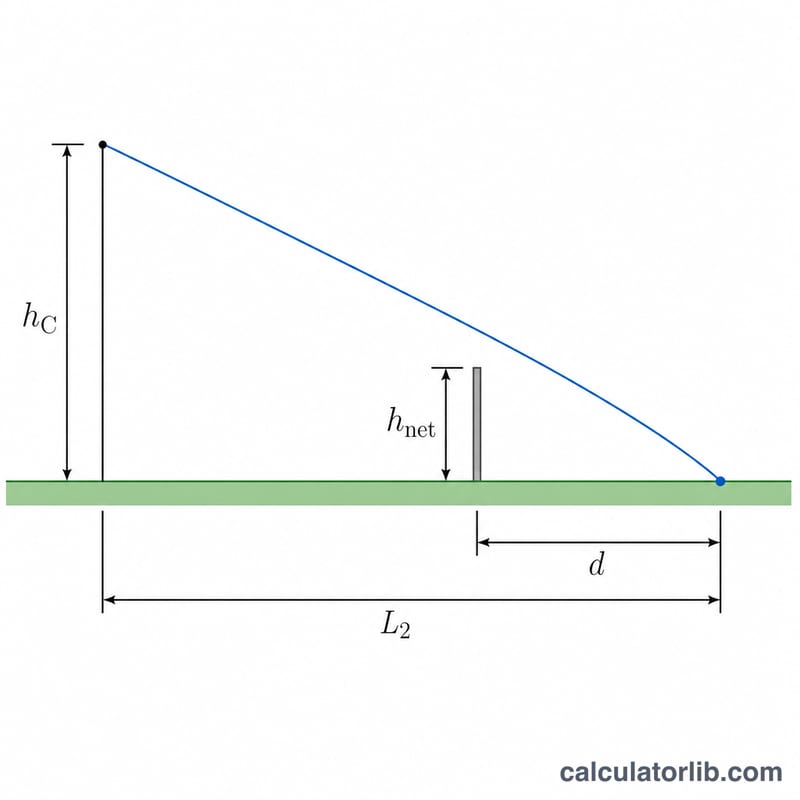
Two straight lines bound the window, both starting at the contact point (height hC). The lower line just grazes the net top — that is the steepest legal line and gives zero clearance above the net. The upper line just lands on the far service line, at horizontal distance L2 = baseline-to-net + net-to-service-line. Its height at the net plane (horizontal distance L1) is hC times (net-to-service-line / L2). Subtracting the net height gives the window:
$$\text{window} = h_C \times \frac{\text{net-to-service-line}}{L_2} - \text{net height}$$
Worked example
With \(h_C = 2.8\) m and standard dimensions, \(L_2 = 11.885 + 6.40 = 18.285\) m. Height at net:
$$2.8 \times \frac{6.40}{18.285} = 0.980 \text{ m}$$
Window:
$$0.980 - 0.914 = 0.066 \text{ m} \approx 6.6 \text{ cm}$$
So the serve must pass through the net plane between 0.914 m and 0.980 m — a very small window, which is why flat serves are so demanding.
FAQ
Why is the window so small? The court is long relative to net height, so the geometry leaves only a few centimeters of margin above the net for a flat serve. Higher contact (taller players, full reach) widens it.
Does this account for gravity? No — the straight-line model ignores gravity drop. Real flat serves drop slightly, making the practical window even smaller, so treat this as an upper bound.
What does a negative result mean? The contact height is too low for a gravity-free straight serve to both clear the net and land in — geometrically impossible, so the calculator reports no valid window.