
What is the Area of an Ellipse?
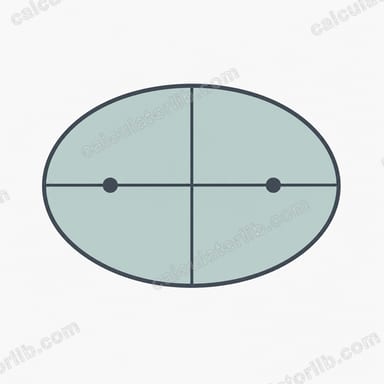
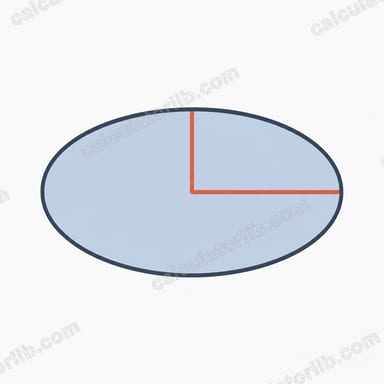
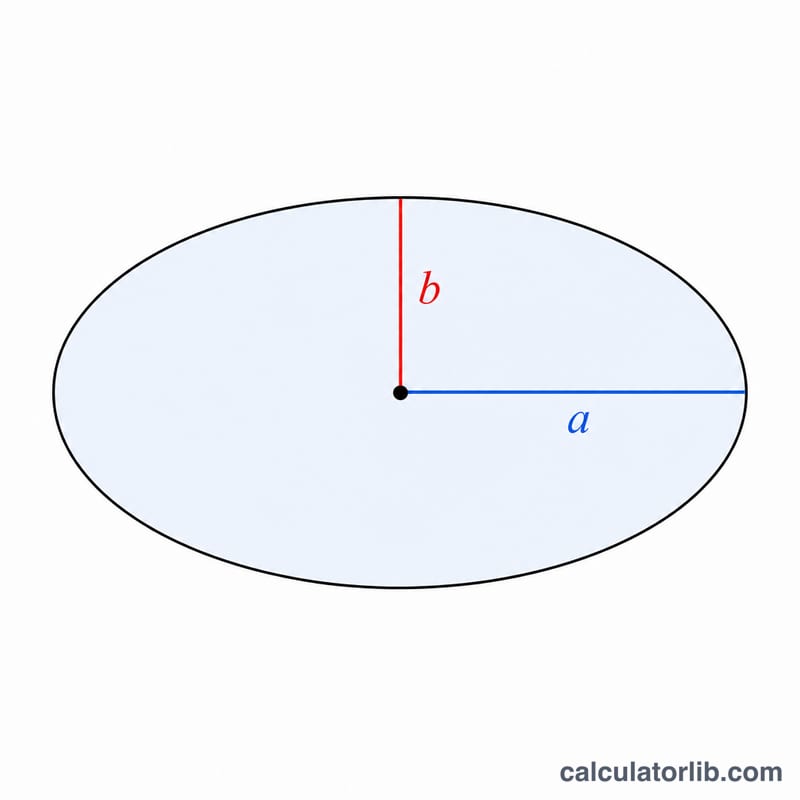
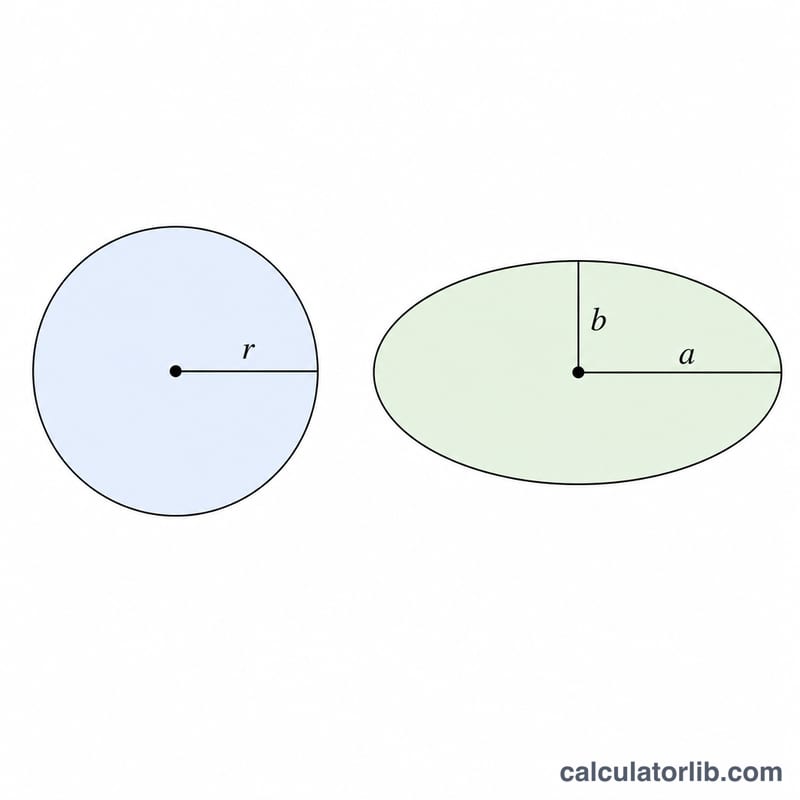
An ellipse is an oval-shaped curve defined by two radii: the semi-major axis a (half the longest diameter) and the semi-minor axis b (half the shortest diameter). The area enclosed by the ellipse is given by the simple, exact formula \(A = \pi \cdot a \cdot b\). When a equals b, the ellipse becomes a circle and the formula reduces to the familiar \(A = \pi r^2\).
How to Use This Calculator
Enter the length of the semi-major axis (a) and the semi-minor axis (b) in any consistent unit — centimetres, metres, inches, etc. The calculator returns the area in square units of whatever unit you used, plus a very accurate approximation of the perimeter. Make sure both values are the half-lengths (radii), not the full diameters.
The Formula Explained
The area formula \(A = \pi \cdot a \cdot b\) multiplies the two semi-axes and the constant \(\pi\) (≈ 3.14159). The perimeter has no simple closed form, so we use Ramanujan's approximation $$P \approx \pi\left[3(a+b) - \sqrt{(3a+b)(a+3b)}\right],$$ which is accurate to better than 0.04% for typical shapes.
Worked Example
Suppose an ellipse has a semi-major axis of 5 and a semi-minor axis of 3. The area is $$A = \pi \times 5 \times 3 = 15\pi \approx 47.12 \text{ square units}.$$ The Ramanujan perimeter is $$\pi\left[3(5+3) - \sqrt{(15+3)(5+9)}\right] = \pi\left[24 - \sqrt{18 \times 14}\right] = \pi\left[24 - \sqrt{252}\right] \approx \pi \times 8.13 \approx 25.53 \text{ units}.$$
FAQ
Do I enter radii or diameters? Enter the semi-axes (radii). If you only have the full diameters, divide each by 2 first.
What units does the result use? The area is in the square of whatever unit you enter; if a and b are in cm, the area is in cm².
Why is the perimeter only approximate? The exact ellipse perimeter requires an elliptic integral with no elementary form, so a high-accuracy approximation is used instead.