What is the centroid of a triangle?
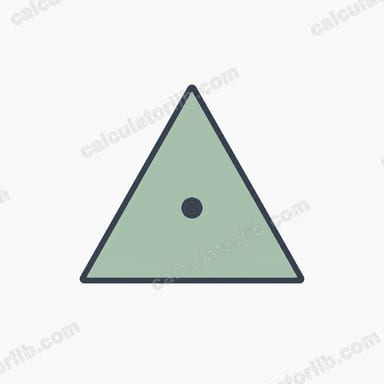
The centroid (often labelled G) is the point where the three medians of a triangle intersect. A median connects a vertex to the midpoint of the opposite side. The centroid is also the triangle's center of mass or balance point: a uniform triangular plate balances perfectly on a pin placed at G. It always lies inside the triangle, and it divides each median in a 2:1 ratio measured from the vertex.

How to use this calculator
Enter the (x, y) coordinates of the three corners — Vertex A, Vertex B and Vertex C — in any order. The calculator returns the centroid coordinates instantly. Coordinates can be negative, decimal, or zero, and the order of the vertices does not affect the result.
The formula explained
The centroid is simply the average of the three vertices:
$$\left( C_x, C_y \right) = \left( \frac{\text{x}_1 + \text{x}_2 + \text{x}_3}{3},\ \frac{\text{y}_1 + \text{y}_2 + \text{y}_3}{3} \right)$$You add the three x-values and divide by 3 to get the centroid's x-coordinate, then do the same for the y-values. No square roots or trigonometry are required.

Worked example
Take a triangle with vertices A(0, 0), B(6, 0) and C(3, 6).
$$G_x = \frac{0 + 6 + 3}{3} = \frac{9}{3} = 3$$$$G_y = \frac{0 + 0 + 6}{3} = \frac{6}{3} = 2$$So the centroid is at \((3, 2)\).
More Centroid Examples with Negative and Decimal Coordinates
The centroid is the average of the three vertex coordinates: \(C_x = \frac{x_1+x_2+x_3}{3}\) and \(C_y = \frac{y_1+y_2+y_3}{3}\). Negative and decimal values work the same way. Just keep the signs and decimals carefully when adding.
Example 1: Negative coordinates
Triangle with A(−4, 2), B(2, −6), C(5, 7).
- Sum the x-values: \(-4 + 2 + 5 = 3\)
- Divide by 3: \(C_x = \frac{3}{3} = \) 1
- Sum the y-values: \(2 + (-6) + 7 = 3\)
- Divide by 3: \(C_y = \frac{3}{3} = 1\)
The centroid is G = (1, 1).
Example 2: Decimal coordinates
Triangle with A(1.5, 2.5), B(4.5, 0.5), C(3, 6).
- Sum the x-values: \(1.5 + 4.5 + 3 = 9\)
- Divide by 3: \(C_x = \frac{9}{3} = \) 3
- Sum the y-values: \(2.5 + 0.5 + 6 = 9\)
- Divide by 3: \(C_y = \frac{9}{3} = 3\)
The centroid is G = (3, 3).
Interpreting the Centroid Result
- Center of mass: G is the balance point of a uniform, thin triangular plate. The plate would balance on a pin placed at G.
- Median ratio 2:1: Each median joins a vertex to the midpoint of the opposite side. G divides every median in a 2:1 ratio measured from the vertex, so it lies two-thirds of the way from each vertex to the opposite midpoint.
- Always inside: For any non-degenerate triangle (acute, right or obtuse) the centroid lies inside the triangle.
- Equal areas: Joining G to the three vertices splits the triangle into three smaller triangles of equal area, each one third of the total.
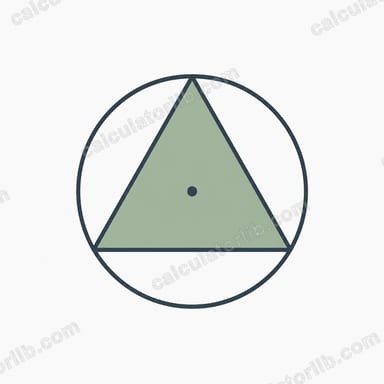
- Equilateral triangles: The centroid coincides with the circumcenter, incenter and orthocenter. For other triangles these points generally differ.
- Translation and scaling: If you shift every vertex by (a, b), the centroid shifts by the same (a, b). If you scale all coordinates by a factor k about the origin, the centroid coordinates are multiplied by k as well.
Quick sanity check: the centroid's x must lie between the smallest and largest vertex x-values, and its y between the smallest and largest vertex y-values (the bounding box). For A(−4, 2), B(2, −6), C(5, 7), the box is x from −4 to 5 and y from −6 to 7, and G = (1, 1) falls inside it. If your result falls outside the box, recheck your signs and sums.
FAQ
Is the centroid the same as the circumcenter or incenter? No. The centroid is the average of the vertices. The circumcenter (center of the circumscribed circle) and incenter (center of the inscribed circle) are generally different points unless the triangle is equilateral.
Can the centroid lie outside the triangle? Never — the centroid of any triangle always lies inside it.
Does the order I enter the vertices matter? No. Because addition is commutative, swapping the vertices gives the same centroid.