What is the Swim Pace Calculator?
The Swim Pace Calculator turns a swim distance and the time it took into a clear, comparable pace — most commonly expressed as minutes and seconds per 100 meters. Pace per 100m is the universal yardstick swimmers use to gauge effort, plan sets, and compare performances across different distances. This tool also reports your pace per 50m and your average speed in meters per second and kilometers per hour.
How to use it
Enter the total distance you swam in meters, then enter the total time as hours, minutes, and seconds. Click calculate to see your pace per 100m, pace per 50m, and speed. For example, a 1500 m swim in 25 minutes gives a steady, comparable per-100 pace you can target in training.
The formula explained
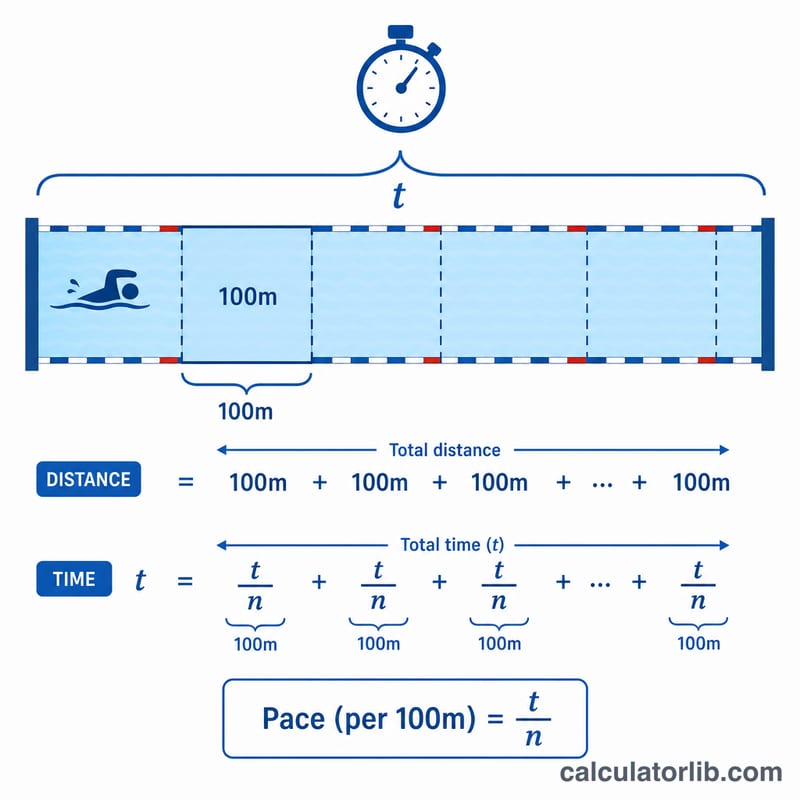
The calculation is simple division. Total time is converted entirely into seconds, then divided by the number of 100-meter segments in the distance: $$\text{pace}_{100} = \dfrac{\text{total time}}{\text{distance}/100}$$ Speed is distance divided by total time, \(v = \dfrac{D}{T}\). Multiplying meters per second by 3.6 converts to kilometers per hour.
Worked example
Swim: 1500 m in 25:00 (1500 seconds). Segments = \(1500 \div 100 = 15\). Pace per 100 = \(1500 \div 15 = 100\) seconds = 1:40 per 100m. Speed = \(1500 \div 1500 = 1.0\) m/s = 3.6 km/h.
Typical Swim Pace per 100m by Level
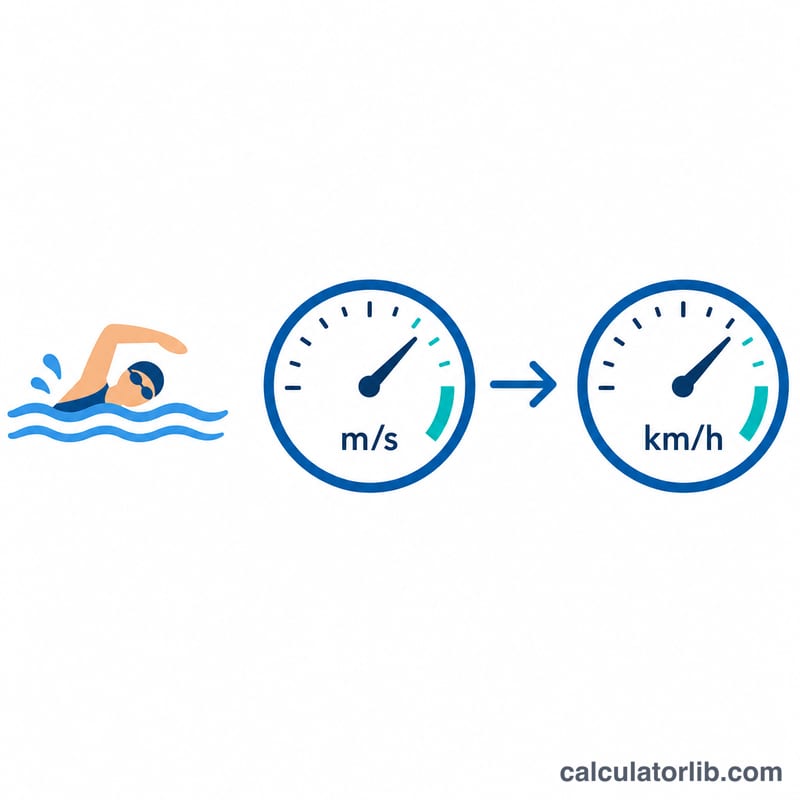
The bands below are general, approximate ranges used for orientation only. They are not official standards, and individual swimmers vary widely with stroke, age, pool length, turns, and conditions. Speed is calculated as \(v = 100 / \text{pace in seconds}\) in m/s, and km/h = m/s × 3.6.
| Level | Approx. pace per 100m | Speed (m/s) | Speed (km/h) |
|---|---|---|---|
| Beginner | 2:30 or slower | 0.67 or less | 2.4 or less |
| Recreational | 2:00 – 2:30 | 0.67 – 0.83 | 2.4 – 3.0 |
| Intermediate | 1:40 – 2:00 | 0.83 – 1.00 | 3.0 – 3.6 |
| Advanced | 1:20 – 1:40 | 1.00 – 1.25 | 3.6 – 4.5 |
| Competitive | Faster than 1:20 | Above 1.25 | Above 4.5 |
These ranges are general information only and are not personal advice or a prediction of your own ability.
Pace Comparison Across Common Swim Distances
Total time = pace per 100m × distance / 100. For example, 1:30 per 100m (90 s) over 1500m: \(90 \times 1500 / 100 = 1350\) s = 22:30. The Ironman swim is 3.8 km (3800m).
| Pace per 100m | Speed (m/s) | 400m | 800m | 1500m | 3.8 km (Ironman) |
|---|---|---|---|---|---|
| 1:20 | 1.25 | 5:20 | 10:40 | 20:00 | 50:40 |
| 1:30 | 1.11 | 6:00 | 12:00 | 22:30 | 57:00 |
| 1:40 | 1.00 | 6:40 | 13:20 | 25:00 | 1:03:20 |
| 2:00 | 0.83 | 8:00 | 16:00 | 30:00 | 1:16:00 |
| 2:30 | 0.67 | 10:00 | 20:00 | 37:30 | 1:35:00 |
Times are for continuous swimming at a constant pace; real races include turns, starts, sighting, and open-water conditions that change the result.
Pace per 100m to Speed Conversion
| Pace per 100m | Pace per 50m | Speed (m/s) | Speed (km/h) |
|---|---|---|---|
| 1:15 | 0:37.5 | 1.33 | 4.80 |
| 1:30 | 0:45 | 1.11 | 4.00 |
| 1:45 | 0:52.5 | 0.95 | 3.43 |
| 2:00 | 1:00 | 0.83 | 3.00 |
| 2:15 | 1:07.5 | 0.74 | 2.67 |
| 2:30 | 1:15 | 0.67 | 2.40 |
Yards conversion
Since 100 yards = 91.44 m, a pace per 100 yd is shorter than the pace per 100 m for the same speed:
$$\text{Pace}_{100\,\text{yd}} = \text{Pace}_{100\,\text{m}} \times 0.9144$$
Example: 1:40 per 100m = 100 s, and \(100 \times 0.9144 = 91.44\) s, about 1:31.4 per 100 yd. To go the other way, divide by 0.9144: 1:30 per 100 yd = 90 s, and \(90 / 0.9144 \approx 98.4\) s, about 1:38.4 per 100m.
FAQ
Why per 100 meters? It is the standard reference distance in pool swimming, making paces easy to compare regardless of total distance.
Does it work in yards? The tool assumes meters. If you swam in yards, enter the yard distance and treat the pace as "per 100 yards" — just keep your units consistent.
What is a good pace? It varies widely. Beginners may swim around 2:30/100m, while competitive swimmers hold 1:20/100m or faster over distance.