
What is the HEART Score?
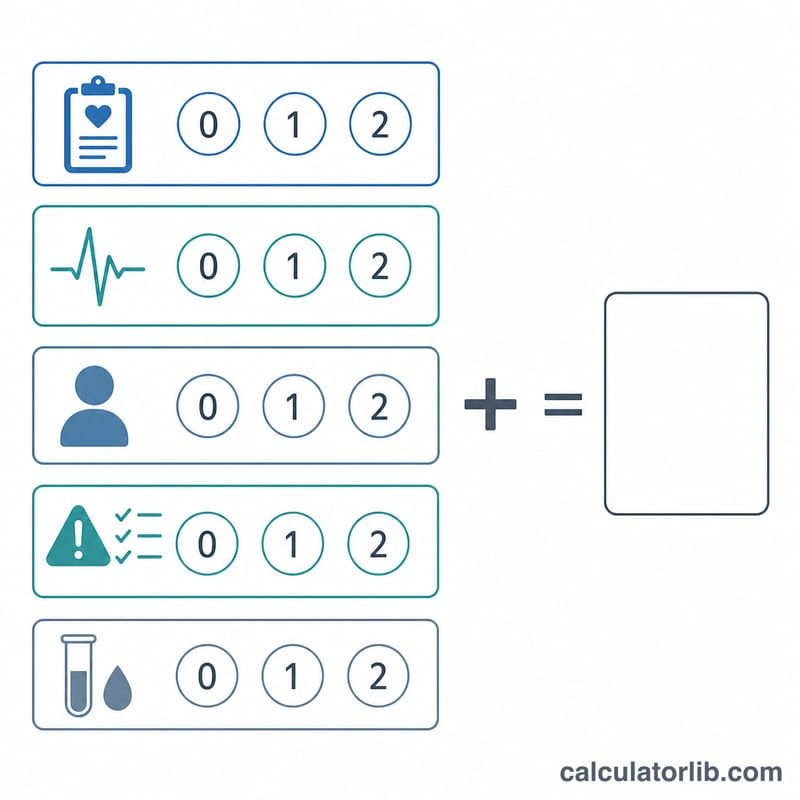
The HEART Score is a clinical decision tool used in emergency departments worldwide to estimate the short-term risk of a major adverse cardiac event (MACE) in patients presenting with chest pain. HEART is an acronym for its five components: History, ECG, Age, Risk factors and Troponin. Each item is scored 0, 1 or 2, producing a total between 0 and 10 that maps to a low, moderate or high risk category.
How to use this calculator
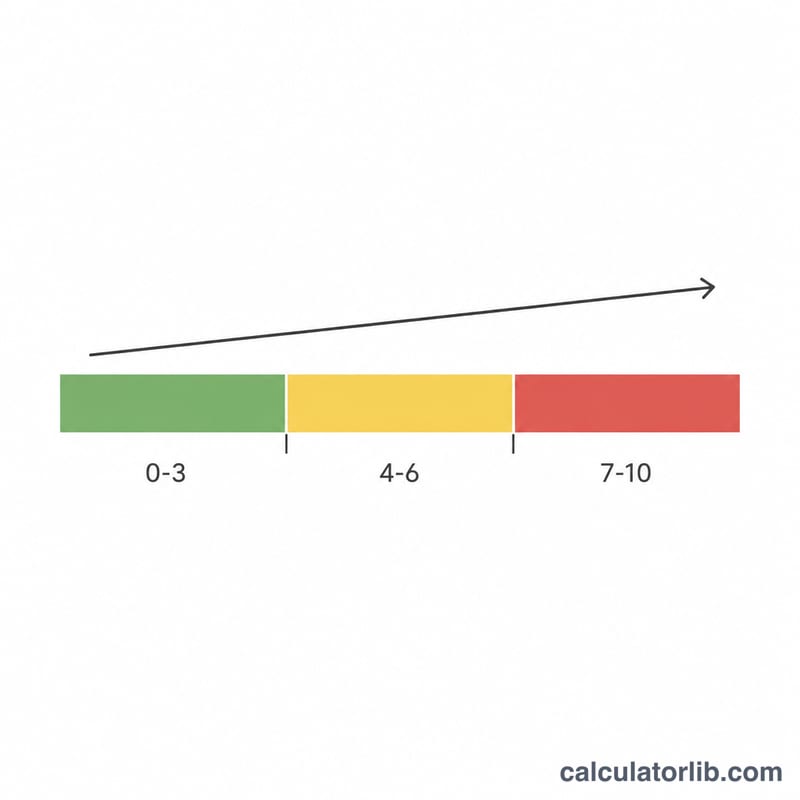
Select the option that best describes your patient for each of the five categories. The calculator adds the points and reports the total score plus the approximate 6-week MACE risk. As a guide: 0–3 is low risk (~1–2% MACE, often suitable for discharge), 4–6 is moderate risk (~12–17%, observation/admission), and 7–10 is high risk (~50–65%, early invasive management). Always combine the score with clinical judgment and local protocols.
The formula explained
The score is a simple sum:
$$\text{Score} = \text{History}\,(0\text{-}2) + \text{ECG}\,(0\text{-}2) + \text{Age}\,(0\text{-}2) + \text{Risk factors}\,(0\text{-}2) + \text{Troponin}\,(0\text{-}2)$$There is no weighting — each component contributes equally, and the maximum possible value is 10.
Worked example
A 58-year-old (Age = 1) with a moderately suspicious history (History = 1), non-specific ECG repolarization changes (ECG = 1), two cardiovascular risk factors (Risk = 1) and a normal troponin (Troponin = 0) scores
$$1 + 1 + 1 + 1 + 0 = 4$$placing them in the moderate-risk band.
FAQ
Is the HEART Score a diagnosis? No. It estimates risk and supports disposition decisions; it does not diagnose acute coronary syndrome.
What troponin value should I use? Use the initial troponin relative to your assay's normal upper limit.
Can a low score rule out cardiac events? A low score indicates low risk but never zero risk; clinical correlation is essential.