
What Is Glycemic Load?
The glycemic load (GL) estimates how much a typical serving of food will raise your blood glucose. While the glycemic index (GI) ranks a carbohydrate's quality on a 0–100 scale, it ignores how much you actually eat. Glycemic load combines both quality (GI) and quantity (grams of available carbohydrate), giving a more practical picture of a food's real-world impact on blood sugar.
How to Use the Calculator
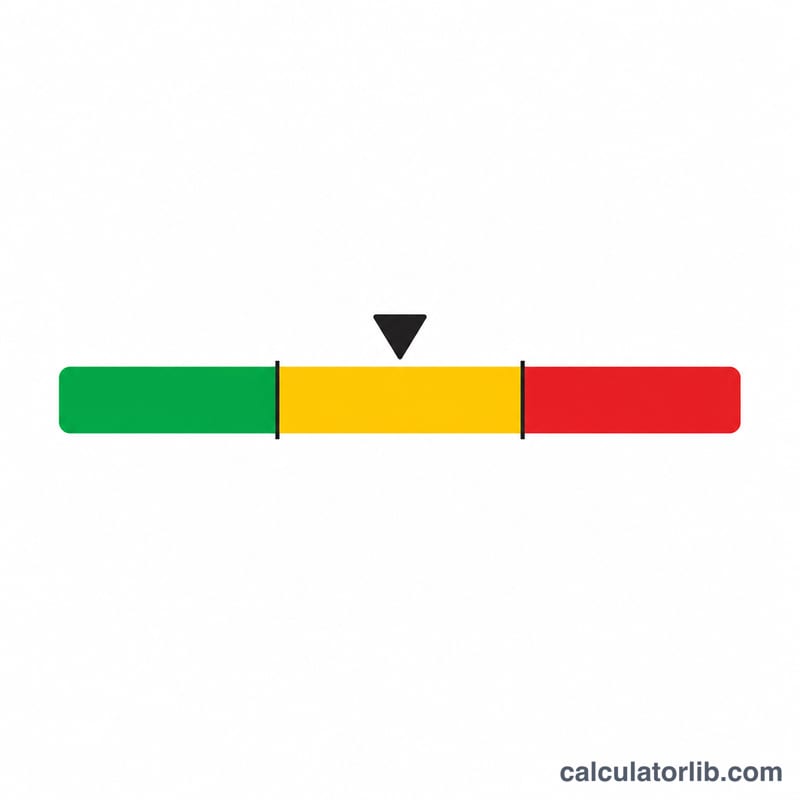
Enter the food's glycemic index (look it up from a GI table — for example, white bread ≈ 75) and the available carbohydrate content of the serving you plan to eat (total carbs minus fiber, in grams). The calculator returns the glycemic load and classifies it as low, medium, or high.
The Formula Explained
The equation is simple:
$$\text{GL} = \frac{\text{GI} \times \text{available carbs (g)}}{100}$$
Dividing by 100 scales the GI percentage against the carbohydrate amount. A GL of 10 or less is considered low, 11–19 medium, and 20 or more high.
Worked Example
Suppose a serving of food has a glycemic index of 70 and contains 40 g of available carbohydrate. The glycemic load is $$\frac{70 \times 40}{100} = \textbf{28},$$ which falls in the "high" category — likely to cause a notable blood-sugar spike.
FAQ
What are "available carbs"? These are the carbohydrates your body can digest into glucose — typically total carbohydrate minus dietary fiber (and sometimes minus sugar alcohols).
Is a low GL always better? Lower-GL meals tend to produce steadier blood sugar, which is helpful for diabetes management and sustained energy, but overall diet quality and portion size still matter.
How does GL differ from GI? GI rates carbohydrate quality regardless of amount; GL accounts for both the quality and the actual quantity in a serving, so it better reflects what happens when you eat.