
What Is Glycemic Load?
Glycemic load (GL) estimates how much a typical serving of a food will raise your blood sugar. While the glycemic index (GI) ranks how quickly the carbohydrate in a food is digested, it ignores how much carbohydrate you actually eat. Glycemic load combines both — quality (GI) and quantity (carbs per serving) — giving a more practical picture of a food's real impact.
How to Use This Calculator
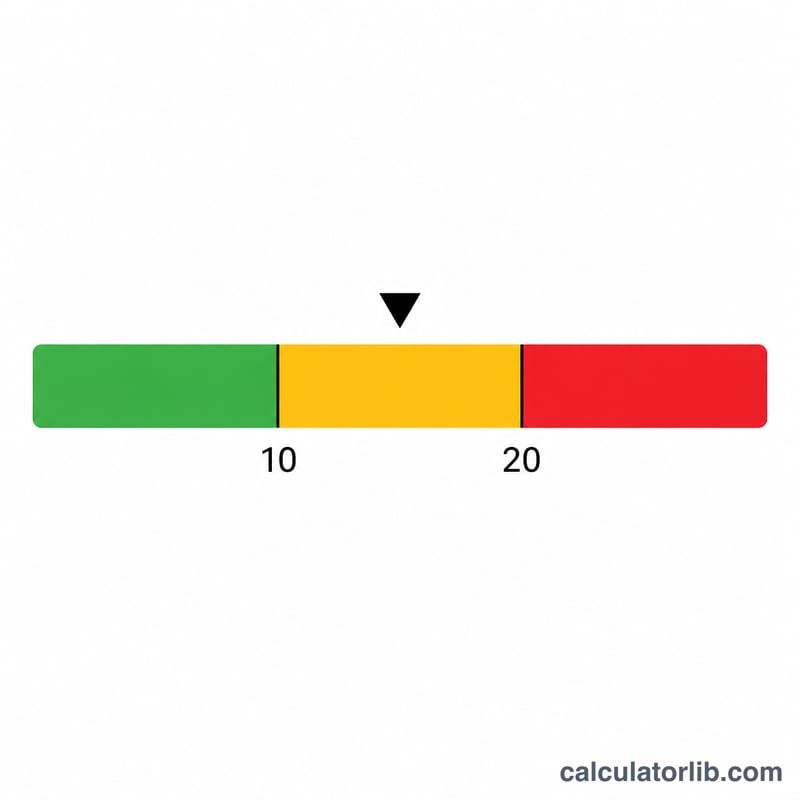
Enter the food's glycemic index (a value from 0 to 100, typically found in published GI tables) and the grams of available carbohydrate in one serving. The calculator multiplies them and divides by 100 to return the glycemic load for that serving, then classifies it as low, medium, or high.
The Formula Explained
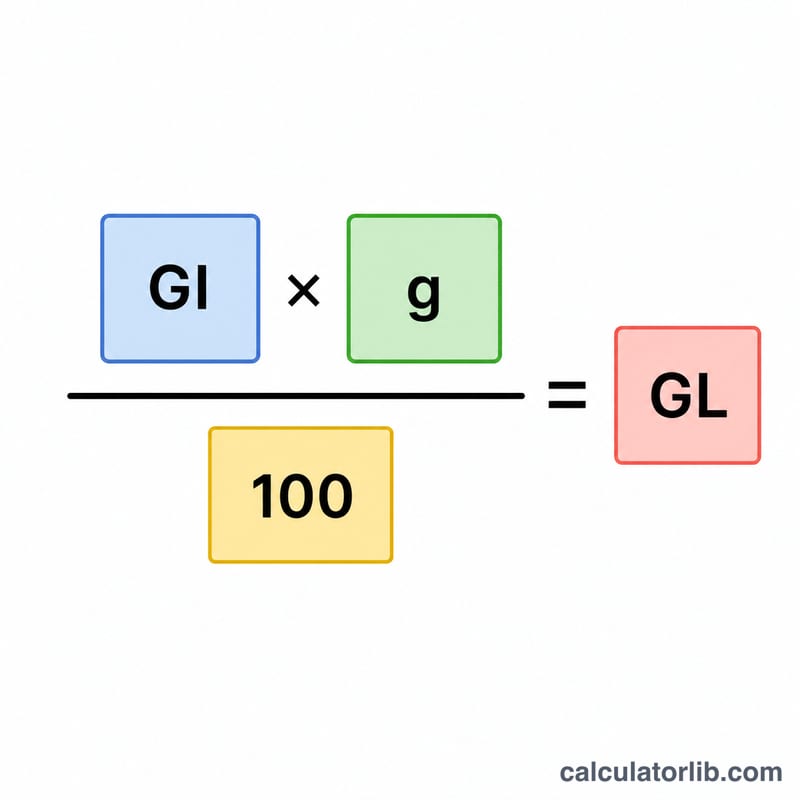
The equation is $$\text{GL} = \frac{\text{GI} \times \text{Carbs (g)}}{100}$$ Dividing by 100 scales the GI (a percentage-style index relative to pure glucose) so the result reflects the actual carbohydrate dose. Interpretation: a GL under 10 is low, 10–19 is medium, and 20 or above is high. Daily totals below about 100 are generally considered low.
Worked Example
A medium apple has a GI of about 38 and contains roughly 25 g of carbohydrate. $$\text{GL} = \frac{38 \times 25}{100} = \frac{950}{100} = \mathbf{9.5}$$ which is a low glycemic load. By contrast, a baked potato (GI 85, 30 g carbs) gives \(\frac{85 \times 30}{100} = 25.5\) — a high glycemic load.
FAQ
Is GL better than GI? For everyday eating, GL is more useful because it accounts for portion size, not just carbohydrate type.
What counts as carbohydrate here? Use available (digestible) carbohydrate — total carbs minus fibre — if your data source lists it that way.
Can I add up GL across a meal? Yes. Sum the GL of each food to estimate the meal's total glycemic load.