
What Is the LDL Cholesterol Calculator?
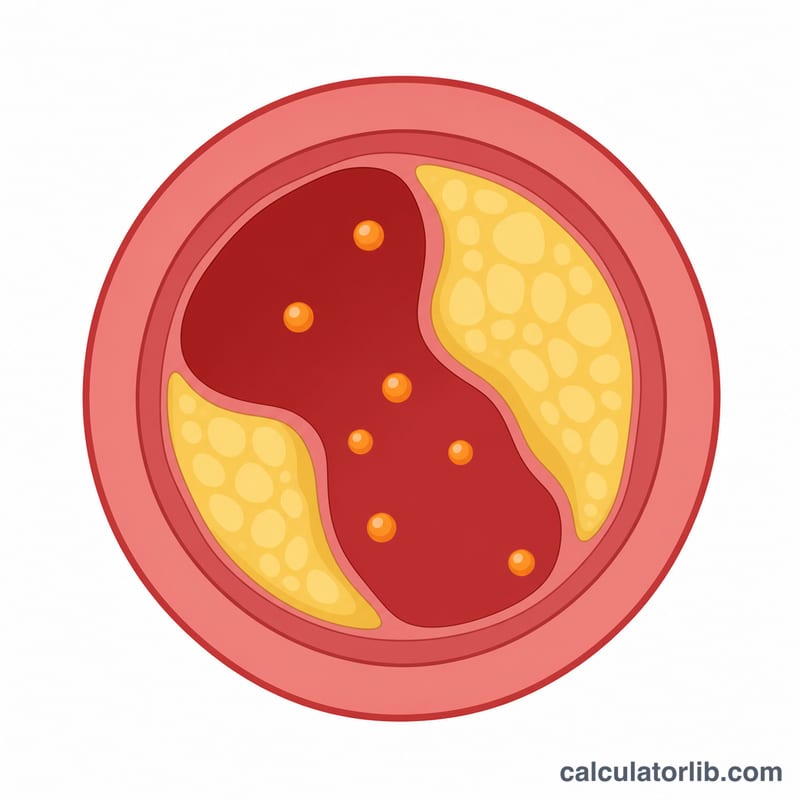
This calculator estimates your LDL ("bad") cholesterol using the Friedewald equation, the most widely used formula for deriving LDL from a standard lipid panel. Instead of measuring LDL directly, most labs estimate it from total cholesterol (TC), HDL cholesterol, and triglycerides (TG). This tool is informational and not a substitute for medical advice.
How to Use It
Select your unit system (mg/dL is common in the US; mmol/L is common in most other countries). Enter your total cholesterol, HDL, and triglyceride values from a fasting lipid panel, then read your estimated LDL plus your non-HDL cholesterol.
The Formula Explained
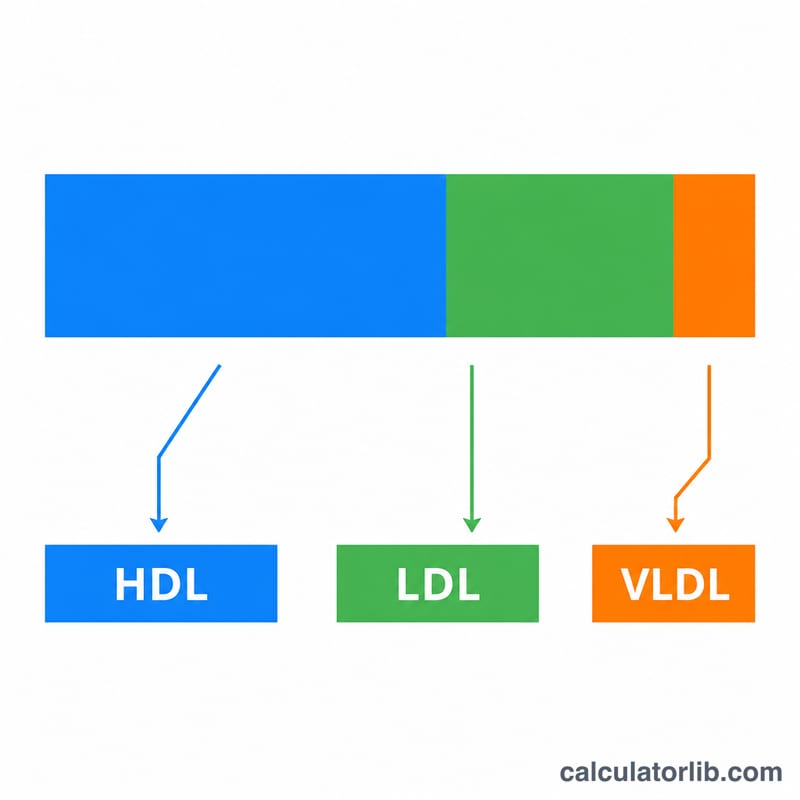
In mg/dL: $$\text{LDL} = \text{TC} - \text{HDL} - \frac{\text{TG}}{5}$$ The TG ÷ 5 term estimates VLDL cholesterol. In mmol/L the divisor changes to 2.2: $$\text{LDL} = \text{TC} - \text{HDL} - \frac{\text{TG}}{2.2}$$ The equation becomes inaccurate when triglycerides exceed 400 mg/dL (about 4.5 mmol/L), in which case a direct LDL measurement is recommended.
Worked Example
With TC = 200, HDL = 50, and TG = 150 mg/dL: $$\text{LDL} = 200 - 50 - \frac{150}{5} = 200 - 50 - 30 = \mathbf{120 \text{ mg/dL}}$$ Non-HDL cholesterol = \(200 - 50 = 150\) mg/dL.
FAQ
Is this accurate? The Friedewald estimate is reliable for fasting samples with triglycerides under 400 mg/dL; outside that range it underestimates LDL.
What is non-HDL cholesterol? It is total cholesterol minus HDL and captures all atherogenic particles — often a better risk marker than LDL alone.
What is a healthy LDL? Generally below 100 mg/dL (2.6 mmol/L) is considered optimal, but targets depend on your overall cardiovascular risk. Consult your doctor.