
What Is the Cholesterol Ratio?
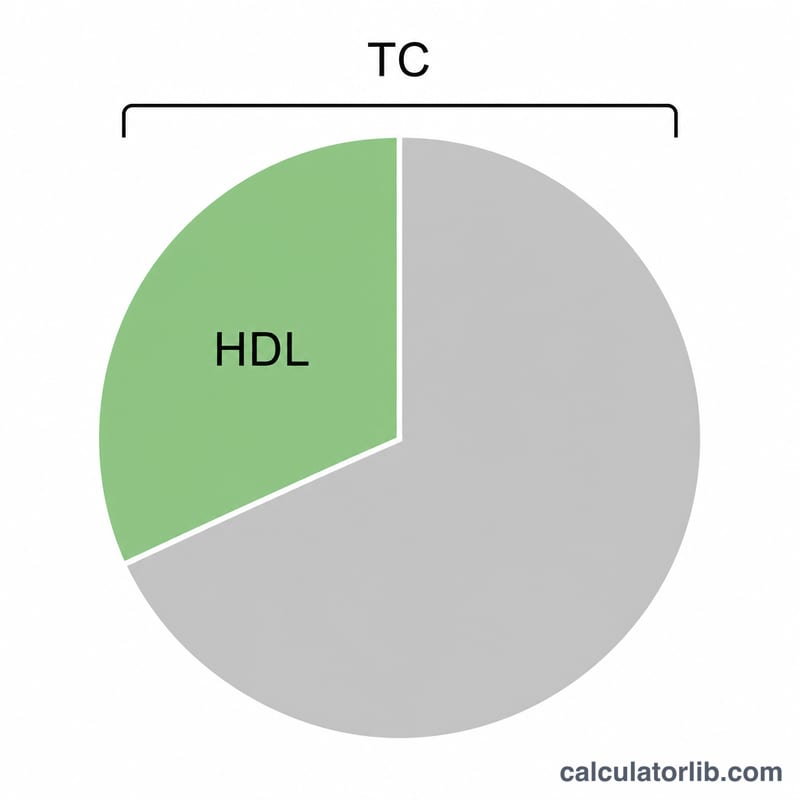
The cholesterol ratio is a simple measure used to gauge cardiovascular health. It compares your total cholesterol to your HDL ("good") cholesterol. While total cholesterol alone tells part of the story, the ratio gives a clearer picture of how much of your cholesterol is protective HDL versus the rest. A lower ratio is associated with a lower risk of heart disease.
How to Use This Calculator
Enter your total cholesterol and your HDL cholesterol, both in mg/dL (the standard US lab unit). The calculator returns your total-cholesterol-to-HDL ratio (written as X:1) and your HDL as a percentage of total cholesterol. These values appear directly on most blood lipid panel reports.
The Formula Explained
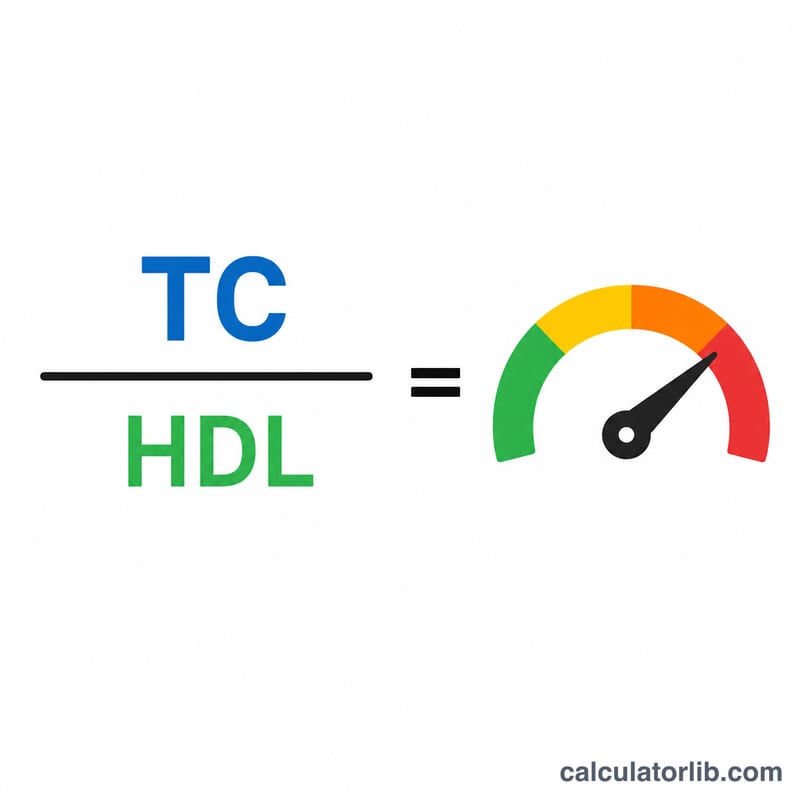
The primary calculation is simply:
$$\text{TC/HDL Ratio} = \frac{\text{Total Cholesterol}}{\text{HDL}}$$
The secondary figure expresses the inverse as a percentage:
$$\text{HDL \%} = \frac{\text{HDL}}{\text{Total Cholesterol}} \times 100$$
Many clinicians consider a ratio under 5:1 acceptable, under 3.5:1 ideal, and a ratio of 2:1 or lower as optimal.
Worked Example
Suppose your total cholesterol is 200 mg/dL and your HDL is 50 mg/dL. The ratio is \(200 \div 50 = 4.0\), so your TC/HDL ratio is 4.0:1. Your HDL percentage is \((50 \div 200) \times 100 = 25\%\). This is in the acceptable range but improving HDL would lower the ratio.
FAQ
Is a lower or higher cholesterol ratio better? Lower is better. A lower ratio means a larger share of protective HDL relative to total cholesterol.
What is a good cholesterol ratio? Generally below 5:1 is acceptable and below 3.5:1 is considered ideal, though targets depend on your overall risk profile.
Does this replace medical advice? No. This tool is for educational purposes. Discuss your lipid results with a healthcare professional.