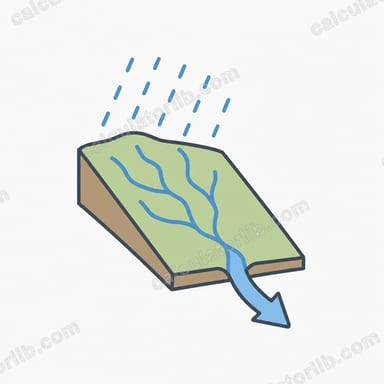

What Is the Rational Method?
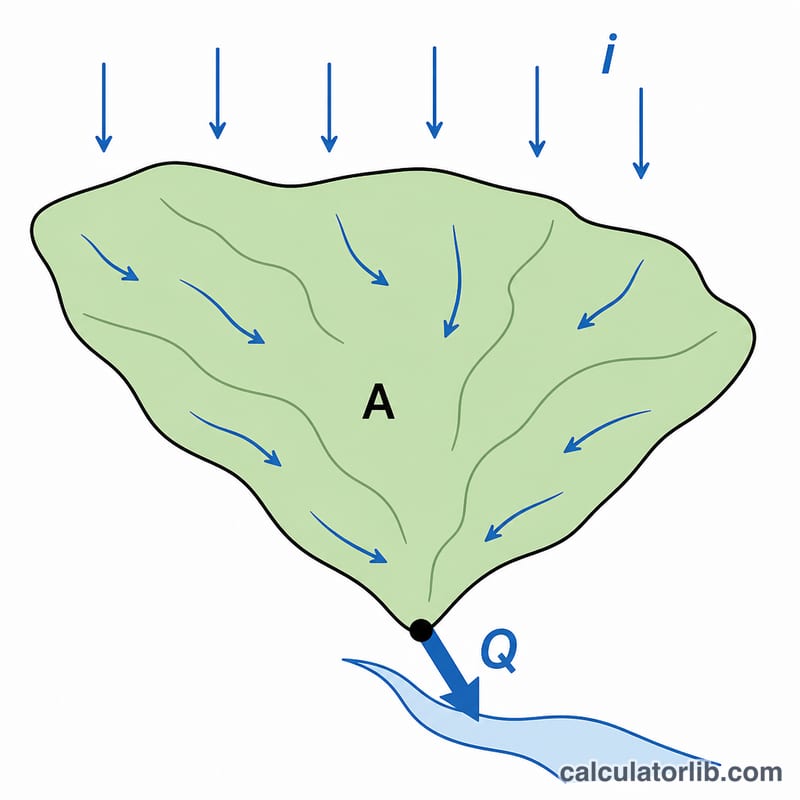
The Rational Method is the most widely used technique in civil and stormwater engineering for estimating the peak runoff rate from a small drainage area (generally under 200 acres / 80 hectares). It relates the peak discharge Q to three quantities: the dimensionless runoff coefficient C, the rainfall intensity i, and the catchment area A, through the simple relationship \(Q = C \cdot i \cdot A\).
How to Use the Calculator
Choose your unit system, then enter the three inputs. In US units, i is in inches per hour and A in acres, which conveniently yields Q in cubic feet per second (cfs) because the conversion factor is approximately 1.008. In SI units, i is in millimetres per hour and A in hectares, and the result is divided by 360 to give Q in cubic metres per second.
The Formula Explained
The runoff coefficient C represents the fraction of rainfall that becomes surface runoff: roughly 0.10–0.30 for lawns and parks, 0.40–0.60 for residential areas, and 0.70–0.95 for paved or commercial surfaces. Rainfall intensity i is taken from an IDF (Intensity–Duration–Frequency) curve for the design storm, using a duration equal to the time of concentration. Multiplying these by the area gives the instantaneous peak flow.
$$Q = \text{C} \times \text{i (in/hr)} \times \text{A (acres)}$$$$Q = \frac{\text{C} \times \text{i (mm/hr)} \times \text{A (ha)}}{360}$$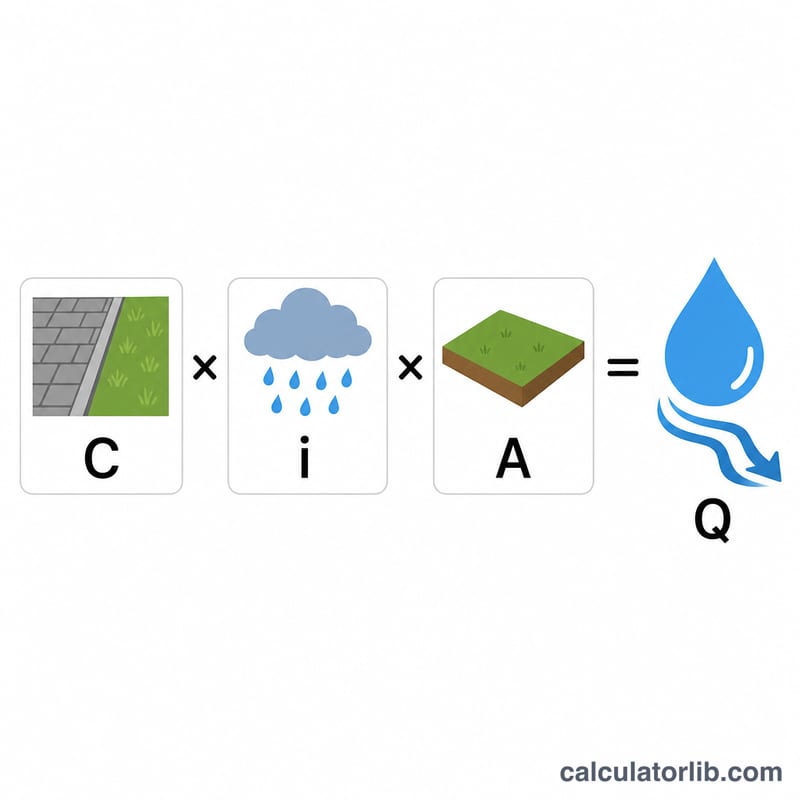
Worked Example
A 5-acre commercial site has C = 0.70 and a design rainfall intensity of 2.5 in/hr. Then $$Q = 0.70 \times 2.5 \times 5 = 8.75 \text{ cfs}.$$ In SI, a 5-hectare site with C = 0.70 and i = 60 mm/hr gives $$Q = \frac{0.70 \times 60 \times 5}{360} = 0.583 \text{ m}^3/\text{s}.$$
FAQ
What size area is the Rational Method valid for? It is best suited to small, fairly uniform catchments — typically less than 200 acres. Larger or complex watersheds should use hydrograph methods like SCS/NRCS.
Why is the US factor ignored? The exact factor (\(1 \text{ acre} \cdot \text{in/hr} = 1.008 \text{ cfs}\)) is so close to unity that engineers treat it as 1, which this tool follows.
How do I pick the rainfall intensity? Use a local IDF curve for the chosen return period (e.g., 10-year storm) and a storm duration equal to the time of concentration of the watershed.