
What is the LM317 Resistor Calculator?
The LM317 is one of the most popular adjustable linear voltage regulators. Its output voltage is set by two external resistors, R1 and R2, that form a feedback divider. This calculator finds the regulated output voltage (Vout) for any pair of resistors, letting you design a power supply rail without trial and error.
How to use it
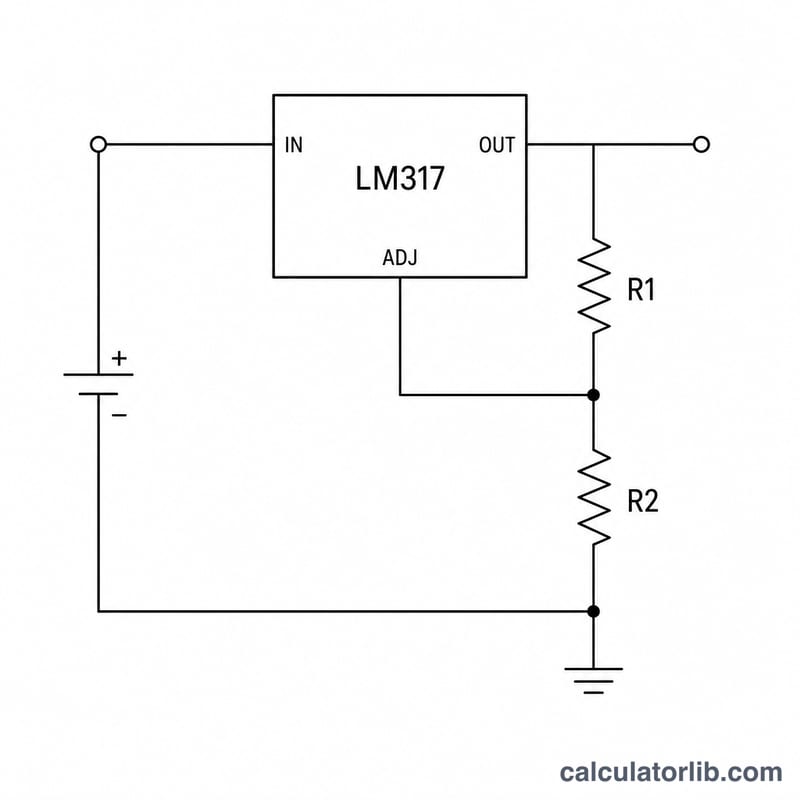
Enter R1 (the resistor between the output and the adjust pin), R2 (the resistor between the adjust pin and ground), the reference voltage (1.25 V for a standard LM317), and the adjustment pin current Iadj in microamps (typically about 50 µA). The calculator returns the output voltage and the R2/R1 ratio. Manufacturers usually recommend R1 = 240 Ω so that the minimum load current keeps the regulator stable.
The formula explained
The output voltage is:
$$V_{out} = \text{V}_{ref} \left(1 + \frac{\text{R2}}{\text{R1}}\right) + \text{I}_{adj} \cdot \text{R2}$$
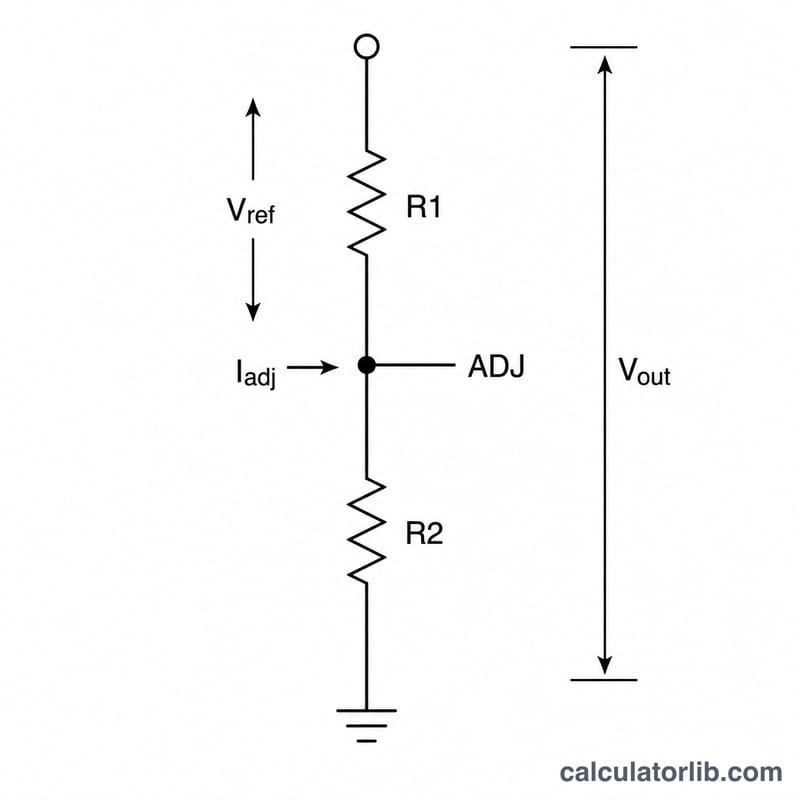
Vref is the fixed reference between the output and adjust pins (1.25 V nominal). The term \(\text{V}_{ref}\left(1 + \frac{\text{R2}}{\text{R1}}\right)\) is the main divider contribution, while \(\text{I}_{adj} \cdot \text{R2}\) is a small correction from the current flowing out of the adjust pin. Because Iadj is tiny (≈50 µA), this last term is often negligible but matters for high-precision designs.
Worked example
With R1 = 240 Ω, R2 = 1000 Ω, Vref = 1.25 V, and Iadj = 50 µA: $$V_{out} = 1.25 \times \left(1 + \frac{1000}{240}\right) + 0.00005 \times 1000 = 1.25 \times 5.1667 + 0.05 = 6.4583 + 0.05 = \mathbf{6.508\ \text{V}}$$
FAQ
Why is R1 usually 240 ohms? It provides enough minimum load current (about 5 mA) so the regulator maintains regulation even with no external load.
Can I ignore Iadj? For most hobby projects yes, since it adds only millivolts. Set it to 0 if you want the simplified formula.
What is the maximum output? The LM317 output is limited by the input voltage minus its dropout (~3 V) and the device's rated maximum (typically 37 V).