
What Is an Op-Amp Gain Calculator?
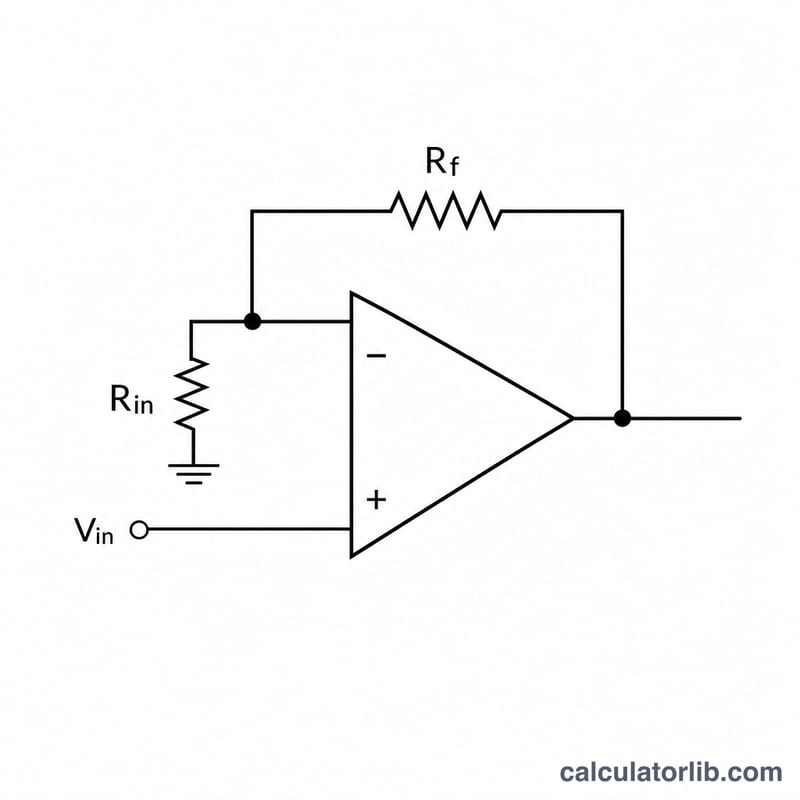
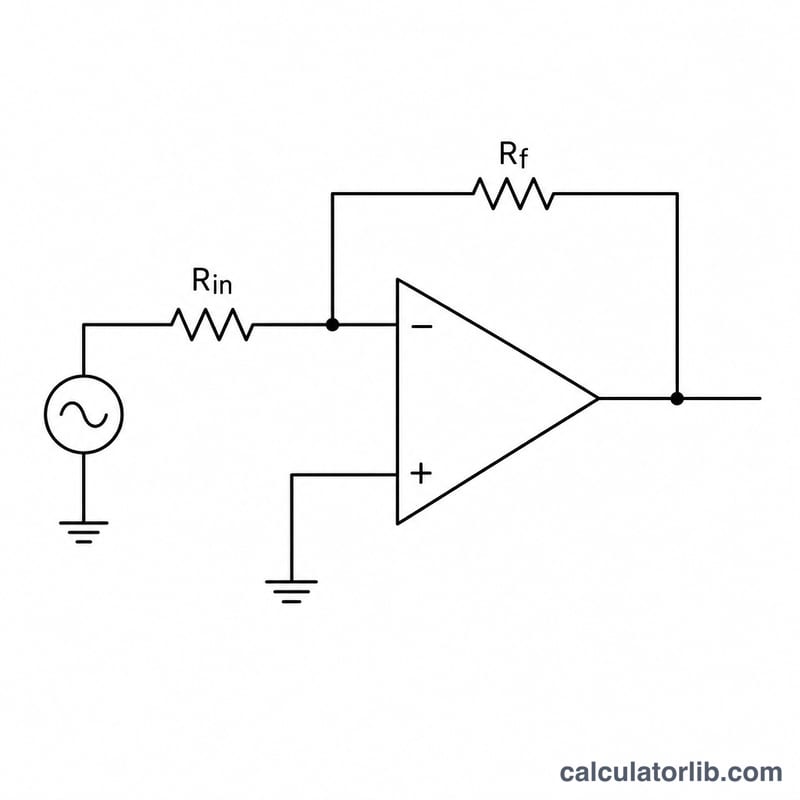
An operational amplifier (op-amp) is a high-gain voltage amplifier whose closed-loop gain is set almost entirely by two external resistors: the feedback resistor (Rf) and the input resistor (Rin). This calculator determines the voltage gain (Av) for both the inverting and non-inverting configurations and also reports the gain in decibels (dB). It is a universal electronics tool that applies to any standard ideal op-amp circuit.
How to Use It
Select the amplifier configuration, then enter the feedback resistor Rf and the input resistor Rin in ohms. The calculator returns the voltage gain in V/V and the corresponding decibel value. For a non-inverting amplifier the output is in phase with the input (positive gain); for an inverting amplifier the gain is negative, indicating a 180° phase shift.
The Formula Explained
For a non-inverting amplifier, the gain is $$A_v = 1 + \frac{\text{R}_f}{\text{R}_{in}}$$ Because of the leading "1", a non-inverting amplifier always has a gain of at least 1 (unity). For an inverting amplifier, the gain is $$A_v = -\frac{\text{R}_f}{\text{R}_{in}}$$ which can be less than, equal to, or greater than 1 in magnitude. The decibel value is computed as \(20 \cdot \log_{10}(|A_v|)\).
Worked Example
Suppose Rf = 10,000 Ω and Rin = 1,000 Ω in a non-inverting configuration. Then $$A_v = 1 + \frac{10{,}000}{1{,}000} = 1 + 10 = 11 \text{ V/V}$$ In decibels this is \(20 \cdot \log_{10}(11) \approx 20.83 \text{ dB}\). The same resistors in an inverting circuit give $$A_v = -\frac{10{,}000}{1{,}000} = -10 \text{ V/V}$$ or 20 dB in magnitude.
FAQ
Why is the inverting gain negative? The negative sign indicates the output signal is inverted (180° out of phase) relative to the input; the magnitude is what determines amplification.
Can the non-inverting gain be less than 1? No. The "+1" term guarantees a minimum gain of 1 (a voltage follower when Rf = 0).
What happens if Rin is zero? Dividing by zero is undefined, so a valid non-zero input resistance is required for a meaningful gain.