
What This Calculator Does
This tool tells you how many amp-hours (Ah) of battery capacity you need to run a given electrical load for a set amount of time. Enter the load power in watts, how long you want it to run, and your battery system voltage (commonly 12V, 24V or 48V). It converts the energy demand into the battery capacity required.
How to Use It
1. Enter your load power in watts (add up all devices running at once).
2. Enter the runtime in hours you need.
3. Enter your battery nominal voltage.
4. Optionally set the usable depth of discharge (DoD) — lead-acid is often 50%, lithium (LiFePO4) is often 80–100%. The result is the battery capacity you should buy.
The Formula Explained
Energy in watt-hours equals power times time: \(\text{Wh} = \text{W} \times \text{hours}\). Since amp-hours measure charge at a given voltage, divide by the battery voltage: \(\text{Ah} = \text{Wh} / \text{V}\). Because you usually should not fully drain a battery, divide again by the usable fraction: \(\text{Ah needed} = \text{Ah} \div (\text{DoD}/100)\).
$$\text{Ah} = \frac{\text{Watts} \times \text{Hours}}{\text{Volts} \times \dfrac{\text{DoD (\%)}}{100}}$$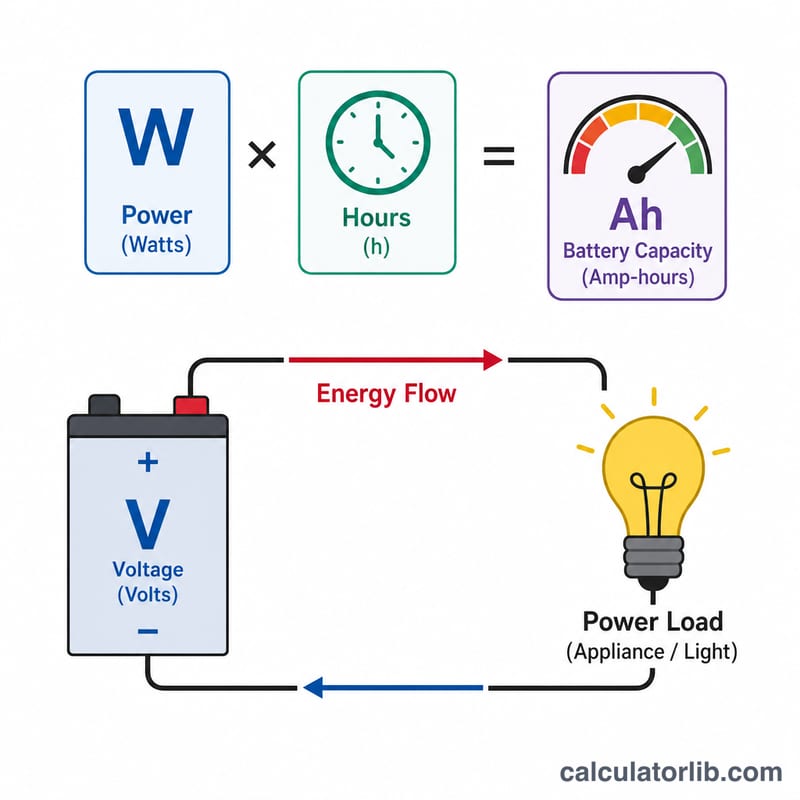
Worked Example
You want to run a 100 W appliance for 5 hours on a 12 V battery. Energy:
$$\text{Energy} = 100 \times 5 = 500 \text{ Wh}$$Raw capacity:
$$\text{Raw capacity} = 500 \div 12 = 41.67 \text{ Ah}$$At 100% DoD you need about 41.67 Ah; at 50% DoD you would need 83.33 Ah, so a 100 Ah battery would be a safe choice.
Typical Depth-of-Discharge by Battery Type
Depth of discharge (DoD) is the percentage of a battery's rated capacity that you can safely use on each cycle. Discharging deeper than the recommended limit shortens cycle life, so the usable capacity is always less than the nameplate amp-hours. Use the values below as the dod input when sizing a bank.
| Battery type | Recommended usable DoD | Cycle-life impact |
|---|---|---|
| Flooded lead-acid (FLA) | ~50% | Routinely going past 50% sharply cuts cycle life; staying at or above 50% state-of-charge maximizes longevity. |
| AGM (sealed lead-acid) | ~50–60% | Tolerates slightly deeper cycling than flooded, but life still falls steeply below ~50% remaining charge. |
| Gel (sealed lead-acid) | ~50% | Similar to flooded; deep, frequent discharges degrade the gel electrolyte and reduce cycles. |
| LiFePO4 (lithium iron phosphate) | ~80–100% | Can be cycled to 80–100% with minimal penalty; the BMS protects against over-discharge, giving thousands of cycles. |
Because lithium delivers roughly twice the usable capacity per rated Ah versus lead-acid, a 100 Ah LiFePO4 battery (≈80–100 Ah usable) often replaces a 200 Ah lead-acid bank (≈100 Ah usable).
Practical Recommendations
- Round up to the next standard size. Batteries come in nominal sizes (e.g. 50, 100, 200 Ah). If the formula gives 83.3 Ah, choose a 100 Ah battery rather than under-sizing.
- Add a 15–25% margin. Real systems lose energy to inverter inefficiency (typically 85–95%), wiring, cold temperatures (which reduce lead-acid capacity), and gradual aging. For a 250 Ah calculated need, plan for roughly 290–310 Ah of installed capacity.
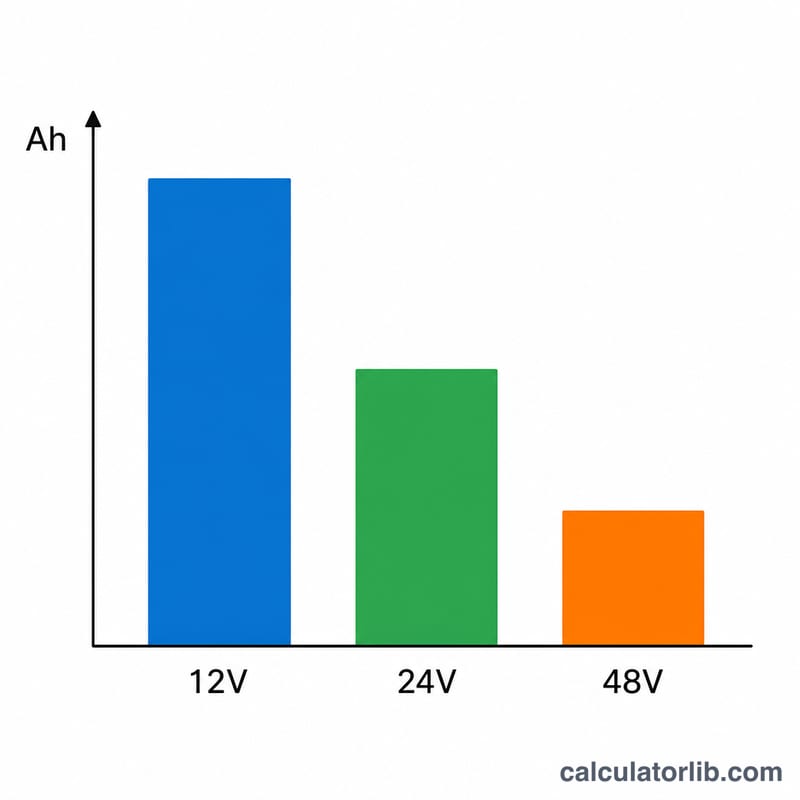
- Choose a higher system voltage for large loads. Moving from 12 V to 24 V or 48 V cuts the current (and therefore amp-hours and wire size) for the same power, reducing losses and cost. Use 12 V for small setups, 24 V for mid-size, and 48 V for large solar/off-grid banks.
- Match DoD to your chemistry. Enter ~50% for flooded/gel lead-acid, ~50–60% for AGM, and ~80–100% for LiFePO4. Using the correct DoD prevents both under-sizing (which kills lead-acid early) and over-paying for unused lithium capacity.
- Cross-check the inverter and current draw. Size the inverter to your peak watts with its own margin, and verify the battery can supply the resulting current continuously without exceeding its discharge rating.
This is general information for planning purposes, not professional engineering advice. For permanent or high-power installations, confirm sizing and wiring with a qualified installer and the manufacturer's specifications.
FAQ
Does higher voltage need fewer amp-hours? Yes. The same energy at 24V needs roughly half the amp-hours of a 12V system, which is why larger systems use higher voltage.
Should I add a safety margin? Yes — add 15–25% for inverter losses, cold weather and battery aging.
What DoD should I use? Use about 50% for flooded lead-acid, 50–60% for AGM, and 80–100% for LiFePO4 lithium.