
What this calculator does
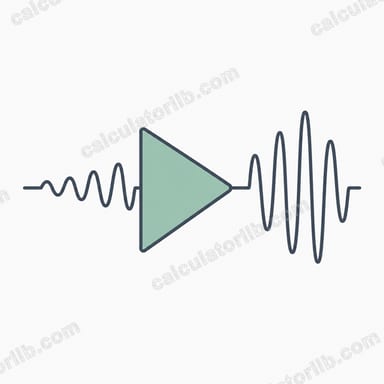
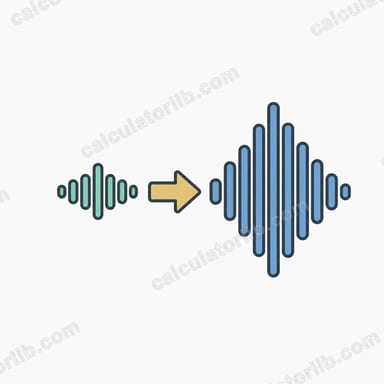
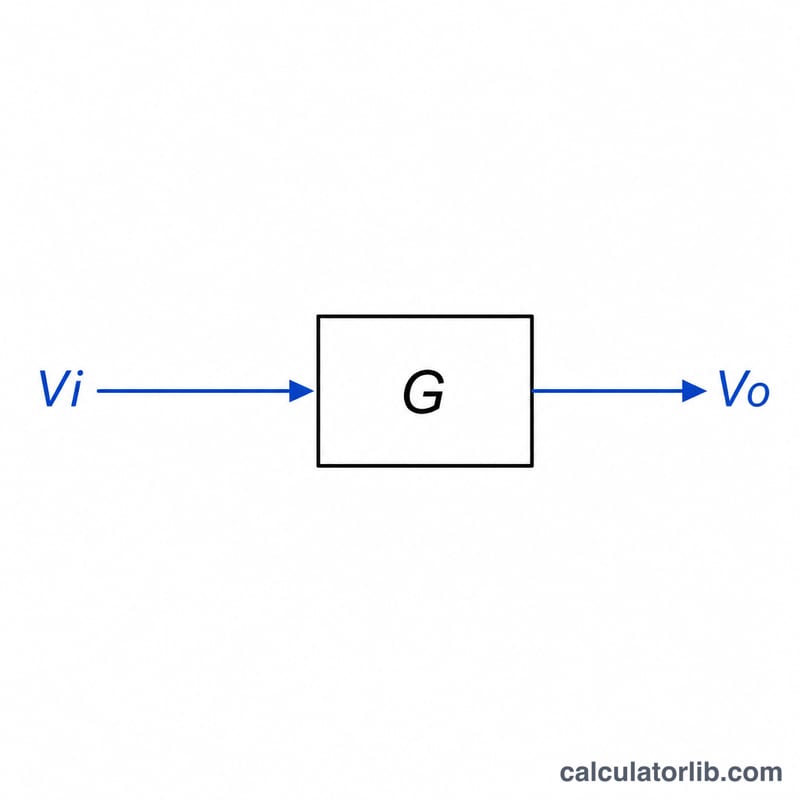
The decibel (dB) is a logarithmic way to express a gain or loss. This calculator converts a gain G given in decibels into the equivalent linear ratio — the actual magnification of output over input. Because the decibel is defined differently for amplitude quantities than for power quantities, the tool returns two answers: a voltage ratio and a power ratio. This is a pure physics/electronics conversion that applies the same everywhere, and it is widely used in audio, RF, antenna, amplifier and hearing-aid work.
How to use it
Enter the gain in decibels in the single input field and read off both ratios. A positive value means amplification (ratio greater than 1), a negative value means attenuation or loss (ratio between 0 and 1), and 0 dB means no change (ratio of exactly 1). Use the voltage ratio when your quantity is an amplitude/field quantity such as voltage, current or sound pressure; use the power ratio for power or intensity.
The formula explained
The decibel definitions are \(G = 20\cdot\log_{10}(V_o/V_i)\) for amplitude and \(G = 10\cdot\log_{10}(P_o/P_i)\) for power. Inverting them gives:
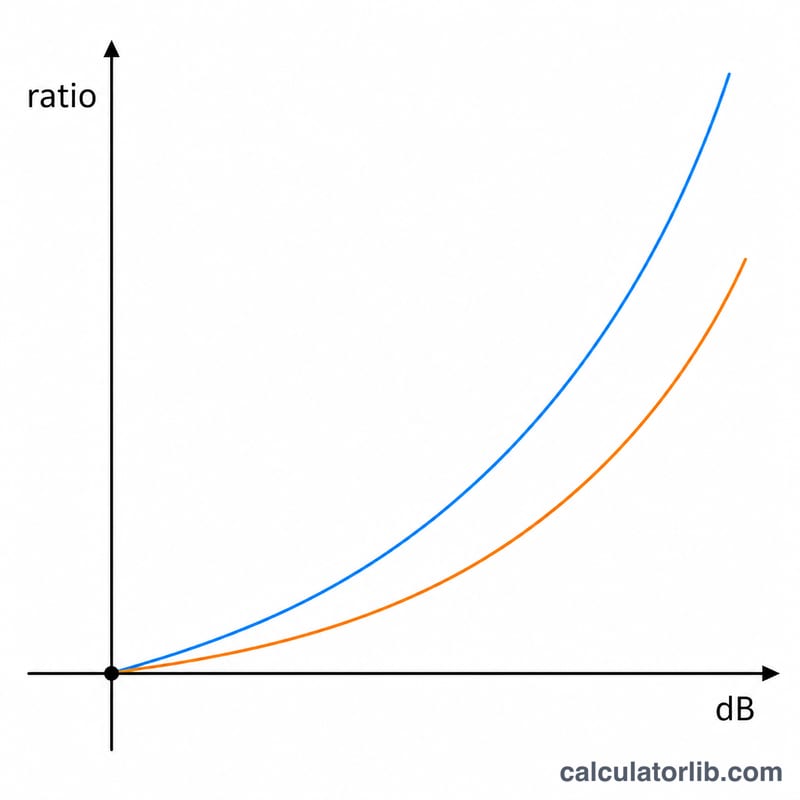
$$\frac{V_o}{V_i} = 10^{\frac{G}{20}}$$$$\frac{P_o}{P_i} = 10^{\frac{G}{10}}$$Since \(10^{\frac{G}{10}} = \left(10^{\frac{G}{20}}\right)^2\), the power ratio is always the square of the voltage ratio — consistent with power being proportional to voltage squared at a fixed impedance.
Worked example
For \(G = 10\) dB the voltage ratio is $$10^{\frac{10}{20}} = 10^{0.5} \approx 3.16228$$ times, and the power ratio is $$10^{\frac{10}{10}} = 10^1 = 10$$ times. Check: \(3.16228^2 \approx 10\). For \(G = -6\) dB you get a voltage ratio of about \(0.50119\) (half amplitude) and a power ratio of about \(0.25119\) (a quarter of the power) — the classic "-6 dB halves the amplitude" rule.
FAQ
Why are there two different ratios? Because dB compresses both amplitude and power onto one scale; the same dB number corresponds to a smaller amplitude factor than power factor.
What does a negative dB mean? A loss or attenuation; both ratios stay positive but fall below 1.
Is 3 dB really double the power? Approximately — \(10^{\frac{3}{10}} \approx 1.995\), so +3 dB is very close to twice the power and +6 dB is roughly twice the voltage.