
What is the decibel (dB) gain/loss calculator?
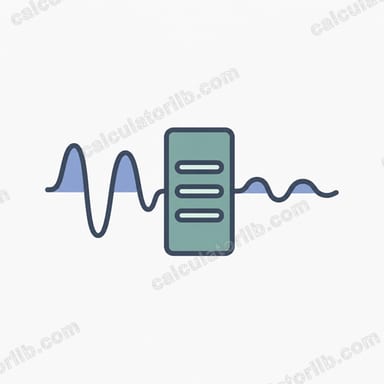
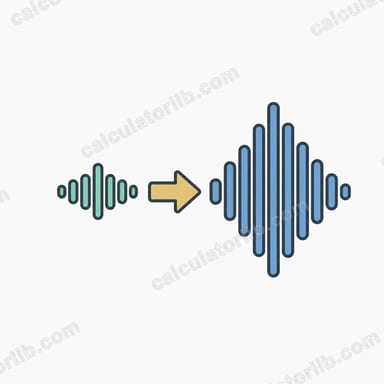
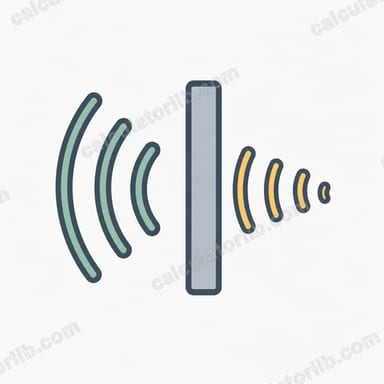
The decibel (dB) is a logarithmic unit that expresses the ratio between two values — most often an output level relative to an input level. This calculator converts a power ratio or a voltage/current ratio into decibels, telling you how much gain (amplification) or loss (attenuation) a signal experiences. Because the scale is logarithmic, it compresses the enormous range of real-world signal levels into convenient, easy-to-read numbers.
How to use it
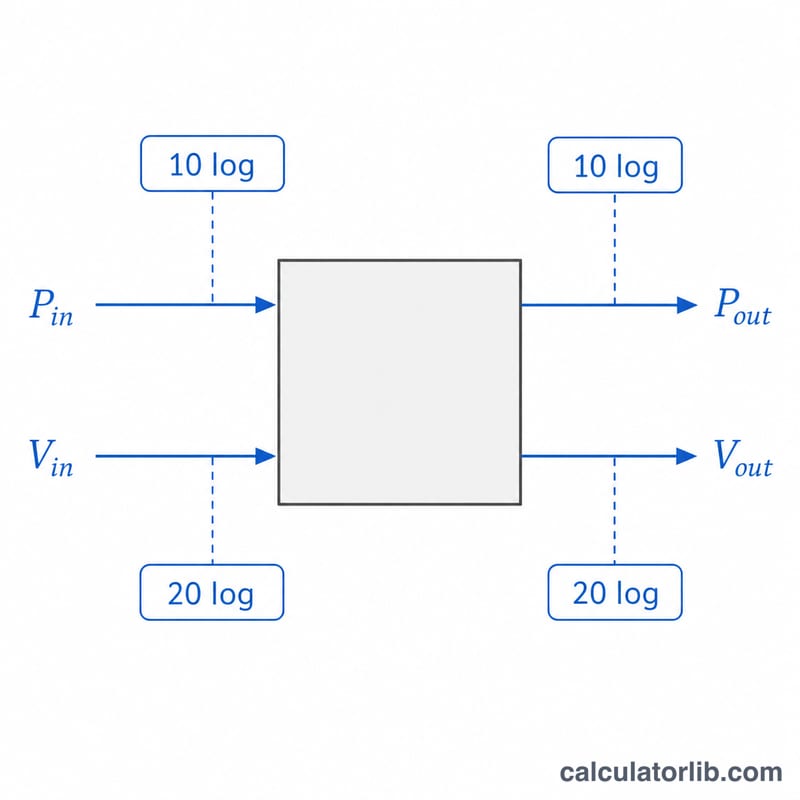
Choose whether you are comparing power (watts, milliwatts) or voltage/current (volts, amps). Enter the input value (\(P_{in}\) or \(V_{in}\)) and the output value (\(P_{out}\) or \(V_{out}\)). The calculator returns the result in dB: a positive value means gain, a negative value means loss, and 0 dB means the output equals the input.
The formula explained
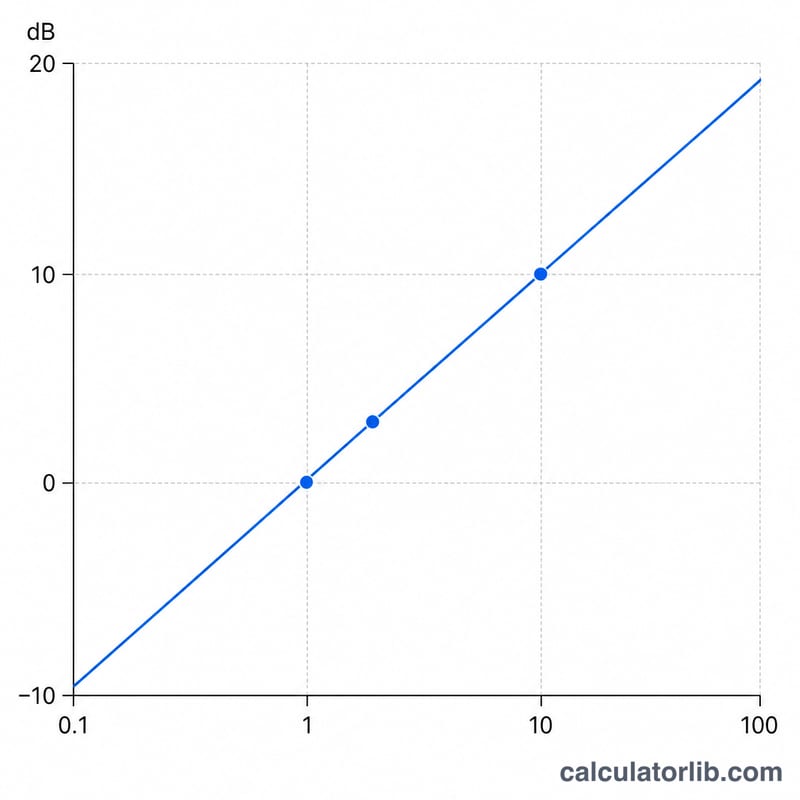
For power, $$\text{dB} = 10 \cdot \log_{10}\!\left(\frac{\text{P}_{out}}{\text{P}_{in}}\right)$$ For voltage or current, $$\text{dB} = 20 \cdot \log_{10}\!\left(\frac{\text{V}_{out}}{\text{V}_{in}}\right)$$ The factor differs because power is proportional to the square of voltage (\(P \propto V^2\)), and log of a square doubles the multiplier (\(2 \times 10 = 20\)). This is why doubling power is +3 dB while doubling voltage is +6 dB.
Worked example
An amplifier raises power from 1 W to 100 W. Ratio = 100/1 = 100. $$\text{dB} = 10 \cdot \log_{10}(100) = 10 \times 2 = 20\ \text{dB}$$ of gain. If instead the voltage rose from 1 V to 10 V, $$\text{dB} = 20 \cdot \log_{10}(10) = 20 \times 1 = 20\ \text{dB}$$
FAQ
Why do power and voltage use different factors? Power scales with voltage squared, so the logarithmic multiplier doubles from 10 to 20 for voltage and current ratios.
What does a negative dB mean? A negative value indicates loss or attenuation — the output is smaller than the input (e.g., \(-3\) dB ≈ half the power).
What is 0 dB? 0 dB means the output equals the input (a ratio of exactly 1); it does not mean "no signal."