
What this calculator does
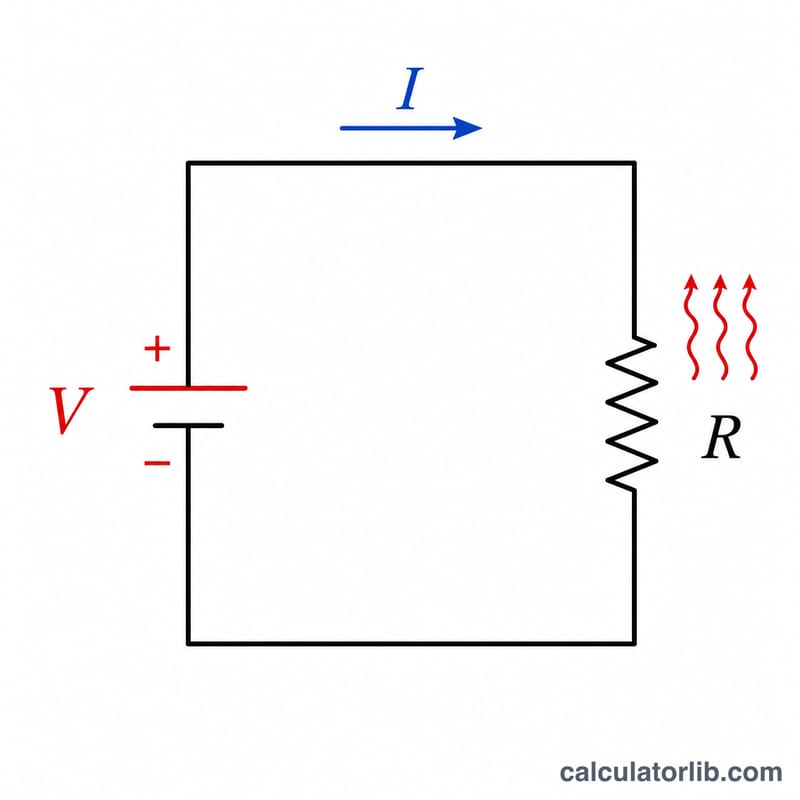
This tool calculates the electrical power dissipated as heat by a resistor. When current flows through a resistance, energy is converted to heat — a key consideration for sizing resistors, designing circuits, and avoiding overheating. You can compute power two ways: from current and resistance, or from voltage and resistance.
How to use it
Pick a calculation mode. For Current & Resistance, enter the current in amperes (A) and the resistance in ohms (Ω). For Voltage & Resistance, enter the voltage across the resistor in volts (V) and the resistance in ohms. The calculator returns the dissipated power in watts (W), plus the complementary voltage or current value derived from Ohm's law.
The formula explained
Power dissipation follows from Joule's law combined with Ohm's law (\(V = I \cdot R\)). The base relation is \(P = V \cdot I\). Substituting \(V = I \cdot R\) gives
$$P = I^{2} \cdot R$$and substituting \(I = V/R\) gives
$$P = \frac{V^{2}}{R}$$All three forms describe the same physical quantity — the rate at which electrical energy becomes heat in the component.
Worked example
Suppose a current of 2 A flows through a 10 Ω resistor. Then
$$P = I^{2} \cdot R = 2^{2} \times 10 = 4 \times 10 = 40\ \text{W}$$The voltage across it is \(V = I \cdot R = 2 \times 10 = 20\ \text{V}\). Alternatively, with 12 V across a 10 Ω resistor,
$$P = \frac{V^{2}}{R} = \frac{12^{2}}{10} = \frac{144}{10} = 14.4\ \text{W}$$with a current of 1.2 A.
FAQ
Why does power increase with the square of current? Because both the voltage drop (\(V = I \cdot R\)) and the current rise with I, their product scales with \(I^{2}\).
What if resistance is zero? The voltage-based formula divides by R, so a zero resistance returns zero here to avoid an undefined result; in reality an ideal short carries no voltage drop.
Does this account for resistor power rating? No — it gives the actual dissipation. Compare it to your resistor's rated wattage (e.g. 1/4 W, 1 W) and choose a part rated above the calculated value.