
What it is
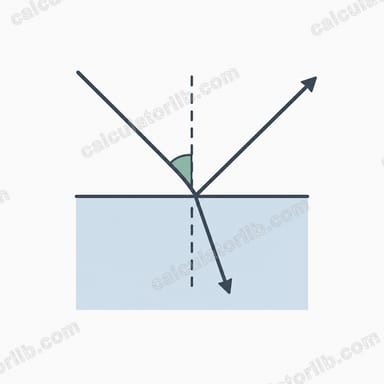
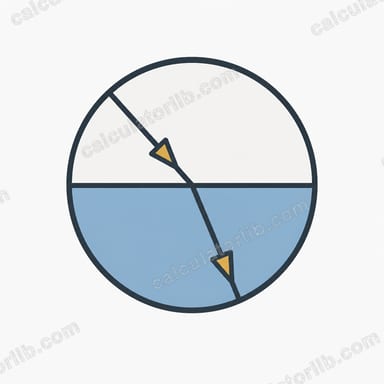
This calculator finds the angle of refraction — the angle a light ray bends to as it crosses the boundary between two transparent media. It uses Snell's law, the fundamental relationship of geometric optics, given the refractive indices of both media and the angle of incidence.
How to use it
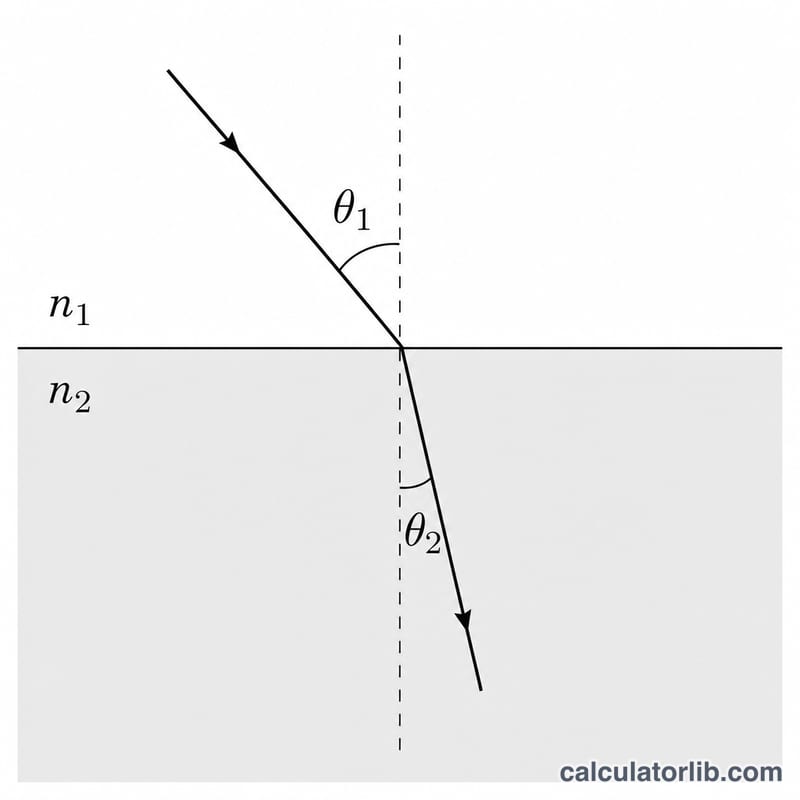
Enter the refractive index of the first medium (n₁) where the light starts, the index of the second medium (n₂) it enters, and the angle of incidence measured from the normal (0–90°). The calculator returns the refraction angle θ₂. If the geometry produces total internal reflection, it tells you so.
The formula explained
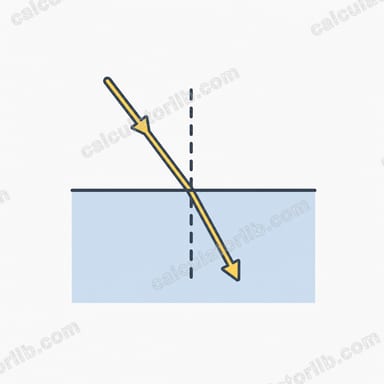
Snell's law states \(\text{n}_1\cdot\sin\theta_1 = \text{n}_2\cdot\sin\theta_2\). Rearranging for the refraction angle gives $$\theta_2 = \arcsin\!\left(\frac{\text{n}_1\cdot\sin\theta_1}{\text{n}_2}\right)$$ When light moves to a denser medium (\(\text{n}_2 > \text{n}_1\)) it bends toward the normal; moving to a less dense medium it bends away. If \(\text{n}_1\cdot\sin\theta_1 / \text{n}_2\) exceeds 1, the arcsine has no solution — this is total internal reflection.
Worked example
Light travels from air (n₁ = 1.0) into glass (n₂ = 1.5) at 30°. $$\sin\theta_2 = \frac{1.0 \times \sin 30^\circ}{1.5} = \frac{0.5}{1.5} = 0.3333$$ so \(\theta_2 = \arcsin(0.3333) \approx 19.47^\circ\). The ray bends toward the normal, as expected when entering a denser medium.
Refractive Indices of Common Materials
The refractive index \(n\) of a medium is the ratio of the speed of light in vacuum to its speed in that medium, \(n = c/v\). It governs how much a light ray bends at a boundary according to Snell's law, \(n_1 \sin\theta_i = n_2 \sin\theta_r\). The values below are measured at a standard visible wavelength of about 589 nm (the sodium D line); refractive index varies slightly with wavelength, an effect called dispersion.
| Material | Refractive index (n) |
|---|---|
| Vacuum | 1.0000 (exact) |
| Air (at sea level) | 1.0003 |
| Ice | 1.31 |
| Water (20 °C) | 1.33 |
| Ethanol | 1.36 |
| Crown glass | 1.52 |
| Flint glass | 1.62 |
| Sapphire | 1.77 |
| Diamond | 2.42 |
Because \(n \geq 1\) for ordinary transparent media, light always travels slowest in the denser (higher-\(n\)) material. A larger index difference between two media produces a larger change in the ray's direction at the boundary.
FAQ
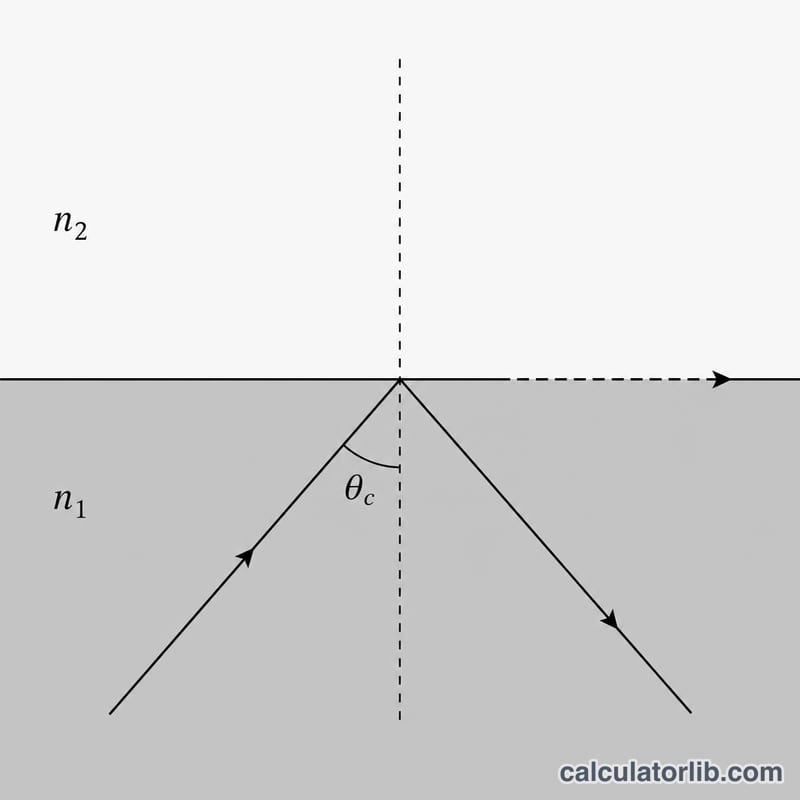
What is total internal reflection? When light tries to pass from a denser to a less dense medium beyond a critical angle, no refracted ray exists and all light reflects back. This calculator flags it.
What is the critical angle? It is the incidence angle where \(\theta_2 = 90^\circ\), found from \(\sin\theta_c = \text{n}_2/\text{n}_1\) (only when \(\text{n}_1 > \text{n}_2\)).
Is the angle measured from the surface? No — all angles here are measured from the normal (perpendicular to the surface).