
What Is the Index of Refraction?
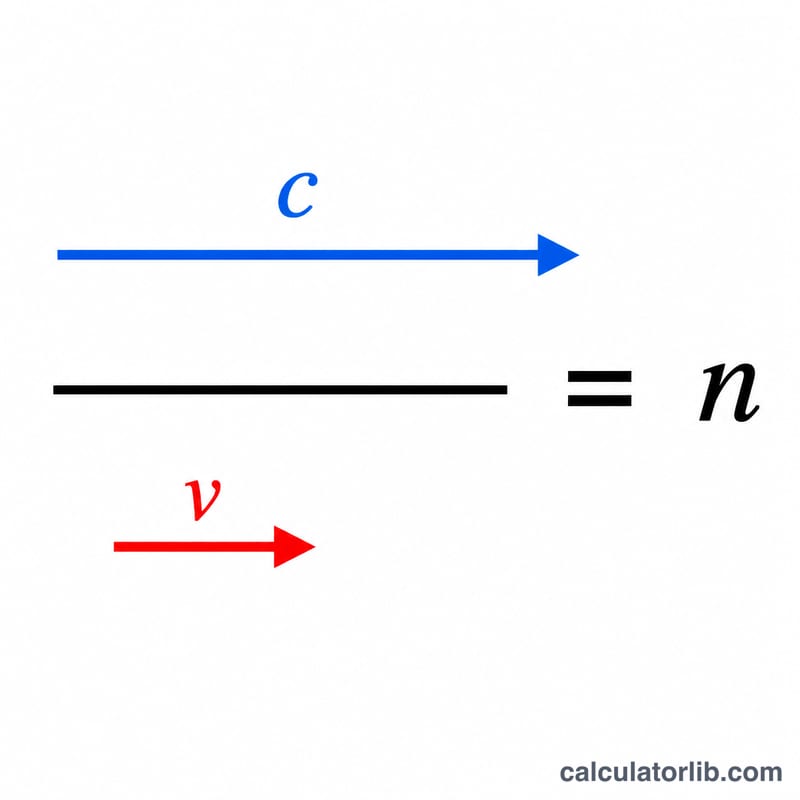
The index of refraction (or refractive index), symbol n, is a dimensionless number that describes how fast light travels through a medium relative to its speed in a vacuum. It is defined as the ratio of the speed of light in vacuum (\(c \approx 299{,}792{,}458\ \text{m/s}\)) to the speed of light in the medium (\(v\)). Because light always slows down in matter, n is always greater than or equal to 1. Common values include 1.0003 for air, 1.33 for water, and about 1.5 for ordinary glass.
How to Use This Calculator
Enter the speed of light inside the medium (in meters per second) and the speed of light in vacuum. The vacuum value defaults to 299,792,458 m/s, but you can change it if you are using a rounded figure such as \(3\times10^{8}\). The calculator divides c by v to return the refractive index instantly.
The Formula Explained
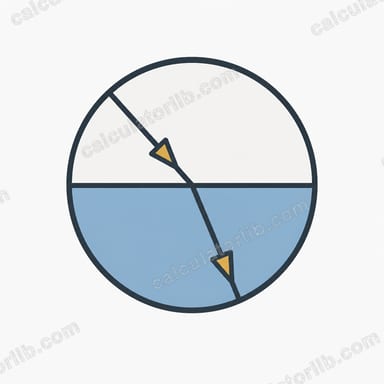
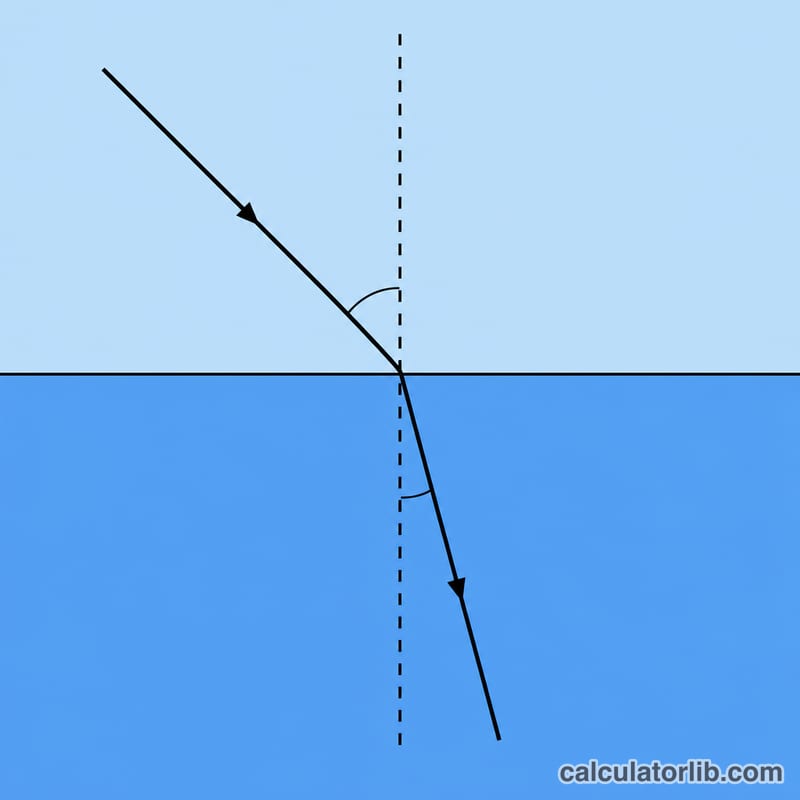
The governing equation is $$n = \frac{c}{v}$$ Here c is the universal speed of light in a vacuum and v is the (slower) phase speed inside the material. A higher index means light slows down more and bends more sharply at the surface, as described by Snell's law.
Worked Example
Suppose light travels through a medium at \(v = 225{,}000{,}000\ \text{m/s}\) while the vacuum speed is \(c = 299{,}792{,}458\ \text{m/s}\). Then $$n = \frac{299{,}792{,}458}{225{,}000{,}000} \approx 1.3324$$ This is close to the refractive index of water, meaning the material would bend and slow light much like water does.
FAQ
Can the index of refraction be less than 1? For the phase velocity in certain materials (like X-rays in some media) it can be slightly less than 1, but for visible light in ordinary materials it is always \(\geq 1\).
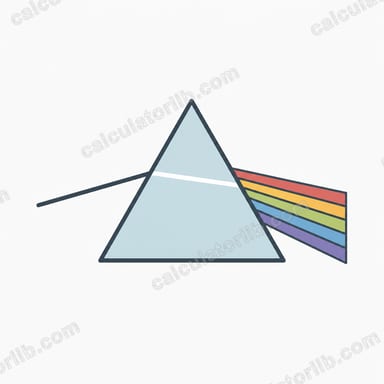
Is the refractive index constant? No—it varies slightly with the wavelength of light, an effect called dispersion, which is why prisms split white light into colors.
What units should I use? Use the same units for both speeds (typically m/s). Since n is a ratio, the units cancel and the result is dimensionless.