
What Is Laser Brightness?
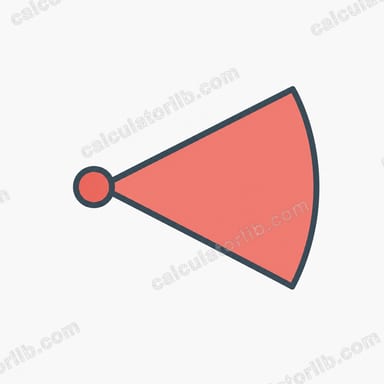
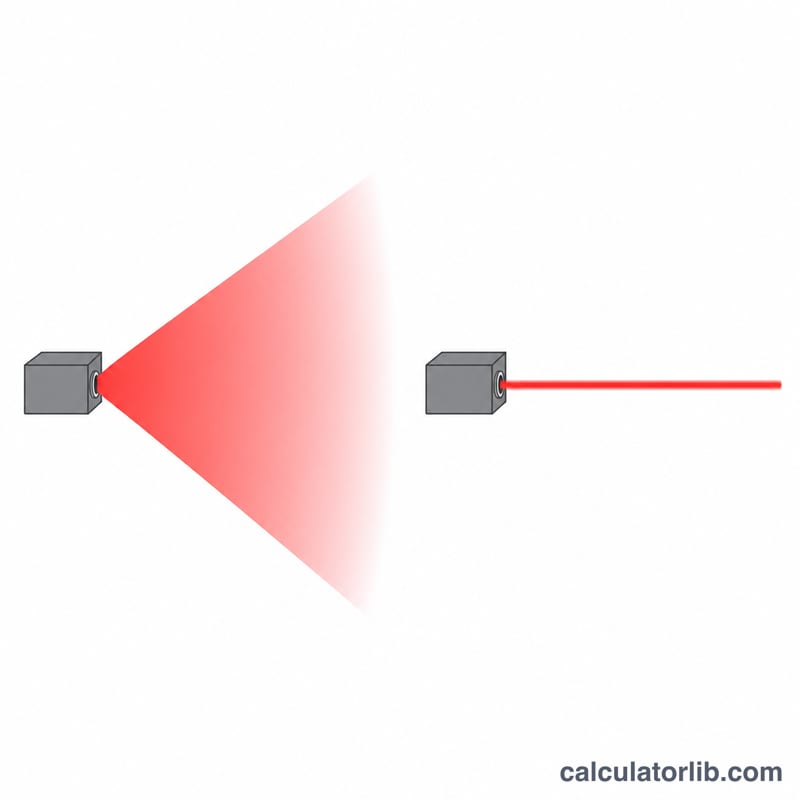
Laser brightness — more formally called radiance — describes how much optical power a laser delivers per unit emitting area per unit solid angle. It is one of the most fundamental figures of merit for a laser source because, unlike raw power alone, brightness captures how tightly the energy can be focused and collimated. Two lasers can have identical power yet very different brightness if one has a larger beam or a wider divergence.
The Formula
Brightness is defined as:
$$B = \frac{P}{A \cdot \Omega}, \quad \text{with} \quad \Omega = \pi \cdot \theta^{2}$$
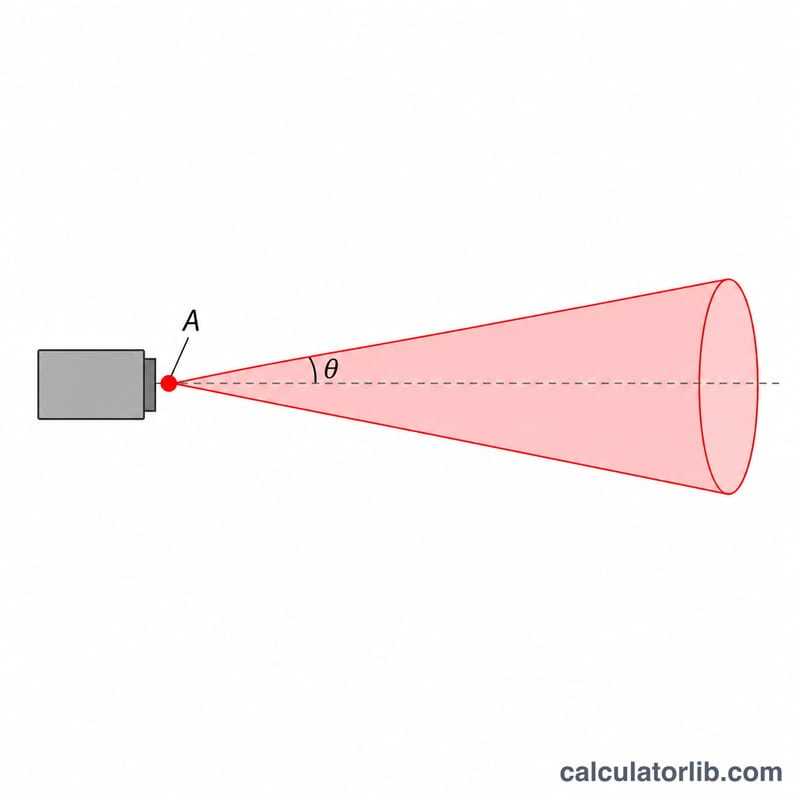
where P is the laser power in watts, A is the beam cross-sectional area in square metres, θ is the beam divergence half-angle in radians, and Ω is the beam solid angle in steradians. Combining the two gives $$B = \frac{P}{A \cdot \pi \cdot \theta^{2}}$$ with units of \(\text{W}\cdot\text{m}^{-2}\cdot\text{sr}^{-1}\).
How to Use This Calculator
Enter the laser power, the beam area at the aperture, and the beam divergence half-angle in radians. The calculator computes the beam solid angle Ω and then divides power by the product of area and solid angle to return brightness. Increasing power raises brightness, while a larger spot or wider divergence lowers it.
Worked Example
Suppose a laser outputs P = 1 W through a beam area A = 0.0001 m² with a divergence half-angle θ = 0.001 rad. The solid angle is $$\Omega = \pi \times 0.001^{2} \approx 3.1416 \times 10^{-6}\ \text{sr}.$$ Then $$B = \frac{1}{0.0001 \times 3.1416 \times 10^{-6}} \approx 3.183 \times 10^{9}\ \text{W}\cdot\text{m}^{-2}\cdot\text{sr}^{-1}.$$
FAQ
Why does divergence matter so much? Brightness depends on \(\theta^{2}\), so halving the divergence quadruples the brightness — collimation is critical.
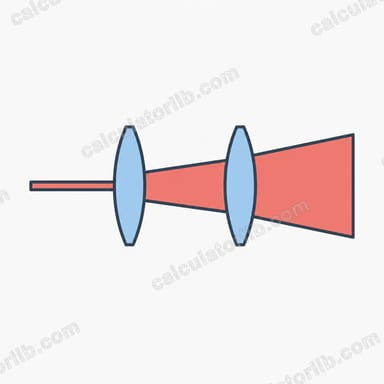
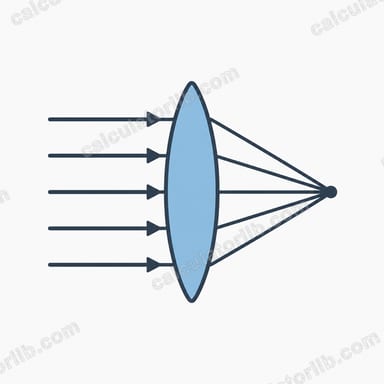
Is brightness conserved? In an ideal lossless optical system, radiance (brightness) cannot be increased by passive optics; it can only be maintained or reduced.
What units should I use? Use SI throughout: watts, square metres, and radians, giving brightness in \(\text{W}\cdot\text{m}^{-2}\cdot\text{sr}^{-1}\).