
What this calculator does
This tool applies to Japan. It computes the calendar dates of Christian (Catholic and Protestant) funeral and memorial observances as customarily practiced in Japan, starting from a date of death. The calendar arithmetic itself is universal Gregorian math, but the list of memorial milestones and their labels follow Japanese-Christian custom. Year input may be a Western (Gregorian) year or a Japanese era year (Meiji, Taisho, Showa, Heisei, Reiwa). Japanese-era input is only meaningful from 1 January 1873 (Meiji 6) onward, when Japan adopted the Gregorian calendar.
How to use it
Choose the denomination (Catholic or Protestant), select how the year should be read (Western or an era), then enter the year, month and day of death. The calculator normalizes era years to a Gregorian year and lists each observance with its date and weekday.
The formula explained
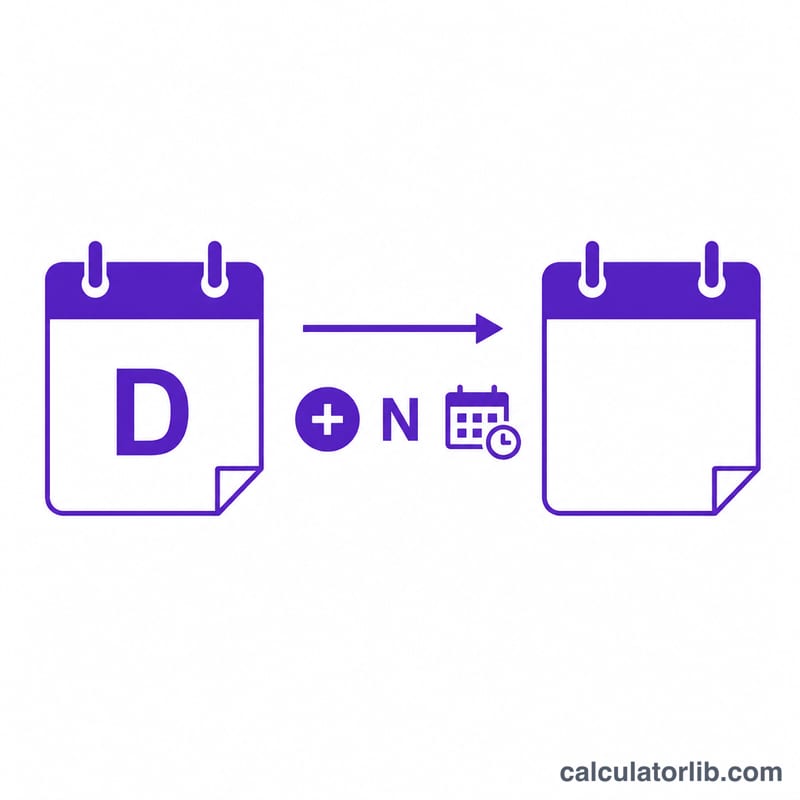
An important counting rule: the day of death is counted as day 1. So an "Nth day" service falls N-1 days after the death date, written \(\text{date} = D + (N-1)\ \text{days}\). Yearly anniversary services keep the same month and day with the year advanced by N, \(\text{date} = D + N\ \text{years}\). A February 29 death clamps its anniversary to February 28 in non-leap years. Era years convert as \(\text{gregorianYear} = \text{eraBase} + \text{enteredYear}\) (for example Showa adds 1925, so Showa 50 = 1975).
$$\begin{gathered} D_0 = \left(\,\text{Year} + B,\ \text{Month},\ \text{Day}\,\right) \\[1.5em] \text{where}\quad \left\{ \begin{aligned} \text{Day Mass} &= D_0 + (k-1)\ \text{days} \\ \text{Anniversary} &= D_0 + n\ \text{years} \\ B &= \text{era base year} \end{aligned} \right. \end{gathered}$$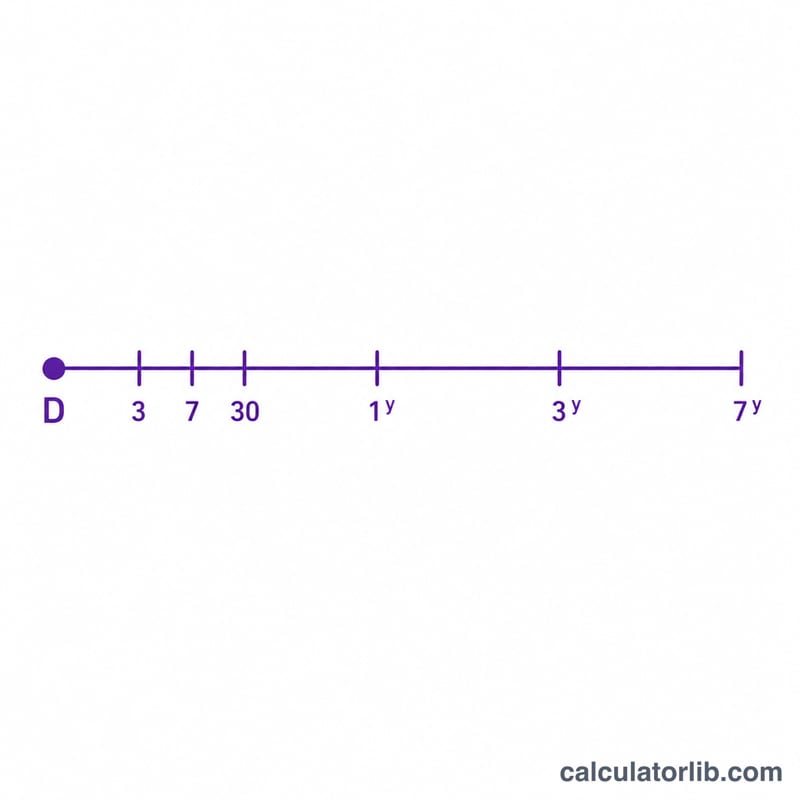
Worked example
Catholic, Western year 2024, month 6, day 15, so \(D = 2024/06/15\) (Saturday). The 3rd day \(= D+2 = 2024/06/17\); the 7th day \(= D+6 = 2024/06/21\); the 30th day \(= D+29 = 2024/07/14\); the 1st anniversary \(= 2025/06/15\).
FAQ
Why is the 7th day six days after death? Because the day of death is counted as the first day, so the 7th day is only six days later.
How do era years work? Select the era and enter the era-year; the tool adds the era base year to get the Gregorian year (e.g. Showa 50 becomes 1975).
Are the exact milestones the same everywhere? No. These reflect Japanese Christian convention; local parishes may schedule services on a nearby weekend for convenience.