
What Is Malus's Law?
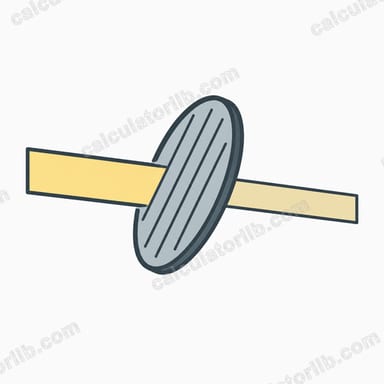
Malus's Law describes how the intensity of plane-polarized light changes after passing through a polarizing filter (an analyzer). When light that is already polarized hits a polarizer whose transmission axis makes an angle θ with the light's polarization direction, the transmitted intensity is reduced by a factor of cos²θ. The law was discovered by Étienne-Louis Malus in 1809 and is fundamental to optics, photography, LCD displays, and laser physics.
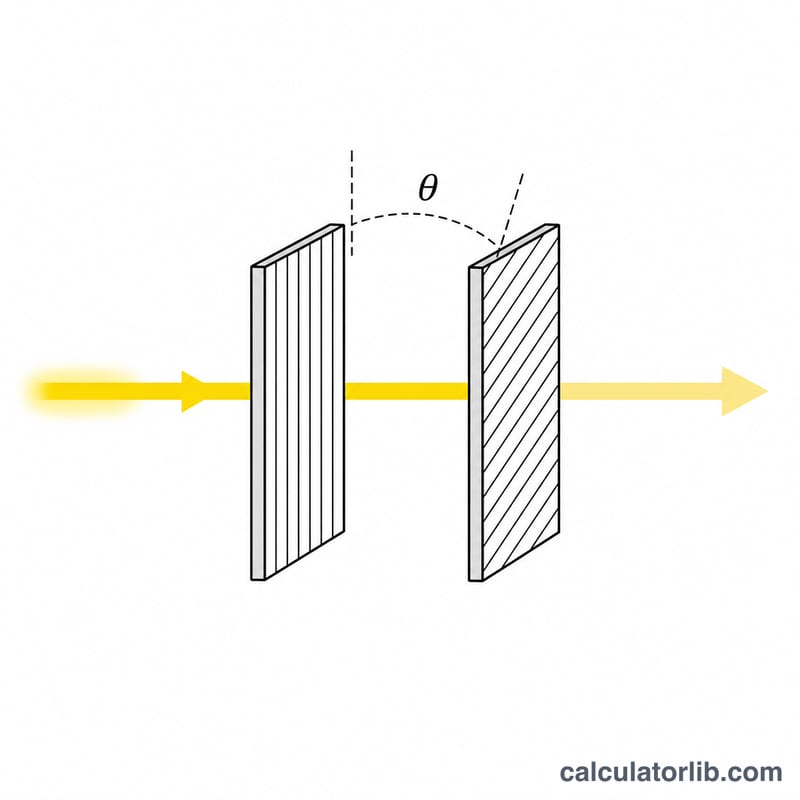
The Formula
The transmitted intensity is given by:
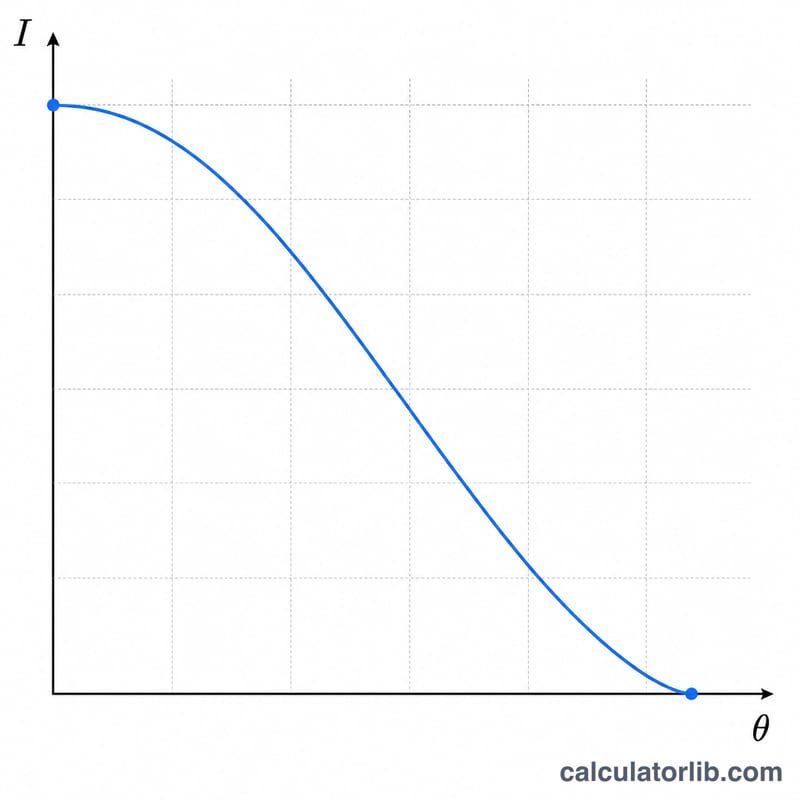
$$I = \text{I}_0 \cdot \cos^{2}\!\left(\theta\right)$$where I₀ is the intensity of the incoming polarized light, θ is the angle between the polarization direction and the polarizer's transmission axis, and I is the resulting transmitted intensity. When θ = 0°, all light passes (I = I₀); when θ = 90°, the polarizer fully blocks the light (\(I = 0\)).
How to Use This Calculator
Enter the initial intensity I₀ in any consistent units (W/m², lumens, or a relative value like 1) and the angle θ in degrees. The calculator returns the transmitted intensity and the percentage of light that gets through.
Worked Example
Suppose polarized light of intensity I₀ = 100 W/m² strikes a polarizer at θ = 60°. Then \(\cos(60°) = 0.5\), so \(\cos^{2}(60°) = 0.25\), giving $$I = 100 \times 0.25 = 25 \ \text{W/m}^2.$$ Only 25% of the original light is transmitted.
FAQ
Does this apply to unpolarized light? No. Malus's Law applies to light that is already polarized. Unpolarized light passing through the first polarizer drops to half its intensity (I₀/2) regardless of angle, then follows Malus's Law for subsequent polarizers.
What angle gives zero transmission? θ = 90° (crossed polarizers) gives \(\cos^{2}(90°) = 0\), blocking all light.
Can θ exceed 90°? Yes. Because cos² is periodic, the formula works for any angle; for example 120° gives the same result as 60°.