
What is the Brinkman Index?
The Brinkman Index (also called the Smoking Index), introduced by G. L. Brinkman, is a simple, internationally recognized clinical metric that estimates a person's cumulative exposure to cigarette smoke. It combines smoking intensity and duration into a single number, which clinicians use as a rough indicator of lung and throat (pharyngeal) cancer risk. Because it is based on universal smoking behavior rather than any country-specific scheme, this tool applies everywhere.
How to use this calculator
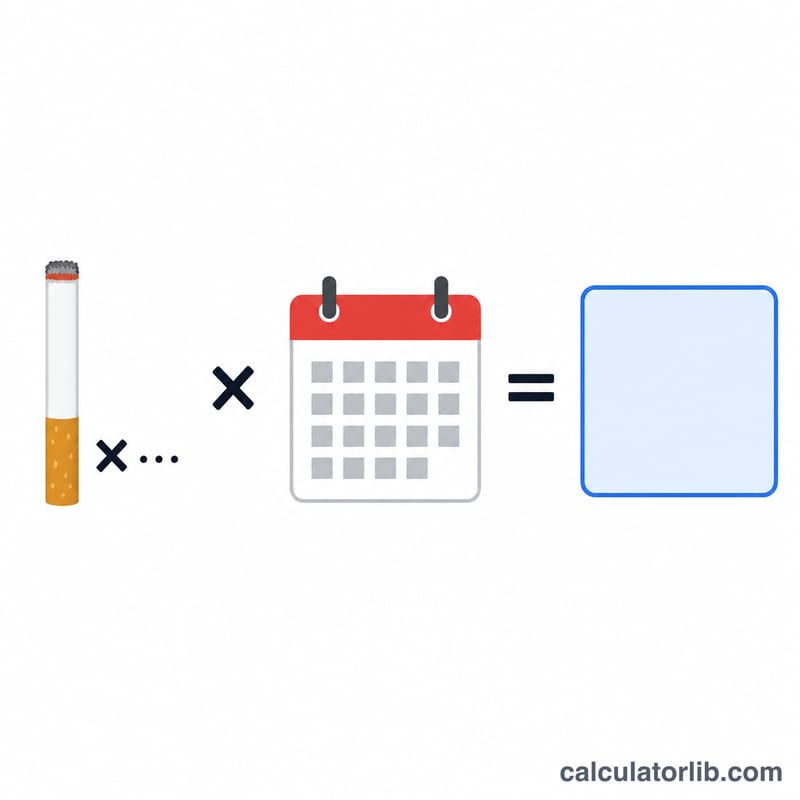
Enter the average number of cigarettes you smoke per day and the total number of years you have smoked. The calculator multiplies these two values to produce your Brinkman Index and classifies the result against established risk thresholds.
The formula explained
The formula is straightforward: $$\text{Brinkman Index} = \text{Cigarettes per day} \times \text{Years smoked}$$. The risk thresholds are: below 400 means no elevated category is indicated; 400 or above signals lung cancer risk; 600 or above signals high lung cancer risk; and 1200 or above signals very high throat (pharyngeal) cancer risk.
Worked example
Suppose you smoke 20 cigarettes a day and have smoked for 20 years. The Brinkman Index is $$20 \times 20 = 400.$$ Since 400 reaches the 400 threshold but is below 600, the result is "Lung cancer risk". A heavier smoker at 40 cigarettes a day for 30 years scores $$40 \times 30 = 1200,$$ placing them in the "Very high throat (pharyngeal) cancer risk" band.
Interpreting Your Brinkman Index
The Brinkman Index (BI), also called the Smoking Index, is the product of the average number of cigarettes smoked per day and the number of years of smoking. It provides a single number that estimates cumulative tobacco exposure. For example, smoking 20 cigarettes per day for 30 years gives a Brinkman Index of 600. The result is interpreted using broad bands, summarized below.
| Brinkman Index | Category | Clinical interpretation |
|---|---|---|
| Less than 400 | No elevated category | Cumulative exposure has not reached the threshold associated with markedly raised cancer risk in the index. Risk is not zero, but the index does not place it in an elevated band. |
| 400 or more | Lung cancer risk | Exposure is high enough to be associated with an increased risk of lung cancer. Often used as a threshold to flag smokers warranting closer attention. |
| 600 or more | High lung cancer risk | Exposure corresponds to a high lung cancer risk band; commonly cited as a criterion for considering lung cancer screening in eligible smokers. |
| 1200 or more | Very high risk | Very heavy cumulative exposure, associated with a very high risk including pharyngeal (throat) and other aerodigestive cancers in addition to lung cancer. |
These bands are guidelines drawn from epidemiological use of the index and may vary slightly between clinical sources. The boundaries are not sharp cut-offs at which risk suddenly changes; risk rises continuously with exposure.
Important limitations to keep in mind:
- It is a coarse exposure proxy, not a diagnosis. A high index indicates elevated risk, not the presence of disease; a low index does not guarantee absence of disease.
- It does not adjust for smoking cessation. The index treats past exposure the same whether you quit years ago or still smoke, even though risk declines after quitting.
- It ignores tar and nicotine content. All cigarettes are counted equally regardless of brand, strength, or how deeply they are inhaled.
- It does not account for passive (second-hand) smoking or other exposures such as occupational carcinogens, which also contribute to risk.
This is general health information, not professional medical advice. Use your Brinkman Index as a conversation starter with a qualified healthcare provider, who can assess your individual risk and screening needs.
FAQ
Is the Brinkman Index accurate? It is only a coarse indicator. Tar and nicotine content vary by brand, and the index does not account for quitting time or passive smoking, so it should not replace professional medical advice.
What if I quit smoking? The classic index still counts the years you smoked; it does not reduce the score for cessation time. Discuss your full history with a doctor.
Can I enter decimals? Yes. While cigarettes per day and years are usually whole numbers, decimals are accepted and multiplied directly.