
What is the Earth Curvature Calculator?
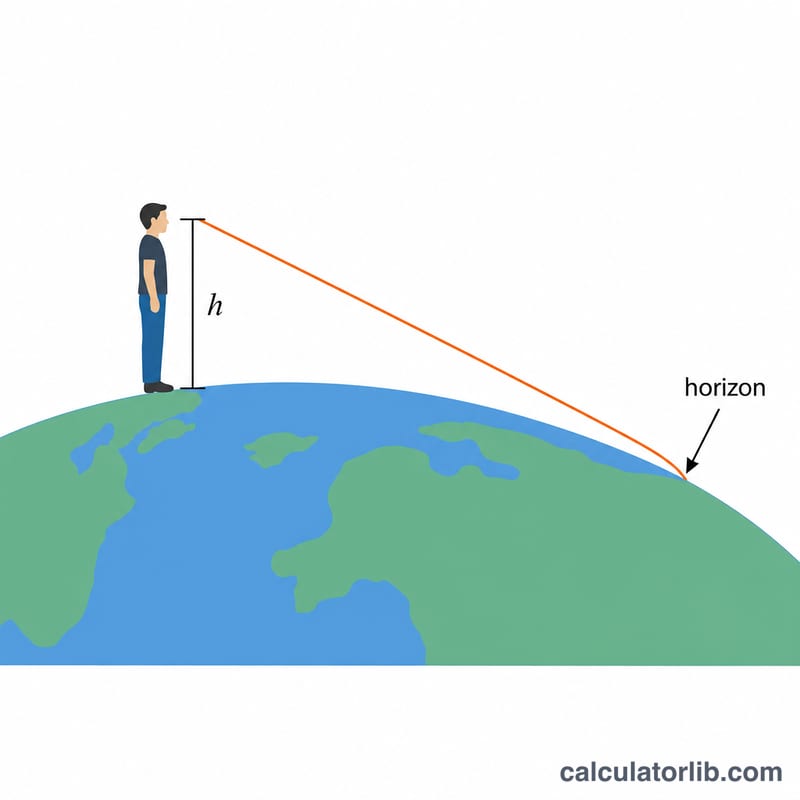
This tool estimates how much the Earth's surface "drops" away from a straight, tangent line over a given distance, and how far away the horizon appears from a given eye height. It uses a spherical Earth model with a mean radius of \(R = 6{,}371{,}000\) metres (6,371 km). The calculations are purely geometric and universal — they apply anywhere on Earth and require no country-specific data.
How to use it
Enter the straight-line distance in kilometres. Optionally enter your observer eye height in metres to also compute the distance to the horizon. Press calculate to see the exact drop, the simplified approximate drop, and your horizon distance.
The formula explained
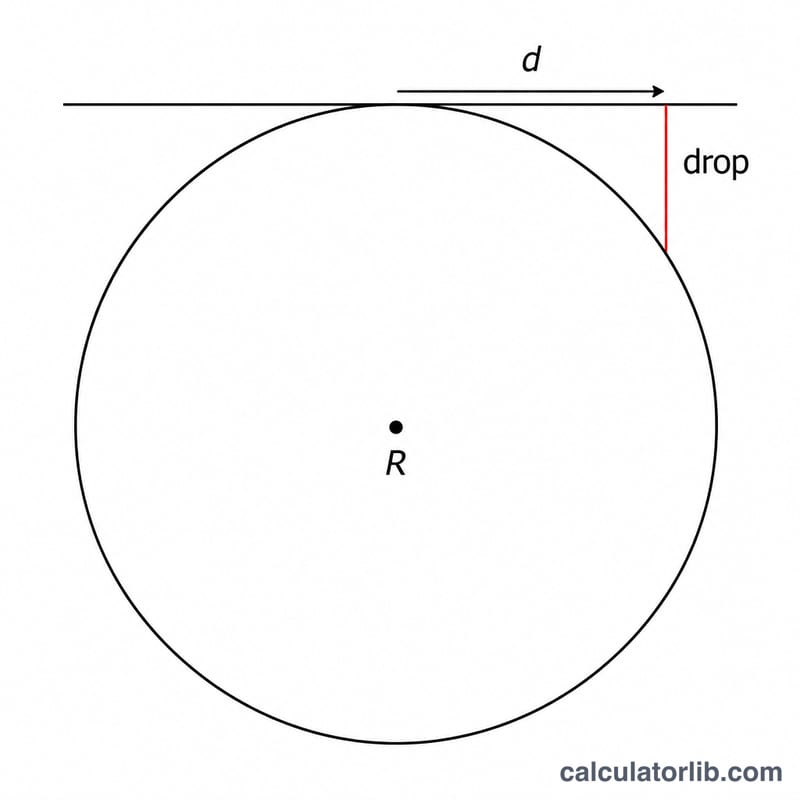
The exact curvature drop is $$\text{drop} = R - \sqrt{R^{2} - d^{2}}$$ where \(d\) is the distance from the observer along the line of sight. For everyday distances (where \(d\) is far smaller than \(R\)), this is closely approximated by $$\text{drop} \approx \frac{d^{2}}{2R}$$ which is much easier to compute. The horizon distance from eye height \(h\) is $$D = \sqrt{2Rh + h^{2}}$$
Worked example
For a distance of 10 km, \(d = 10{,}000\) m. The approximate drop is $$\frac{d^{2}}{2R} = \frac{100{,}000{,}000}{12{,}742{,}000} \approx 7.85 \text{ m}$$ The exact value is $$R - \sqrt{R^{2} - d^{2}} \approx 7.848 \text{ m}$$ — nearly identical, confirming the approximation is excellent at this scale.
FAQ
Does this account for atmospheric refraction? No — these are pure geometric results. Real-world refraction typically lets you see slightly farther, often modelled by using an effective radius about \(7/6\) of the true radius.
Why are the exact and approximate drops so close? Because for distances of tens of kilometres, \(d^{2}\) is tiny compared to \(R^{2}\), so the square-root expansion's higher-order terms are negligible.
What radius is used? The mean Earth radius, 6,371 km, a standard average between the equatorial and polar radii.