
What Is the Angle of Impact?
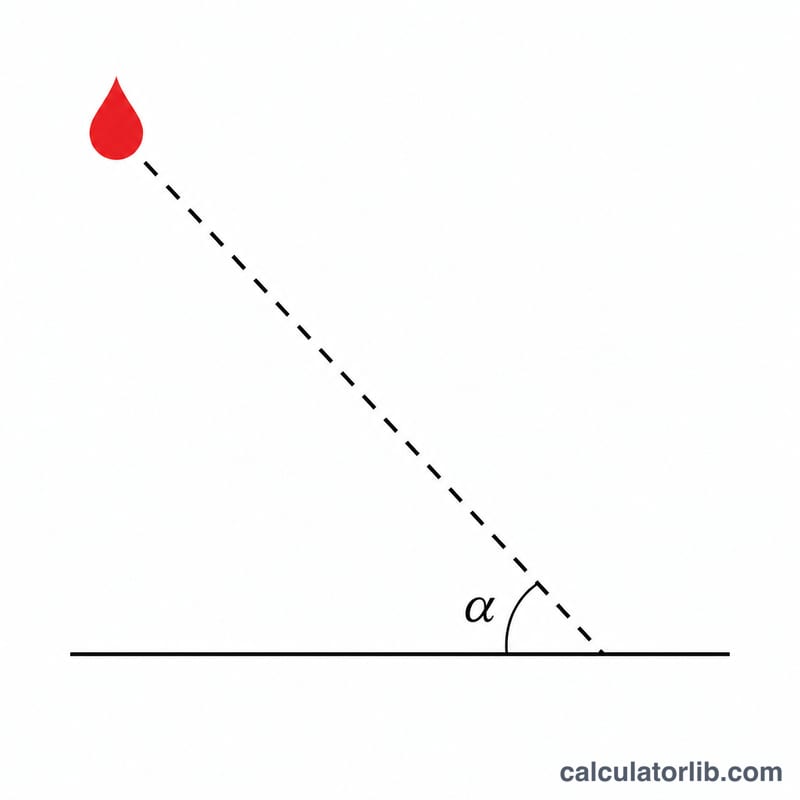
In bloodstain pattern analysis (BPA), the angle of impact is the acute angle at which a blood droplet strikes a surface, measured relative to that surface. A drop hitting at 90° produces a near-circular stain, while shallower angles stretch the stain into a longer, narrower ellipse. By measuring the width and length of the elliptical stain, an analyst can reconstruct the original trajectory of the blood drop.
How to Use This Calculator
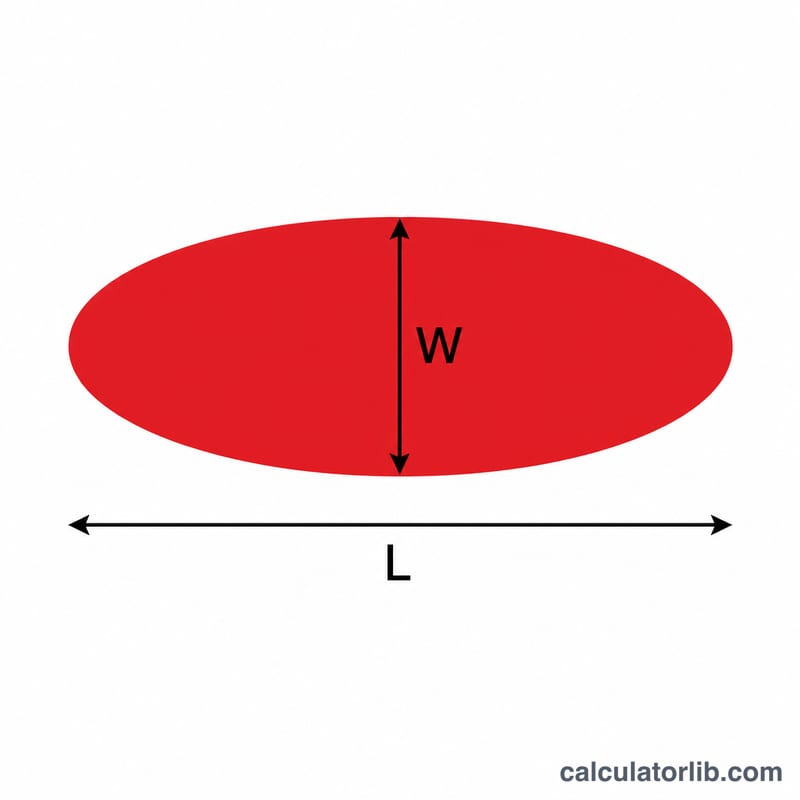
Measure the bloodstain ignoring any tail or spine. Record the width (the shorter axis of the ellipse) and the length (the longer axis). Enter both values in the same units (millimetres work well) and the calculator returns the impact angle in degrees.
The Formula Explained
An idealized blood droplet is spherical. When it strikes a surface at an angle, it leaves an elliptical stain whose width-to-length ratio equals the sine of the impact angle:
$$\theta = \arcsin\left(\frac{\text{Stain Width (mm)}}{\text{Stain Length (mm)}}\right)$$
Because width can never exceed length, the ratio stays between 0 and 1, so the resulting angle ranges from 0° (a grazing impact) to 90° (a perpendicular drop).
Worked Example
Suppose a stain measures 5 mm wide and 10 mm long. The ratio is \(5 / 10 = 0.5\). The arcsine of 0.5 is 30°, so the droplet struck the surface at a 30° angle:
$$\theta = \arcsin\left(\frac{5}{10}\right) = \arcsin(0.5) = 30°$$
Combined with the directionality of the stain, this lets analysts triangulate the area of origin of a blood-spatter event.
Interpreting the Impact Angle Result
Shallow angles (near 0°–20°): A small width-to-length ratio produces a long, thin elliptical stain. This indicates the droplet traveled on a nearly horizontal path relative to the target surface and struck at a glancing angle. Shallow-angle stains often display a more pronounced tail or spine pointing in the direction of travel.
Moderate angles (\(\approx 30^\circ\)–\(45^\circ\)): The stain is a distinct oval. For example, a stain measuring 4 mm wide and 8 mm long gives \(\theta = \arcsin(4/8) = \arcsin(0.5) = \) 30°. These stains balance measurable elongation with reliable edge definition, making angle estimates relatively stable.
Steep angles (near 90°): A width-to-length ratio close to 1.0 produces a nearly circular stain, indicating the droplet struck almost perpendicular to the surface. Because the sine function flattens near 90°, small measurement errors in width or length translate into large angular uncertainty in this range.
Combining angle with directionality: The impact angle alone gives the vertical inclination of the droplet's flight path. By combining it with the stain's directionality (the long-axis orientation, which points back toward the source) for many stains in a pattern, analysts identify an area of convergence on the two-dimensional surface and then project the trajectories upward at their impact angles to estimate the three-dimensional area of origin. Tangent or stringing methods historically used the relationship \(\tan\theta = \text{height}/\text{horizontal distance}\).
Established sources of error: Per bloodstain pattern analysis (BPA) terminology standardized by SWGSTAIN and the OSAC Bloodstain Pattern Analysis subcommittee, accuracy is limited by surface texture (rough or absorbent surfaces distort stain edges), drop volume and velocity, the difficulty of consistently excluding the tail/spine when measuring length, and the flattening of the arcsine relationship near perpendicular impact. Measurements should be taken from the well-defined elliptical body of the stain, not from satellite spatter or wave-cast-off.
This is general technical information about the method, not a substitute for formal forensic training, accreditation, or casework protocols.
Key Terms in Bloodstain Pattern Analysis
- Angle of impact: The acute angle (relative to the plane of the target surface) at which a blood droplet strikes, calculated as \(\arcsin(\text{width}/\text{length})\).
- Stain width: The shorter dimension (minor axis) of the elliptical stain, measured perpendicular to its length.
- Stain length: The longer dimension (major axis) of the elliptical stain, measured along its long axis and excluding any tail or spine.
- Ellipse: The oval shape a blood droplet forms when it strikes a surface at an angle other than 90°; the basis for the width-to-length ratio used in the angle calculation.
- Tail / spine: A narrow elongation or projection extending from the main body of a stain, typically pointing in the direction of droplet travel; excluded from length measurement.
- Directionality: The orientation of a stain that indicates the direction the droplet was traveling, determined from the stain's long-axis and tail.
- Area of origin: The three-dimensional region in space from which the blood droplets that produced a spatter pattern originated.
- Area of convergence: The two-dimensional region on a surface (e.g., a floor or wall) from which the directionality of multiple stains indicates the droplets originated.
- Point of origin: An older term for a single estimated source location; modern terminology favors "area of origin" to reflect inherent measurement uncertainty.
FAQ
Which measurement is width and which is length? Width is the short axis of the ellipse; length is the long axis along the direction of travel. Always exclude the pointed tail.
Why must width be ≤ length? A spherical drop can only elongate, never shorten, so width is always the smaller dimension. If you enter a width larger than length, the calculator caps the ratio at 1 (90°).
How accurate is this? The arcsine method gives a good first approximation. Real-world factors—surface texture, drop volume, and the tail—introduce error, so trained analysts apply corrections.