
What Is the Cube Density Calculator?
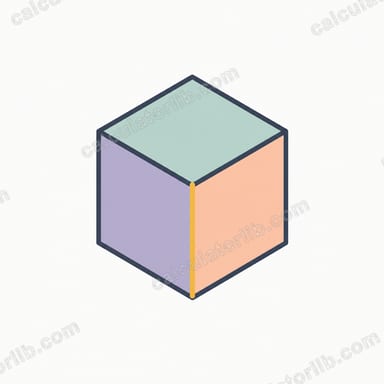
This tool determines the density of a solid cube from two simple measurements: its mass and the length of one side. Density tells you how much matter is packed into a given volume, a key property for identifying materials, checking quality, and solving physics and chemistry problems.
How to Use It
Enter the cube's mass (in grams) and the length of one side (in centimeters). The calculator cubes the side to find the volume, then divides the mass by that volume. The result is the density in grams per cubic centimeter (g/cm³). Because a cube has equal sides, you only need one length measurement.
The Formula Explained
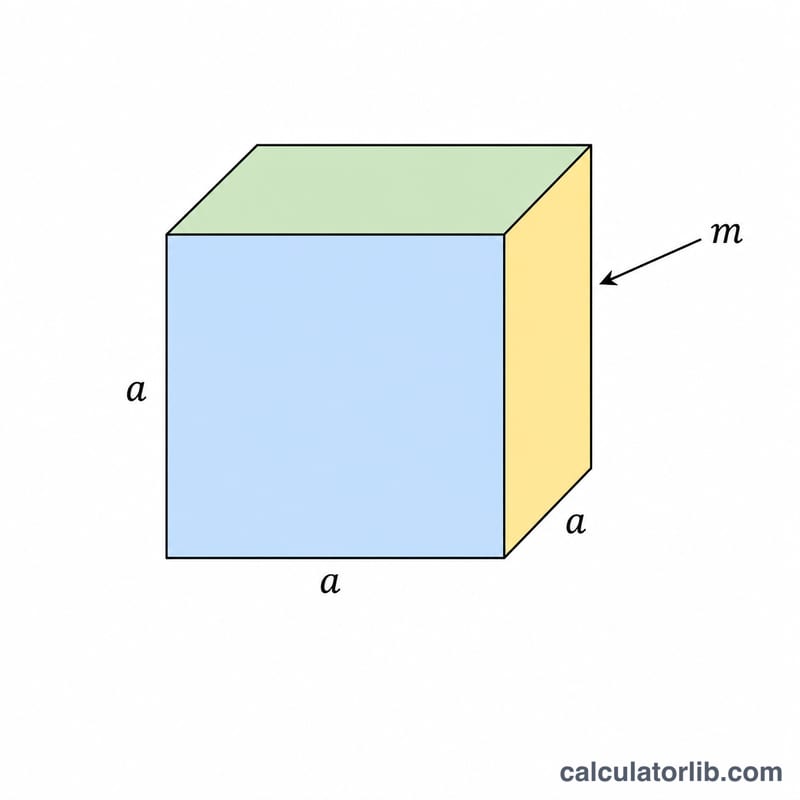
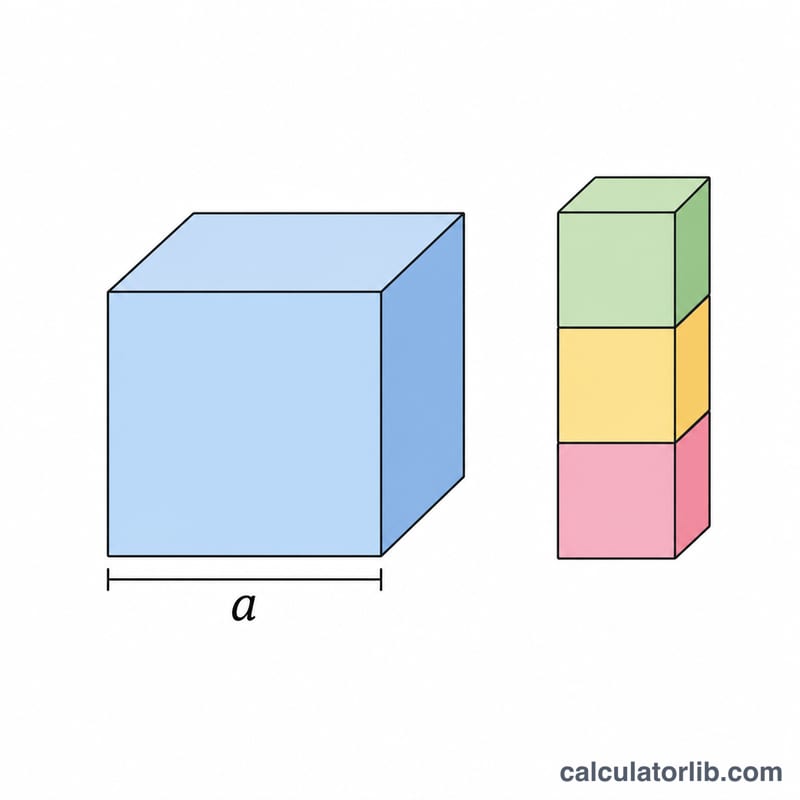
Density is defined as mass per unit volume: \(\rho = m / V\). For a cube, the volume is the side length raised to the third power, so \(V = a^3\). Substituting gives the working formula:
$$\rho = \frac{m}{a^3}$$
where \(\rho\) is density, \(m\) is mass, and \(a\) is the side length. Make sure your units are consistent — grams and centimeters yield g/cm³, the most common unit for solids.
Worked Example
Suppose a metal cube weighs 100 g and each side measures 2 cm. First compute the volume: \(2^3 = 8\) cm³. Then the density:
$$100 \div 8 = 12.5 \ \text{g/cm}^3$$That high value suggests a dense metal such as lead-tin alloy.
FAQ
Can I use other units? Yes, as long as they are consistent. Kilograms with meters gives kg/m³; multiply g/cm³ by 1000 to get kg/m³.
What if my object isn't a perfect cube? This calculator assumes a true cube with equal sides. For a rectangular box, multiply length × width × height for the volume instead.
Why does density matter? Density helps identify substances, predict whether an object floats, and verify material purity, since each material has a characteristic density.